


Product teams have spent the last two years eliminating the cost of making things.
A rough idea can become a polished interface in minutes. A product manager can turn a prompt into a clickable prototype before the kickoff meeting ends. Designers can move into code. Engineers can generate interface directions. Agents can produce variants, documentation and implementation paths faster than a traditional product process can schedule its next review.
The speed is real. That is exactly why the next product problem is so dangerous.
When producing an answer becomes cheap, teams can start confusing the first plausible answer with the right one.
Product teams have never been able to make the wrong thing this quickly.
The Productivity Gain Is Real
There is no useful argument left in pretending AI has not accelerated product work.
Figma’s State of the Designer 2026 found that among designers increasing their use of AI, 89% said the tools helped them work faster, 80% said they collaborated more effectively and 91% said the tools improved their designs.
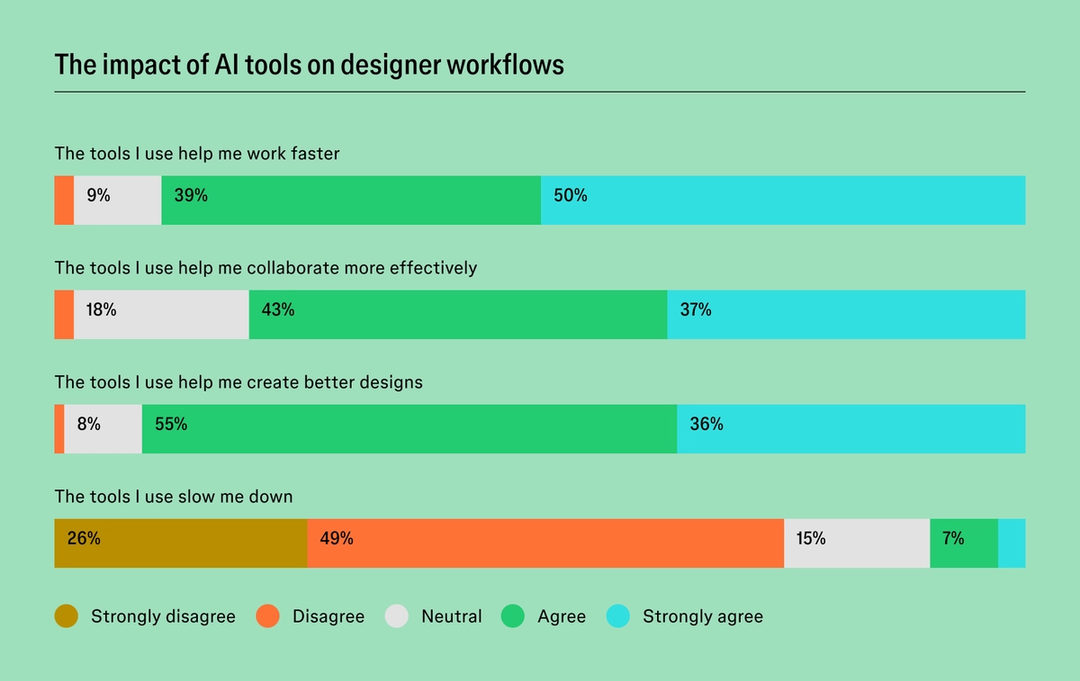
Google’s 2025 DORA research tells a similar story from software delivery. Ninety percent of respondents reported using AI at work, and more than 80% believed it had increased their productivity. DORA also found a positive relationship between AI adoption and both software delivery throughput and product performance.
So this is not another argument for slowing down because speed feels culturally uncomfortable. Faster production is useful. Faster prototyping is useful. Faster implementation is useful.
The mistake is assuming that every part of product development can or should accelerate at the same rate.
Production Was the Bottleneck. Judgment Is Becoming One.
Traditional product development had expensive friction built into it. An idea needed a brief. The brief needed discussion. Design needed time. Engineering needed time. Research needed recruitment. A prototype often arrived after enough effort that the team had been forced to articulate what it was trying to learn.
Some of that friction was waste. Some of it was thinking disguised as waiting.
AI removes both indiscriminately.
That changes the sequencing of product work. Instead of thinking, then making, then evaluating, teams can now make while they are still figuring out what they think. This can be powerful. It can also create premature commitment because a tangible prototype has psychological weight that an unresolved question does not.
Figma’s September 2026 essay on what it takes to build great products now makes the distinction cleanly: getting to a prototype has become easier, while choosing the right direction and sustaining quality through launch remain hard.
That is the new bottleneck. Not generating options. Choosing among them.
The First Plausible Solution Is Winning Too Often
A fast prototype is supposed to expand learning. In practice, it can narrow it.
The moment a team can see and click something, conversation shifts. People stop discussing the problem in the abstract and start reacting to the artifact. That is normally good. But when the artifact arrives before divergent thinking has happened, the prototype does not merely test a direction. It becomes the direction.
Polish makes this worse. AI can jump directly from vague intent to a surprisingly credible interface, skipping the visual roughness that used to communicate uncertainty. A generated product can look much more decided than the thinking behind it actually is.
The danger is not AI slop. The more interesting danger is competent mediocrity: products that are coherent, functional and fast to ship, but built on the first interpretation of the problem that survived a prompt.
This is why the distance from PRD to UI collapsing is not only a workflow story. It is a decision-quality story.
AI Is Moving Onto the Roadmap
The pressure is not limited to how teams build. It is changing what they build.
Figma’s 2026 AI research draws on 8,403 survey responses and 639 qualitative interviews collected over three years. The organizational picture is no longer one of uniform experimentation. Figma identified four distinct adoption patterns: unified teams where individual and organizational adoption reinforce each other, directive companies pushing AI from the top down, grassroots teams where practitioners are moving faster than the organization, and nascent organizations where adoption remains limited.
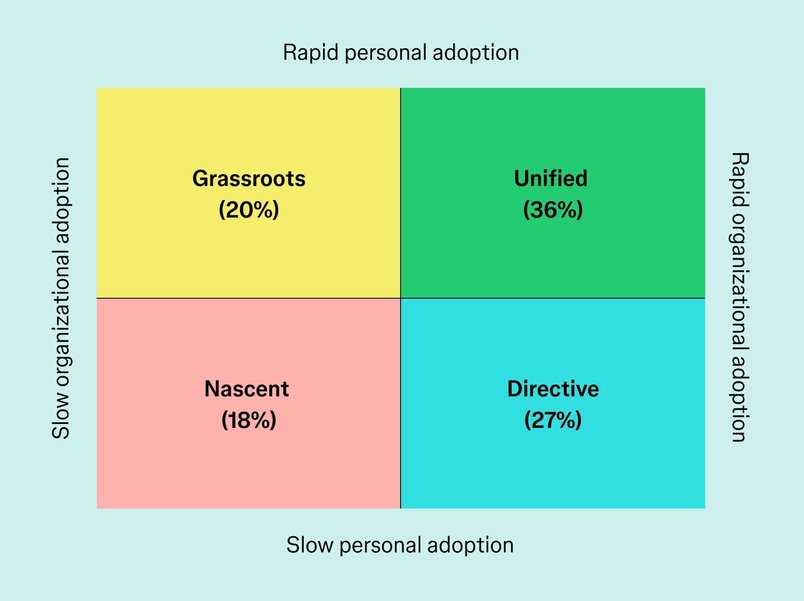
That split matters because speed is now entangled with organizational pressure. In directive companies, AI momentum can arrive as an executive expectation before teams have developed shared working norms. In grassroots companies, practitioners may move quickly while the wider organization still lacks a common playbook.
Once that happens, the pressure to demonstrate movement can become stronger than the pressure to demonstrate understanding.
A product team can always produce another prototype, another agent, another workflow or another AI surface. The harder question is whether users needed that new behavior, whether the model is reliable enough for it, whether the interaction is understandable, and whether the feature improves the underlying product instead of simply proving that the company is doing AI.
When output becomes abundant, restraint becomes a product capability.
Discovery Cannot Be Compressed Like Production
This is where product teams risk applying the wrong lesson from AI productivity.
If prototyping time falls dramatically, it does not follow that understanding a user problem should be compressed by the same amount. If implementation becomes dramatically faster, it does not mean organizational alignment, risk assessment or product judgment should happen at the same speed.
Some work scales with computation. Human evidence does not.
Research can become more efficient. Synthesis can accelerate. Recruiting, analysis and documentation can all improve. Synthetic methods can be useful when their limits are understood. But real user behavior still unfolds in context, and the distinction between generated evidence and observed evidence remains consequential. Our work on synthetic user research tools reaches the same conclusion from another direction: speed is useful only when teams remain clear about what kind of evidence they actually have.
A faster product loop should create more opportunities to learn, not an excuse to remove learning from the loop.
Local Productivity Can Create System-Level Chaos
DORA’s research offers perhaps the most important warning for product leaders. In 2025, AI adoption correlated positively with throughput and product performance, but it still had a negative relationship with software delivery stability. DORA describes AI as an amplifier: it magnifies the strengths and weaknesses of the system around it.
That is a useful model for design and product work too.
A team with strong research habits, clear product strategy, fast feedback loops, good design systems and thoughtful critique can use AI to explore more possibilities and execute them faster. A team with weak strategy, vague ownership and poor feedback loops can use the same tools to produce more confusion at higher velocity.
This is why our guide to building an AI-native UX team treats governance, critique and task boundaries as part of the workflow rather than as bureaucracy around it. The point of an AI-native team is not to remove human judgment. It is to move human judgment toward the decisions where it matters most.
The Product Review Has to Change
The old review question was often, “Is this ready?”
That question made more sense when creating the artifact was expensive. In an AI-assisted workflow, a polished artifact tells us much less about how much thinking has occurred.
The review needs to move upstream. What problem are we solving? What evidence makes us believe it matters? What alternatives did we reject? What would make us reverse this decision? Which parts of the experience are generated, probabilistic or difficult to recover from? What happens when the model is wrong?
Those questions are not a return to heavyweight process. They are how teams prevent cheap production from making expensive mistakes.
The same principle appears in our analysis of ChatGPT sycophancy and the limits of A/B testing for AI UX. Metrics can say an experience is working while expert judgment notices something structurally wrong. More output and more experiments do not automatically produce better product understanding.
Speed Needs a Counterweight
None of this requires teams to move slowly.
The opportunity is better than that. AI can make exploration cheaper enough that teams test more directions. It can make prototyping fast enough that research happens against something tangible earlier. It can reduce handoff loss. It can let designers work closer to implementation and engineers participate earlier in interaction decisions. The interview we published with Zhengyang Yang on the end-to-end AI product designer captures the upside well: the distance between idea and evidence can shrink dramatically.
But shorter distance only helps if evidence still changes the destination.
The new product advantage is not being the team that can make the most things. It is being the team that can decide what deserves to exist.
Thinking Is Now the Scarce Resource
Software spent decades making production cheaper. AI has pushed that curve almost vertical.
The scarce resource moves somewhere else.
Attention is scarce. Taste is scarce. User access is scarce. Strategic clarity is scarce. The willingness to discard a polished idea is scarce. The ability to recognize that a feature should not be built is scarce.
That is why “move faster” is becoming an incomplete product strategy. Teams will move faster whether leaders tell them to or not. The tools guarantee it.
The differentiator is whether judgment can keep up with output.
Product teams are going to ship faster. The question for 2026 is whether they can learn, choose and say no at the same speed.



Where has AI actually improved your product process, and where has increased speed created new pressure to make decisions before the evidence is ready?