
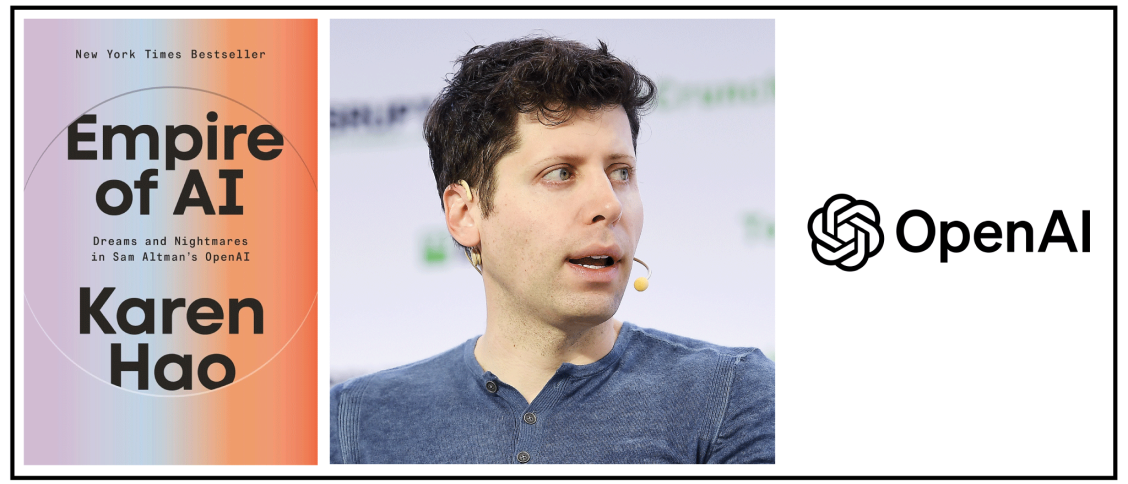
Karen Hao’s “Empire of AI” opens with the kind of corporate drama that reads like a Silicon Valley thriller: Sam Altman logging onto a Google Meet on November 17, 2023, to face four of his five board members in what would become one of the most shocking CEO firings in tech history. The scene, Silicon Valley’s golden boy staring down his own board in a virtual meeting that would temporarily end his reign, sets the tone for a book that promises to reveal how OpenAI transformed from an ostensibly altruistic nonprofit into the poster child for AI’s most troubling corporate excesses.
DesignWhine's Verdict
Overall
-
Reporting Quality
-
Writing Style
-
Analytical Depth
-
Reader Engagement
Summary
If you want to understand what’s really happening behind OpenAI’s success story, Empire of AI cuts straight through the promotional narrative to reveal uncomfortable truths. Hao combines rigorous journalism with compelling storytelling, delivering insights unavailable elsewhere about one of the world’s most influential companies and its enigmatic leader, Sam Altman. For anyone seeking to grasp the forces shaping our AI-driven future, this is essential reading.
Pros
Exceptional investigative reporting
Global perspective connecting local impacts to systemic patterns
Clear, engaging writing that makes complex AI topics accessible
Comprehensive examination of hidden environmental and labor costs behind AI
Valuable insights into AI industry power dynamics
Cons
Occasionally polemical tone that may limit appeal to some readers
Focuses more on problems than pathways forward
In an era where artificial intelligence dominates headlines and shapes our digital future, few books offer as comprehensive as Karen Hao’s latest work. “Empire of AI: Dreams and Nightmares in Sam Altman’s OpenAI” presents a meticulously researched examination of the company that has become synonymous with the AI revolution. Hao, an award-winning journalist and the first reporter to profile OpenAI, delivers a gripping narrative that challenges the sanitized corporate story we’ve been told about one of the world’s most influential tech companies.
The book reads like a thriller wrapped in investigative journalism, chronicling OpenAI’s transformation from a nonprofit research organization into a commercial powerhouse valued at over $150 billion. What emerges is a complex portrait of ambition, innovation, and the inevitable compromises that accompany unprecedented technological advancement. Hao’s narrative spans from Silicon Valley boardrooms to data centers in Chile, from content moderation facilities in Kenya to the environmental costs hidden in plain sight.
Karen Hao: The Journalist Behind the Investigation

Karen Hao brings exceptional credentials to this investigation. As a former senior editor at MIT Technology Review and a correspondent for The Wall Street Journal, she has spent years covering artificial intelligence and its global implications. Her expertise in AI journalism is evident throughout the book, where technical concepts are explained with clarity while maintaining the accessibility needed for general readers. Hao’s background as someone who initially viewed OpenAI favorably adds credibility to her later criticisms, suggesting a journalist who followed the evidence rather than starting with predetermined conclusions.
OpenAI’s Empire: From Nonprofit Mission to Corporate Dominance
The central thesis of “Empire of AI” revolves around the company’s evolution from idealistic nonprofit to profit-driven entity, a transformation that mirrors historical patterns of empire-building. Hao argues that OpenAI’s leadership has cultivated a self-perception that allows them to justify their growing influence over global AI development. This self-appointed role as stewards of humanity’s technological future serves as a powerful justification for accumulating unprecedented control over artificial intelligence research and deployment. The parallels to historical empires are striking. Both believed their expansion served a higher purpose, masking the concentration of power behind noble rhetoric.
OpenAI’s mission statement of “benefiting all humanity” echoes the “civilizing mission” rhetoric used by colonial powers to legitimize their expansion
The colonial parallels that Hao draws are particularly compelling. OpenAI’s mission statement of “benefiting all humanity” echoes the “civilizing mission” rhetoric used by colonial powers to legitimize their expansion. This language of benevolence masks what Hao identifies as a fundamentally extractive relationship with global communities. The company harvests data and labor from around the world while concentrating the benefits in Silicon Valley, creating what she terms a new form of digital colonialism.
The Hidden Costs of AI Innovation
One of the book’s strongest sections examines the hidden costs of AI development that rarely make headlines. The environmental impact is staggering, training large language models requires enormous amounts of electricity and water, contributing significantly to carbon emissions. Hao reveals how data centers consume resources equivalent to small cities while companies like OpenAI present themselves as environmentally conscious. The labor dimension is equally troubling, with thousands of workers in countries like Kenya performing the unglamorous but essential work of content moderation and data cleaning for minimal wages.
The ethical dilemmas surrounding AI development receive thorough treatment throughout the narrative. Hao explores how the rush to deploy increasingly powerful AI systems has outpaced our ability to understand their implications. The risks of misuse from surveillance applications to the spread of misinformation are examined alongside the unintended consequences of biased algorithms and the gradual erosion of privacy. These concerns are not theoretical; they’re already manifesting in real-world applications that affect millions of users.
Inside OpenAI’s Corporate Transformation
Perhaps the most significant transformation Hao documents is OpenAI’s shift from nonprofit to for-profit status. Originally founded with the explicit mission of developing AI for humanity’s benefit, the company restructured to attract the massive investment required to compete in the AI arms race. This pivot, while financially necessary, fundamentally altered the organization’s incentives and priorities. The influx of billions from Microsoft and other investors created pressure to prioritize commercial applications over safety research, a tension that continues to define the company’s trajectory.
Hao’s reporting benefits from remarkable access to current and former OpenAI employees, providing insider perspectives on the company’s culture and decision-making processes. These firsthand accounts reveal an organization where idealism and pragmatism exist in constant tension. The book captures the genuine belief among many employees that their work will benefit humanity, while simultaneously documenting the compromises required to maintain competitive advantage.
The influx of billions from Microsoft and other investors created pressure to prioritize commercial applications over safety research
The writing style throughout “Empire of AI” balances journalistic rigor with narrative engagement. Hao has a talent for making complex technical concepts accessible without oversimplification. Her prose is clear and compelling, moving seamlessly between boardroom intrigue and global impact stories. The book maintains momentum throughout its examination of OpenAI’s rise, keeping readers engaged while delivering substantial analytical content.
However, the book’s strength as a critique also presents its primary weakness. Hao’s argument is undeniably compelling, but at times the analytical framework feels predetermined. The colonial empire metaphor, while illuminating, occasionally constrains the analysis rather than enhancing it. Some readers may find the consistently critical tone limiting, particularly when discussing the genuine innovations and potential benefits of AI development. The book would benefit from more nuanced exploration of the genuine dilemmas facing AI companies rather than viewing all decisions through the lens of empire-building.
Empire of AI: Strengths and Limitations
The reporting quality throughout “Empire of AI” is exceptional. Hao’s investigative work reveals previously unknown details about OpenAI’s operations and decision-making processes. The global perspective she brings examining AI’s impact far beyond Silicon Valley provides crucial context often missing from technology coverage. Her ability to connect local impacts in places like Kenya and Chile to broader patterns of technological development demonstrates the kind of comprehensive reporting the field desperately needs.
Despite its critical stance, the book acknowledges the complexity of AI development and the genuine challenges facing companies like OpenAI. Hao doesn’t present simple solutions to the problems she identifies, recognizing that the path forward requires nuanced thinking about regulation, corporate responsibility, and technological governance. While this is intellectual honesty from her, it weakens rather than strengthens her critique.
The book’s examination of power dynamics within the AI industry extends beyond OpenAI to encompass the broader ecosystem of companies, investors, and governments shaping artificial intelligence development. This wider lens helps readers understand how individual corporate decisions aggregate into systemic patterns with global implications.
When Hao first began covering OpenAI in 2019, she “thought they were the good guys” but her investigation reveals a more unsettling truth: in the age of artificial intelligence, those who promise to save humanity may be the very ones reshaping it in their image. The empire has already begun.