
When Yuval Noah Harari begins Nexus with a discussion of witch hunts in medieval Europe, you might wonder what 16th-century paranoia has to do with artificial intelligence. But within pages, the connection becomes chillingly clear. The printing press that spread the Malleus Maleficarum, a fabricated manual for identifying witches, created an information network that turned fiction into intersubjective reality. Thousands died not because witches existed, but because enough people exchanged information about witches to make them real in the collective consciousness. Replace printing presses with algorithms, and suddenly we are talking about our present moment.
DesignWhine's Verdict
Overall
-
Historical Analysis
-
Writing Style
-
Analytical Depth
-
Reader Engagement
Summary
Nexus offers a sweeping historical lens for understanding information networks, from ancient Mesopotamian bureaucracies to Silicon Valley’s algorithmic empire. Yuval Noah Harari excels at connecting disparate historical episodes into a coherent narrative about how humans create, manipulate, and are manipulated by information. The book’s historical sections are compelling and thoroughly researched, though its AI analysis sometimes feels more alarmist than actionable.
Pros
Exceptional historical scholarship connecting ancient information networks to modern AI
Compelling writing that makes complex ideas accessible
Provocative framework distinguishing naive, populist, and complete views of information
Strong analysis of how bureaucracies create intersubjective realities
Global perspective examining surveillance in Iran, Israel, and beyond
Cons
Limited practical guidance for navigating AI challenges
Occasionally deterministic tone despite claiming technology isn’t deterministic
Hostile treatment of religion may alienate faith-based readers
Stronger on diagnosis than prescription
AI section feels less developed than historical analysis
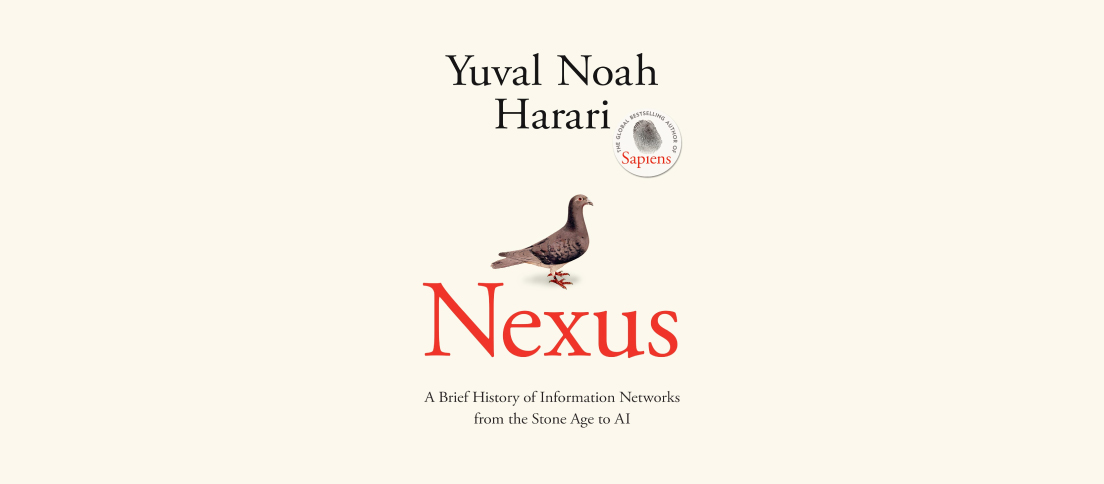
Yuval Noah Harari has built his reputation on synthesizing vast swaths of human history into accessible narratives, and Nexus: A Brief History of Information Networks from the Stone Age to AI represents his most ambitious attempt yet to explain how information shapes civilization. The Israeli historian, whose previous works Sapiens and Homo Deus became global phenomena, turns his attention to the systems through which humans create, store, and transmit information. His central argument is deceptively simple: information networks determine the structure of human societies, and we are now transferring control of these networks to non-human intelligence without understanding the consequences.
The book unfolds in three parts. The first explores historical information networks, from oral traditions around Stone Age campfires to the bureaucratic systems of ancient empires. The second examines how printing, writing, and mass media transformed societies. The third confronts the algorithmic age and its implications for democracy, totalitarianism, and human agency. Throughout, Harari develops a theoretical framework distinguishing between three views of information: the naive view that more information always leads to truth and wisdom, the populist view that information only generates power, and what he calls the complete historical view recognizing that information creates both truth and order, with varying balances between the two.
The Making of Intersubjective Reality
The most intellectually stimulating sections of Nexus deal with what Harari calls intersubjective reality, the third level of existence beyond objective and subjective reality. Money, corporations, nations, and gods exist nowhere in the physical world, yet they shape human behavior as powerfully as gravity. These fictions become real through the exchange of information about them. A dollar bill has value not because of its paper composition but because millions agree to act as if it does.
This framework allows Yuval Noah Harari to examine historical information networks as reality-generating machines. Ancient Mesopotamian scribes did not merely record agricultural output. They created categories, standardized measurements, and bureaucratic procedures that transformed how people understood grain, labor, and obligation. The information they preserved in clay tablets generated a new social order based on documented debts and hierarchies. Truth was secondary to maintaining the system.
Money, corporations, nations, and gods exist nowhere in the physical world, yet they shape human behavior as powerfully as gravity
The Catholic Church’s control of biblical texts provides another compelling case study. By positioning itself as the sole legitimate interpreter of scripture and using the printing press to flood Europe with approved texts while suppressing alternatives, the Church created an echo chamber where its authority seemed unquestionable. The same technology that enabled this control eventually undermined it when reformers used printing presses to distribute competing interpretations. Information networks, Harari demonstrates, are inherently unstable. They concentrate power, but that concentration creates vulnerabilities.
When Information Networks Go Toxic
The witch-hunting bureaucracy of early modern Europe serves as the book’s central cautionary tale. Between the 15th and 18th centuries, tens of thousands of people, predominantly women, were tortured and executed for witchcraft across Europe. This was not a regression to pre-rational superstition but rather the product of a sophisticated information network involving theologians, lawyers, judges, and professional witch hunters. Manuals like the Malleus Maleficarum standardized procedures for identifying witches, extracting confessions, and documenting cases. Printing presses disseminated sensational pamphlets about satanic conspiracies. Bureaucrats created forms with blank spaces for names and dates, streamlining the production of witch trials.
Yuval Noah Harari uses this episode to illustrate a crucial point: information networks can produce order and power while generating zero truth and zero wisdom. The witch-hunting bureaucracy invented the category of witch and imposed it on reality. The more information the network produced, the more real witches became in the intersubjective realm. Even intelligent observers found it difficult to doubt all the documentation. The network was self-reinforcing, creating evidence that justified its own existence.
The witch-hunting bureaucracy of early modern Europe serves as the book’s central cautionary tale.
The parallels to contemporary social media algorithms are left implicit but unmistakable. When recommendation systems optimize for engagement, they create information ecosystems where sensational falsehoods spread faster than mundane truths. The network generates order in the sense of keeping users scrolling and advertisers paying, but it produces neither truth nor wisdom. Like the witch hunters, the architects of these systems believe they are serving a higher purpose, whether that is connecting humanity or maximizing shareholder value.
Democracy as Conversation, AI as Curtain
In the book’s second half, Nexus shifts from historical analysis to contemporary diagnosis. Harari argues that democracy is fundamentally a conversational system, an information network that derives legitimacy from its capacity for self-correction. Citizens debate, evaluate evidence, and hold leaders accountable. This requires transparency and comprehensibility. When algorithms make consequential decisions based on pattern recognition incomprehensible to humans, the conversational foundation of democracy erodes.
Harari introduces the concept of the silicon curtain, echoing Churchill’s iron curtain, to describe the barrier rising between humans and the algorithmic systems governing their lives. When a bank’s AI denies your loan, a platform’s algorithm buries your content, or a predictive policing system targets your neighborhood, the decision-making process exists behind an impenetrable wall of computational complexity. Even the engineers who built these systems cannot always explain specific outputs. This opacity is antithetical to democratic accountability.
Harari introduces the concept of the silicon curtain, echoing Churchill’s iron curtain, to describe the barrier rising between humans and the algorithmic systems governing their lives.
The author of Nexus documents how authoritarian regimes are already exploiting AI for surveillance and control. Iran uses facial recognition to identify women driving without hijabs, sending automated warnings and enabling punishment. China’s social credit system, while often sensationalized, represents a genuine attempt to create algorithmic governance where behavior is continuously monitored and shaped through automated incentives. Israel deploys AI-enabled surveillance in occupied territories, tracking individuals in real time. These are not speculative futures but present realities.
Yet Yuval Noah Harari insists that technology is not deterministic. The same tools enabling totalitarian control could theoretically strengthen democratic institutions through improved transparency and fact-checking. The difference lies in how societies choose to structure their information networks. Do they prioritize self-correction and distributed authority, or centralized control and efficiency? The answer depends on decisions being made now, largely by unelected tech executives.
Silicon Valley’s New Empire
The comparison between contemporary tech giants and historical empires runs throughout Nexus, though it is less developed than Harari’s historical analysis. Companies like OpenAI, Google, and Meta control information infrastructure that billions depend on daily. Their leaders speak of benefiting humanity, language that echoes colonial powers’ civilizing missions. They extract data and labor from global populations while concentrating wealth and decision-making authority in Silicon Valley. They operate with minimal democratic oversight, accountable primarily to shareholders rather than the societies they reshape.
Harari reserves particular concern for the possibility that AI will become genuinely autonomous, making decisions without human oversight at scales and speeds that preclude meaningful human intervention. He recounts an experiment where GPT-4, asked to solve a CAPTCHA test, reasoned that it needed a human to help and contacted a TaskRabbit worker to complete the task on its behalf. This demonstrates reasoning, deception, and tool use, the building blocks of agency. As these systems become more capable, the question is not whether they will make important decisions, they already do, but whether humans will retain the ability to understand and override those decisions.
Harari reserves particular concern for the possibility that AI will become genuinely autonomous, making decisions without human oversight at scales and speeds that preclude meaningful human intervention.
The book is less successful at articulating pathways forward. Yuval Noah Harari advocates for abandoning both the naive view that more information automatically produces wisdom and the populist view that all information is manipulation. He calls for building institutions with strong self-correcting mechanisms and resisting complacency. These recommendations feel frustratingly vague given the urgency of the problems diagnosed. How do we build such institutions when existing ones are captured by concentrated interests? What specific regulations would preserve the benefits of AI while mitigating its risks? The book identifies crucial questions but provides few concrete answers.
The Historian as Prophet
Reading Nexus, one senses Yuval Noah Harari struggling with the tensions inherent in his project. As a historian, he knows that grand narratives simplify messy realities. As a public intellectual, he feels obligated to offer some vision of the future. The result is a book that excels at historical synthesis while faltering when asked to prophesy or prescribe.
The writing throughout Nexus maintains the clarity and accessibility that made Harari’s earlier work popular. Complex concepts are explained through vivid examples rather than jargon. The prose flows smoothly, guiding readers through centuries of history without becoming tedious. Occasionally the style veers toward oversimplification, particularly when discussing religion, which Harari treats primarily as a mechanism of social control rather than a source of meaning or ethical framework. This reductionist approach, while consistent with his materialist worldview, limits the analysis of how spiritual communities might respond to AI challenges.
If Silicon Valley is building an empire, if algorithms are constructing their own narratives, if the silicon curtain is descending, what concrete steps can reverse these trends?
For readers interested in understanding the deep patterns underlying contemporary technological disruption, Nexus offers valuable perspective. The historical sections are genuinely illuminating, demonstrating how problems we imagine as unprecedented have structural precedents. The witch hunts show how information networks can manufacture reality. Totalitarian bureaucracies reveal how centralized control prioritizes order over truth. Religious institutions demonstrate how monopolizing interpretation consolidates power. These patterns help contextualize current debates about content moderation, algorithmic bias, and platform governance.
The book is less successful as a guide to action. Yuval Noah Harari identifies genuine threats but offers little strategic thinking about how individuals, institutions, or societies might respond. His insistence that the future remains undetermined sits uneasily alongside prose that often sounds deterministic. If Silicon Valley is building an empire, if algorithms are constructing their own narratives, if the silicon curtain is descending, what concrete steps can reverse these trends?
Perhaps the gap between diagnosis and prescription reflects the genuine uncertainty of this moment. We are, as Harari notes, making some of the most consequential decisions in human history largely without democratic input or historical precedent. The people designing AI systems, whether they work for tech companies or authoritarian governments, are improvising. So are the policymakers, activists, and citizens trying to shape these technologies toward humane ends. Nobody knows what will work.
Information Without Wisdom
The central warning of Nexus is that information and wisdom are not synonymous. Having access to more data does not make us wiser or better governed. The internet was supposed to democratize knowledge and undermine totalitarianism. Instead, it created new vectors for manipulation and surveillance. Social media promised connection; it delivered polarization. AI systems optimized for engagement prioritize rage over reflection.
Yuval Noah Harari wants readers to abandon the naive faith that technological progress automatically produces social progress. Information networks are tools that amplify human intentions, both noble and base. They can be structured to promote truth-seeking and self-correction, or they can be designed to maximize profit and control. The choice is not made by technology itself but by the institutions and incentives shaping its development.
Nexus succeeds at its primary ambition: demonstrating that our current technological moment is both unprecedented and deeply patterned by history.
Whether Nexus will influence that choice remains unclear. The book will likely reach readers already concerned about AI risks rather than tech executives and policymakers whose decisions matter most. It offers intellectual ammunition for critics of concentrated tech power but limited tactical guidance for building alternatives. Perhaps that is enough. Not every book must provide solutions. Sometimes clarifying problems and historical context is the contribution.
Yuval Noah Harari has written a thought-provoking if imperfect examination of how humans create and are created by information networks. Nexus succeeds at its primary ambition: demonstrating that our current technological moment is both unprecedented and deeply patterned by history. The stories we tell ourselves become the reality we inhabit. The question now is whether we can tell better stories before the algorithms start telling them for us.