

The internet promised us democracy. In the 1990s and early 2000s, when we still believed in the transformative power of technology, the narrative was almost biblical: digital networks would flatten hierarchies, distribute wealth widely, empower the voiceless, and usher in an era of unprecedented human flourishing.
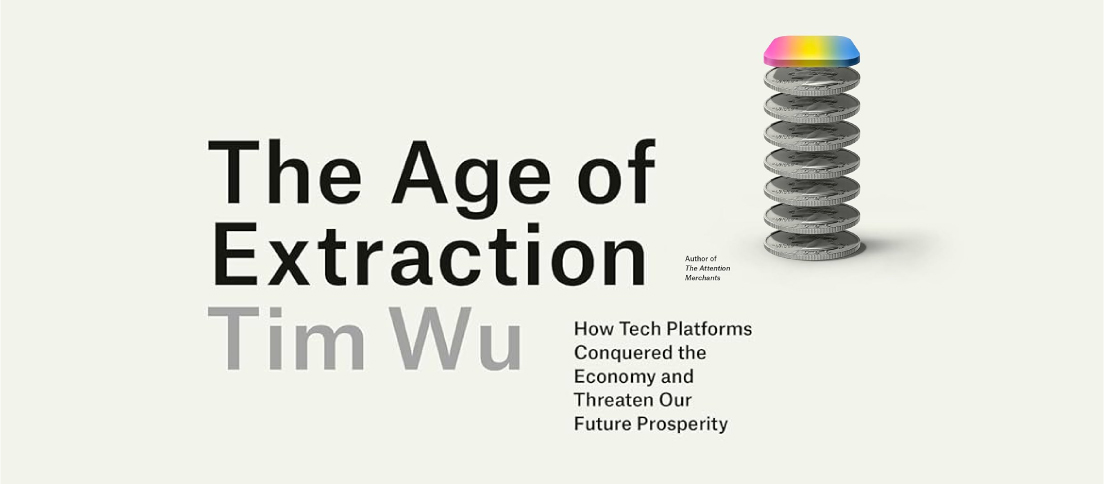
Tim Wu remembers those utopian days clearly, and he opens his latest book, The Age of Extraction: How Tech Platforms Conquered the Economy and Threaten Our Future Prosperity, with the kind of wistful disillusionment that only comes from watching a beautiful dream curdle into its opposite. The transformation, Wu argues with considerable force, was neither accidental nor inevitable. It was a choice, made repeatedly, by companies that discovered they could have their cake and eat it too – or so they thought.
Wu, the Columbia Law professor who coined the term “net neutrality” and served as a special assistant to the president for technology and competition policy in the Biden administration, has spent his career studying how private power concentrates and calcifies. His previous books, The Master Switch and The Attention Merchants, were prescient warnings about the trajectory of technology industries. But those earlier works felt like prophecy delivered from a distance. The Age of Extraction reads less like warning and more like diagnosis from a physician who has watched his most dire predictions come to pass.
- Understanding the Machinery of Platform Extraction
- The Age of Extraction and Political Instability
- Historical Precedent and Tentative Optimism
- The Age of Extraction in the Age of Artificial Intelligence
- Critical Reception and the Age of Extraction in Public Discourse
- Why The Age of Extraction Still Matters
DesignWhine's Verdict
Overall
-
Reporting Quality
-
Writing Style
-
Analytical Depth
-
Reader Engagement
Summary
Tim Wu’s The Age of Extraction delivers a lucid, historically grounded examination of how the internet transformed from a promise of distributed prosperity into a machine for concentrating wealth and power. The book succeeds brilliantly in its diagnosis of platform extraction, its connection between economic inequality and political instability, and its refusal to treat the current order as inevitable. Where it falters is in offering policy solutions that feel commensurate with the scale of the problem and in grappling with how to implement change in a captured political environment.
Pros
Wu’s analysis of platform power is clear and economically literate without sacrificing accessibility. His historical framing of extraction as a deliberate choice rather than a technological necessity is genuinely valuable. The connection between economic extraction and the rise of strongmen politics feels urgent and overdue in mainstream discourse.
Cons
The proposed remedies are familiar and underdeveloped relative to the diagnosis. For a book focused on how we might escape the Age of Extraction, the second half feels rushed and somewhat disconnected from the force of the first half. Wu doesn’t adequately address why previous regulatory frameworks designed to control monopolies have failed so consistently in the digital context.
Understanding the Machinery of Platform Extraction
The book operates in two movements. The first charts the metamorphosis of technology platforms from enablers of commerce to what Wu calls “the most effective instruments of wealth extraction ever invented.” Amazon, Google, Meta, Apple, and others present themselves as neutral marketplaces, digital town squares where anyone can participate. What they actually do is precisely what their architects learned to perfect: they extract. They extract money from buyers and sellers, data from users, attention from billions of eyeballs, and value from work performed for free across their networks. A click, a search, a post, a purchase, a moment of scrolling – all of it becomes raw material in an industrial process that transforms human behavior into profit for shareholders.
A click, a search, a post, a purchase, a moment of scrolling – all of it becomes raw material in an industrial process that transforms human behavior into profit for shareholders.
What makes Wu’s analysis particularly valuable is that he doesn’t treat this state of affairs as inevitable. He traces how major platforms could have chosen a different path, and he spends considerable energy on the roads not taken. Wikipedia exists as a kind of rebuke to the trajectory of Silicon Valley – Jimmy Wales resisted the pressure to monetize aggressively, famously turning down lucrative opportunities that his peers seized upon. The difference wasn’t technological capability or intelligence; it was a choice about what kind of institution to build.
The disease, Wu argues, was the Silicon Valley faith that you could have everything: that you could save the world and become a billionaire simultaneously, that you could provide genuine value and extract maximum profit with no trade-offs. In the early 2000s, that faith calcified into a business form identical to the one that built Standard Oil and General Motors. The consequences, it turns out, are similarly dire.
The Age of Extraction and Political Instability
The second movement of The Age of Extraction connects economic extraction to political instability. This is where Wu ventures into territory that makes some readers uncomfortable, because it requires accepting an uncomfortable thesis: the concentration of wealth in a small number of hands does not simply create inequality as an economic problem. It creates resentment on a mass scale, which destabilizes democracy itself. When people cannot participate meaningfully in wealth creation, when technological advancement primarily benefits a centi-billionaire class while ordinary people’s situations stagnate or deteriorate, the social fabric frays. Strongmen rise by channeling that resentment.
Wu traces a grim lineage: extraction leads to inequality, inequality produces resentment, resentment corrodes faith in democratic institutions, and – this is the critical move – when the state is perceived as complicit in perpetuating extraction, authoritarianism becomes a plausible alternative. It’s a “real road to serfdom,” as he puts it, borrowing and inverting Friedrich Hayek’s famous formulation.
When the state is perceived as complicit in perpetuating extraction, authoritarianism becomes a plausible alternative.
The Age of Extraction deserves credit for not pretending this is abstract political philosophy. Wu watched this dynamic unfold in real time during the Trump era and beyond. He saw economic grievance mobilized into political movements, often incoherently, sometimes viciously. He also witnessed, during his tenure in the Biden administration, how difficult it is to alter the trajectory even when you hold significant policy-making power. The antitrust revival of the past five years feels substantial in retrospect, yet Wu captures something crucial about its limitations: without structural change to how these companies operate, enforcement actions feel like applying a bandage to a patient bleeding out.
Historical Precedent and Tentative Optimism
What lifts Wu’s book above standard tech criticism is his genuine ambivalence about the future. Unlike polemicists who traffic in despair, Wu maintains a complicated optimism grounded in history. He notes that previous eras of monopolistic concentration, from Standard Oil to AT&T, eventually faced meaningful challenge through some combination of regulatory action, technological disruption, and public pressure. The PC revolution, he observes, ultimately distributed computing power far more widely than anyone in the 1960s anticipated. History is not linear, but it does sometimes bend toward correction. The question is whether society can survive the interval before that bend occurs.
Wu’s proposed remedies feel somewhat familiar if you’ve followed antitrust debates over the past decade: strengthen enforcement, treat platforms as utilities..
This is also where The Age of Extraction reveals its limitations. Wu’s proposed remedies feel somewhat familiar if you’ve followed antitrust debates over the past decade: strengthen enforcement, treat platforms as utilities, encourage skepticism of concentrated power, foster competition through aggressive policy. These are not wrong prescriptions, but in a book of only 224 pages, they feel somewhat underdeveloped.
The first part of the book is considerably more substantial than the second; Wu is far more compelling in his diagnosis of extraction than in his prescription for recovery. A reader finishing The Age of Extraction might reasonably ask: what specifically should happen, and to whom, and by which mechanism? Wu gestures toward answers but rarely commits to them with the same definitiveness he brings to exposing problems.
The Age of Extraction in the Age of Artificial Intelligence
The book does engage seriously with AI, which is to Wu’s credit. Most tech criticism still treats artificial intelligence as either a separate problem or a future concern. Wu correctly identifies it as integral to the extractive machinery already in place. Large language models require massive datasets generated through human interaction with platforms. Every conversation, every piece of content, every engagement becomes training data. The question of who owns and profits from this data, and whether the humans generating it are compensated fairly, is another form of extraction – perhaps the most insidious yet, because the extraction happens so invisibly.
The book does engage seriously with AI, which is to Wu’s credit. Most tech criticism still treats artificial intelligence as either a separate problem or a future concern.
Wu also captures something important about AI’s potential to either reinforce or disrupt existing platform dominance. Google, in particular, has spent years quietly building AI capabilities partly to prevent search functionality from becoming obsolete. Generative AI could theoretically render the entire attention economy moot. The platform companies know this, which is why they’re fighting so hard to ensure they control AI development.
Critical Reception and the Age of Extraction in Public Discourse
What’s striking about the reception of The Age of Extraction is how little pushback Wu faces from serious critics. The New York Times called it “an intelligent and useful guide to a dispiriting present,” noting that while Wu’s earlier books were “dazzlingly prescient,” this one functions as “practical manual for a disheartening reality.” Kirkus Reviews praised it as “a sharp and eye-opening introduction to how we arrived at platform capitalism, where no good click goes unmonetized.”
The endorsements from prominent figures underscore the book’s resonance across different constituencies. Karen Hao, author of “Empire of AI,” writes: “The magic of Tim Wu’s The Age of Extraction is its simplicity. Wu deftly breaks down one of the greatest challenges of our age – the unaccountable power of tech platforms – into such digestible pieces that the solutions for what to do become dead obvious. Essential reading.”
Cory Doctorow, whose own book Enshittification covers related ground, captures something equally important about Wu’s achievement: “The paradox of the platform: without middlemen, we’d all be stuck, but those same middlemen are forever working to declare themselves to be our bosses. Wu’s characteristically insightful book cuts to the core of these world-consuming, usurping enshittifiers, and tells us how to stop them.”
“The magic of Tim Wu’s The Age of Extraction is its simplicity. Wu deftly breaks down one of the greatest challenges of our age – the unaccountable power of tech platforms – into such digestible pieces that the solutions for what to do become dead obvious.”
Karen Hao, author of “Empire of AI,” writes
Yet there is a difference between being praised for truthfulness and being embraced as a guide to change. The Age of Extraction is unquestionably true in its major claims. The extraction is real. The wealth concentration is measurable. The political dangers are evident.
Wu’s mistake, perhaps, is in sharing too much faith in policy solutions at a moment when policy-making itself is hostage to the very powers he seeks to constrain. The Trump administration’s approach to tech regulation is not more lenient than Biden’s out of ideological commitment to free markets; it’s transactional, friendly to figures like Elon Musk while hostile to others, entirely dependent on personal leverage and deal-making. Antitrust enforcement looks different when the enforcers cannot be trusted.
Why The Age of Extraction Still Matters
This is not Wu’s failure as a writer or thinker. It’s the failure of the political moment itself. What makes The Age of Extraction valuable is precisely that it takes seriously the possibility that we are not powerless, that we can learn from historical precedent, that the systems we have built can be rebuilt differently. This sounds naive in November 2025, and yet it’s the only position that allows for action rather than despair.
What makes The Age of Extraction valuable is precisely that it takes seriously the possibility that we are not powerless,.
The book’s real contribution may not be its solutions, which are contested and uncertain, but its refusal to accept the permanent domination of platform capitalism as historically inevitable. Wu argues that technological advances can serve “the greatest possible good” if we choose to orient them that way. Whether we will make that choice before the window closes remains the central political question of our time.