
In a nondescript office building in Redmond, Washington, a team of Microsoft engineers spent months crafting a single paragraph. Not code, not algorithms, but words. Carefully chosen, precisely ordered words designed to coax their large language model into generating more accurate financial summaries. The result was a prompt so effective that it improved output quality by forty percent. The question now haunting boardrooms across Silicon Valley is simple: can they patent it?
The answer, like most things in intellectual property law, is maddeningly complex. As artificial intelligence reshapes entire industries, companies are desperately trying to protect their most valuable AI assets through traditional legal frameworks that were never designed for this brave new world. The AI patent has emerged as the latest battlefield in this war, pitting inventors against patent offices, trade secret advocates against open source evangelists, and lawyers against the fundamental nature of language itself.
Instructions as Innovation
At first glance, seeking an AI patent for prompts might seem absurd. After all, prompts are just instructions written in natural language. But consider the prompt engineers at companies like Anthropic, who spend weeks fine-tuning inputs to achieve specific behaviors from AI systems. Their creations often involve intricate chains of reasoning, carefully structured examples, and nuanced psychological triggers that guide artificial minds toward desired outcomes. These aren’t casual conversations with chatbots; they’re sophisticated pieces of intellectual labor that can be worth millions in competitive advantage.

Explore Mobbin, a living library of mobile and web design patterns trusted by design teams at Uber, Meta, Airbnb, and Pinterest
The U.S. Patent and Trademark Office has begun grappling with this question in earnest. In February 2024, the agency issued new guidance on AI-assisted inventions, acknowledging that human contributions to AI systems including carefully constructed prompts could potentially qualify for patent protection. The guidance suggests that when a person designs a prompt “in view of a specific problem to elicit a particular solution from the AI system,” they may have made a significant enough contribution to merit inventorship status.
Yet the patent office stops short of declaring prompts categorically patentable. The fundamental challenge lies in distinguishing between mere instructions and genuine innovations. Patent law has always struggled with abstract ideas, and prompts occupy an uncomfortable middle ground between concrete inventions and pure thought.
The Case for Protection
Proponents of AI patent protection for prompts point to the sophisticated engineering behind today’s most effective AI instructions. Modern prompts often incorporate complex techniques like chain-of-thought reasoning, few-shot learning examples, and carefully calibrated persona instructions. Creating a prompt that consistently produces high-quality outputs requires deep understanding of both the underlying AI model and the target domain.
Patent law has always struggled with abstract ideas, and prompts occupy an uncomfortable middle ground between concrete inventions and pure thought
Consider a pharmaceutical company that develops a prompt enabling AI to identify novel drug compounds with specific therapeutic properties. The prompt might include detailed chemical constraints, safety parameters, and biological interaction guidelines spanning dozens of carefully crafted paragraphs. If this prompt leads to the discovery of a new medication, shouldn’t the prompt engineering work receive some form of intellectual property protection?
Companies have already begun filing AI patent applications that incorporate prompt engineering as a key component. These applications typically focus on complete systems rather than standalone prompts, describing how specific instructions enable AI models to solve particular technical problems. The strategy acknowledges that while a prompt alone might not be patentable, a prompt as part of a larger technical solution could qualify.
Natural Language, Unnatural Problems
The skeptical view holds that prompts are fundamentally just natural language instructions, no different from a recipe or a how-to guide. This perspective argues that granting prompt patents would create a dangerous precedent, potentially allowing companies to monopolize entire categories of human-AI interaction. Imagine if someone could patent the phrase “write a formal business letter” or claim ownership over requests for code generation.
Patent law has long recognized that abstract ideas, mathematical formulas, and laws of nature cannot be patented. Critics argue that prompts fall squarely into these excluded categories. A prompt is simply a way of expressing an idea or providing instructions; it doesn’t create anything new in the physical world or even in the digital realm beyond triggering pre-existing AI capabilities.
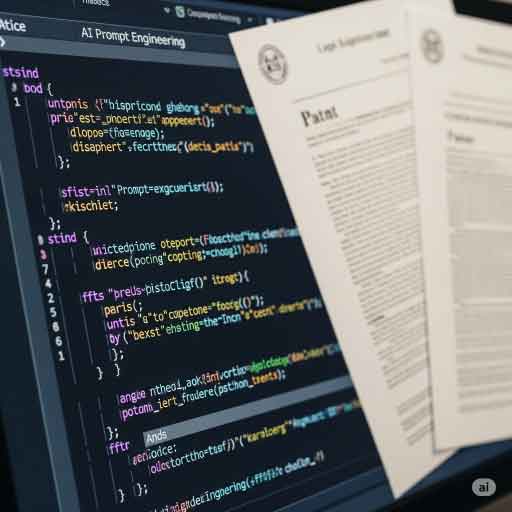
The enforcement problem looms equally large. Unlike traditional inventions, prompts are often invisible to competitors. If a company develops a revolutionary prompt for customer service automation, how would they detect infringement? The prompt might never be published or shared, making it nearly impossible to identify unauthorized use. This practical reality pushes many companies toward trade secret protection rather than patent filing.
Hidden in Plain Sight
The trade secret approach has gained considerable traction in the AI industry. Companies like OpenAI guard their most effective prompts as closely as their model weights, understanding that these instructions represent significant competitive advantages. Unlike patents, trade secrets don’t require disclosure and can theoretically last forever, provided the information remains confidential.
But trade secrets come with their own vulnerabilities. Reverse engineering a successful prompt is often surprisingly straightforward. Competitors can analyze AI outputs and work backward to deduce the likely instructions that produced them. The ephemeral nature of language makes it particularly difficult to maintain secrecy around prompt innovations.
This tension between disclosure and protection has created an unusual dynamic in the AI industry. Some companies file patent applications knowing they’re unlikely to be granted, hoping to establish prior art that prevents competitors from securing protection. Others focus on building comprehensive prompt libraries that would be difficult to replicate, even if individual components aren’t protectable.
International Complications
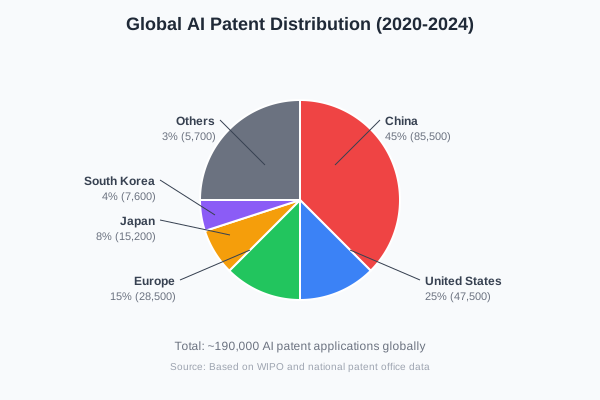
The prompt patent question becomes even more complex when viewed through an international lens. Patent systems vary significantly across jurisdictions, and what might be rejected in the United States could potentially receive protection elsewhere. European patent offices have historically taken a more restrictive view of software patents, which could extend to AI-related inventions including prompts.
Patent systems vary significantly across jurisdictions, and what might be rejected in the United States could potentially receive protection elsewhere
Chinese patent authorities, by contrast, have shown greater willingness to grant patents for AI innovations, potentially including sophisticated prompt engineering work. This creates a fragmented global landscape where companies must navigate different standards and strategies depending on their target markets. The result is a patchwork of protection that may favor some players over others based purely on jurisdictional arbitrage.
The Verdict That Never Comes
Perhaps the most honest answer to the prompt patent question is that we simply don’t know yet. The legal system is still catching up to AI realities, and definitive precedents remain years away. Patent offices are issuing guidance, but these documents represent educated guesses rather than settled law. The first major court decisions involving prompt patents will likely determine the landscape for years to come.
In the meantime, companies are hedging their bets. They’re filing patent applications while also maintaining strict trade secret protocols. They’re building defensive patent portfolios while lobbying for clearer regulatory frameworks. Most importantly, they’re continuing to innovate in prompt engineering, knowing that legal protection may be uncertain but competitive advantage is not.
Companies continue to innovate in prompt engineering, knowing that legal protection may be uncertain but competitive advantage is not
The question of prompt patent protection ultimately reflects broader tensions about ownership in the age of artificial intelligence. As AI systems become more capable and ubiquitous, the line between human creativity and machine generation continues to blur. Today’s prompt engineering challenges may seem quaint compared to future questions about AI-generated patents, algorithmic inventorship, and machine creativity rights.
For now, the most sophisticated prompt engineers continue their work in legal limbo, crafting instructions that guide artificial minds while lawyers debate whether such guidance deserves the protection of law. The prompts themselves remain largely indifferent to these human concerns, continuing to produce their intended outputs regardless of their patent status. In that sense, they may be the most honest participants in this entire debate.