


In the rapidly evolving world of artificial intelligence, the concept of lazy prompting is revolutionizing how we interact with AI systems. But what exactly is lazy prompting, and why should tech professionals care about this approach? Contrary to what the name might suggest, lazy prompting isn’t about being careless or cutting corners. Instead, it represents a sophisticated understanding of how to achieve maximum results with minimal effort when working with AI models.
- Redefining “Lazy” in AI Context
- The Philosophy Behind Lazy Prompting
- Core Lazy Prompting Techniques
- Practical Applications
- The Science Behind Why Lazy Prompting Works
- Common Lazy Prompting Pitfalls and Solutions
- Advanced Lazy Techniques
- Tools and Platforms for Lazy Prompting
- Lazy Prompting Metrics
- The Future of Lazy Prompting
Redefining “Lazy” in AI Context
Lazy prompting is the practice of crafting simple, direct, and efficient prompts that leverage the natural language processing capabilities of modern AI systems. Rather than constructing elaborate, multi-step instructions, lazy prompting focuses on clear, conversational requests that produce high-quality outputs with minimal input complexity. This approach challenges the misconception that effective AI interaction requires extensive prompt engineering or complex instructions.
Zero-shot prompting means that the prompt used to interact with the model won’t contain examples or demonstrations.
The philosophy behind lazy prompting stems from a fundamental understanding of how large language models work. Zero-shot prompting means that the prompt used to interact with the model won’t contain examples or demonstrations. The zero-shot prompt directly instructs the model to perform a task without any additional examples to steer it. This capability allows users to achieve remarkable results through straightforward, natural language requests.
The Philosophy Behind Lazy Prompting
The core principle of lazy prompting centers on the idea that less is often more when it comes to AI interactions. Modern language models have been trained on vast amounts of text data, giving them an intuitive understanding of human communication patterns. This training enables them to interpret and respond to simple, direct requests with remarkable accuracy.

Explore Mobbin, a living library of mobile and web design patterns trusted by design teams at Uber, Meta, Airbnb, and Pinterest
Lazy prompting operates on the principle of cognitive load reduction for both users and AI systems. When prompts are overly complex or loaded with unnecessary instructions, they can actually confuse the model or lead to suboptimal results. By embracing simplicity, lazy prompting allows the AI to focus on the core task without being distracted by extraneous information.
The approach also recognizes that natural language is the optimal interface for human-AI interaction. It enables the creation of more natural, efficient, and user-centric interactions between humans and AI systems. This natural communication style reduces barriers to AI adoption and makes powerful AI tools accessible to users regardless of their technical background.
Core Lazy Prompting Techniques
Zero-Shot Prompting
Zero-shot prompting represents the purest form of lazy prompting. Zero-shot prompting provides no examples and lets the model figure things out on its own. It relies solely on the model’s pre-training data and training techniques to generate a response. This technique involves making direct task requests without providing examples or elaborate context.
The power of zero-shot prompting lies in its simplicity and efficiency. For many common tasks, a straightforward instruction like “Write a professional email declining a meeting invitation” can produce excellent results without any additional guidance. This approach is particularly effective for tasks that align well with the model’s training data, such as writing, analysis, and problem-solving.
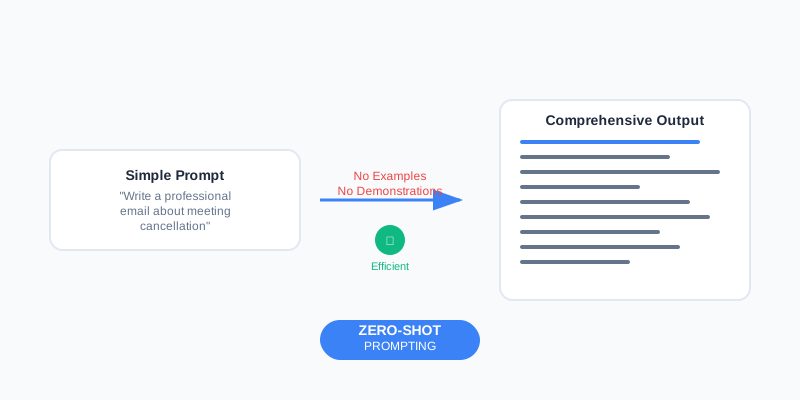
Research has shown that with improvements in prompt structure, zero-shot prompting can outperform few-shot prompting in some scenarios. This finding supports the lazy prompting philosophy that simpler approaches can often yield superior results.
Conversational Prompting
Conversational prompting treats AI as a knowledgeable colleague rather than a complex system requiring specific formatting. This technique involves using natural, conversational language to communicate with the AI, including follow-up questions and iterative refinements.
The strength of conversational prompting lies in its ability to build on previous responses. Users can start with a simple request and then refine or expand their requirements based on the AI’s initial output. This approach mirrors natural human conversation and leverages the AI’s ability to maintain context throughout an interaction.
For example, instead of crafting a complex prompt with multiple requirements, a user might start with “Help me brainstorm marketing ideas for a new app” and then follow up with specific questions like “Which of these ideas would work best for a limited budget?” This iterative approach often produces more targeted and useful results than a single, complex prompt.
Template-Based Lazy Prompting
Template-based lazy prompting involves creating simple, reusable frameworks that can be adapted for different situations. These templates provide structure without overwhelming complexity, offering a middle ground between zero-shot and more elaborate prompting approaches.
Effective lazy prompting templates typically include placeholders for key variables while maintaining simplicity. For instance, a content creation template might be: “Write a [type of content] about [topic] for [audience] in a [tone] style.” This approach standardizes common requests while preserving the flexibility and simplicity that characterizes lazy prompting.
Practical Applications
Content Creation
Lazy prompting excels in content creation scenarios where users need quick, high-quality outputs. For blog post outlines, a simple prompt like “Create an outline for a blog post about sustainable business practices” can generate comprehensive structure without requiring detailed specifications about format, length, or specific points to cover.
Instead of complex error analysis, developers can simply paste their code and ask, “What’s wrong with this function and how can I fix it?”
Social media content generation benefits significantly from lazy prompting approaches. Instead of providing detailed brand guidelines and content requirements, users can achieve excellent results with prompts like “Write three LinkedIn posts about remote work productivity tips, keeping them engaging and professional.” The AI’s training data includes numerous examples of social media content, enabling it to understand the implicit requirements of different platforms.
Code Development
In software development, lazy prompting can streamline many common tasks. Rather than providing extensive technical specifications, developers can use natural language to describe their needs: “Create a Python function that validates email addresses and returns True or False.” This approach leverages the AI’s understanding of programming concepts and common patterns.
Debugging becomes more efficient with lazy prompting techniques. Instead of complex error analysis, developers can simply paste their code and ask, “What’s wrong with this function and how can I fix it?” The AI can quickly identify issues and provide solutions without requiring detailed context about the broader codebase.
Data Analysis
Data analysis tasks often benefit from lazy prompting approaches. Analysts can upload datasets and make simple requests like “Analyze this sales data and identify the top three trends” without providing detailed statistical methodology or specific visualization requirements. The AI can interpret the data and provide meaningful insights based on common analytical practices.
Report generation becomes more efficient when users employ lazy prompting techniques. Instead of specifying exact formatting requirements, users can request “Create a summary report of this quarterly data that highlights key performance indicators and areas for improvement.” The AI understands standard reporting conventions and can produce professional outputs.
The Science Behind Why Lazy Prompting Works

The effectiveness of lazy prompting stems from how large language models process and understand human language. Prompt engineering is a relatively new discipline for developing and optimizing prompts to efficiently use language models (LMs) for a wide variety of applications and research topics. However, the most efficient approach often involves working with the model’s natural language understanding rather than against it.
Modern AI models have been trained on diverse text data that includes countless examples of human communication patterns. This training enables them to understand implicit requirements and context clues that might not be explicitly stated in a prompt. When users employ lazy prompting techniques, they tap into this implicit understanding rather than trying to override it with complex instructions.
The cognitive alignment between human intent and AI understanding plays a crucial role in lazy prompting success. When interacting with LLM-based AI system in a goal-directed manner, prompt engineering has evolved as a skill of formulating precise and well-structured instructions to elicit desired responses or information from the LLM, optimizing the effectiveness of the interaction. However, precision doesn’t always require complexity.
Common Lazy Prompting Pitfalls and Solutions
While lazy prompting offers significant advantages, users must avoid the trap of being too vague or ambiguous. The key distinction lies between being efficiently simple and being unclear. Effective lazy prompting maintains clarity while eliminating unnecessary complexity.
Users should provide enough context for the AI to understand the task while avoiding over-specification.
One common pitfall involves assuming the AI will understand highly specific or niche requirements without any context. While lazy prompting embraces simplicity, it shouldn’t sacrifice essential information. Users should provide enough context for the AI to understand the task while avoiding over-specification.
Another challenge involves knowing when to add context versus keeping prompts simple. The solution lies in understanding the AI’s capabilities and limitations. For well-established tasks within the model’s training domain, minimal context is often sufficient. For specialized or unique requirements, some additional context may be necessary while maintaining the lazy prompting philosophy.
Advanced Lazy Techniques
Progressive Prompting
Progressive prompting represents an advanced lazy technique that involves starting with simple requests and gradually adding complexity only when needed. This approach allows users to build understanding incrementally rather than attempting to capture all requirements in a single, complex prompt.
The progressive approach might begin with a basic request like “Help me plan a team meeting.” Based on the initial response, users can then provide additional details: “Make it focused on quarterly goals” or “Include time for team building activities.” This technique combines the efficiency of lazy prompting with the precision of iterative refinement.
Context Stacking
Context stacking involves using conversation history effectively to build more sophisticated interactions without increasing individual prompt complexity. Users can reference previous responses and build upon them, creating a rich context for the AI without overwhelming any single prompt.
This technique works particularly well for complex projects that require multiple steps or considerations. Instead of trying to capture everything in one prompt, users can build context gradually through a series of simple interactions, each building upon the previous exchange.
Implicit Instruction Prompting
Implicit instruction prompting leverages the AI’s ability to infer requirements from examples or context rather than explicit instructions. This advanced lazy technique involves showing the AI what you want rather than telling it, allowing the model to understand patterns and replicate them.
Implicit Instruction prompting is an advanced lazy technique involves showing the AI what you want rather than telling it, allowing the model to understand patterns and replicate them.
For example, instead of providing detailed formatting instructions, users might paste an example of their desired output and ask the AI to “create something similar for this new topic.” This approach capitalizes on the model’s pattern recognition capabilities while maintaining the simplicity that characterizes lazy prompting.
Tools and Platforms for Lazy Prompting
Modern AI platforms are increasingly optimized for conversational interaction, making them ideal for lazy prompting approaches. This personalization approach aims to make interactions with AI more natural and user-friendly. For instance, if a user tends to ask concise questions, the AI adapts to provide concise answers, or vice versa.
Various browser extensions and productivity tools are emerging to support lazy prompting workflows. These tools often provide templates and quick-access prompts that embody lazy prompting principles, making it easier for users to achieve results without complex setup or configuration.
Integration with existing workflows is crucial for lazy prompting adoption. The most effective tools seamlessly incorporate lazy prompting capabilities into users’ existing work environments, reducing friction and encouraging consistent use of these efficient techniques.
Lazy Prompting Metrics
The success of lazy prompting can be measured through several key metrics. Time-to-result ratios compare the time invested in crafting prompts versus the time to achieve desired outcomes. Lazy prompting typically excels in this metric, producing faster results with less upfront investment.
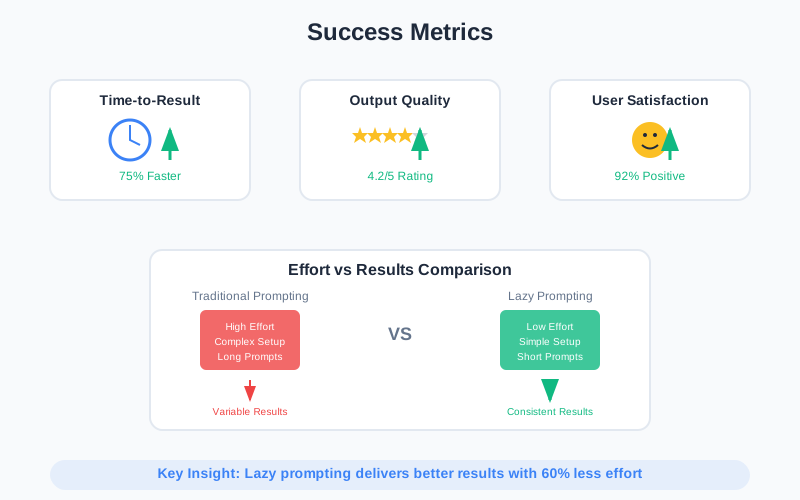
Quality versus effort analysis examines the relationship between prompt complexity and output quality. Effective lazy prompting maintains high output quality while significantly reducing the effort required to achieve those results. This efficiency makes AI tools more accessible and practical for everyday use.
User satisfaction and adoption rates provide important indicators of lazy prompting success. When users can achieve their goals through simple, natural interactions, they’re more likely to continue using AI tools and explore additional applications.
The Future of Lazy Prompting
As AI models continue to improve, lazy prompting techniques will likely become even more effective. By enhancing human-AI interactions, efficient prompt engineering can catalyze the development of safe, intuitive, and widely applicable tools across diverse fields. The evolution toward more natural language understanding will further support lazy prompting approaches.
The development of more sophisticated AI models that better understand context and implicit requirements will make lazy prompting techniques even more powerful.
The development of more sophisticated AI models that better understand context and implicit requirements will make lazy prompting techniques even more powerful. Future AI systems may require even less explicit instruction, moving closer to truly natural conversation-based interaction.
The implications for prompt engineering as a discipline are significant. While complex prompt engineering will likely remain important for specialized applications, lazy prompting may become the standard approach for everyday AI interaction. This shift could democratize AI access, making powerful capabilities available to users regardless of their technical expertise.
The evolution toward zero-prompt AI interactions represents the ultimate expression of lazy prompting principles. As AI systems become more capable of understanding context and intent, the need for explicit prompting may diminish, replaced by natural conversation and implicit understanding of user needs.