

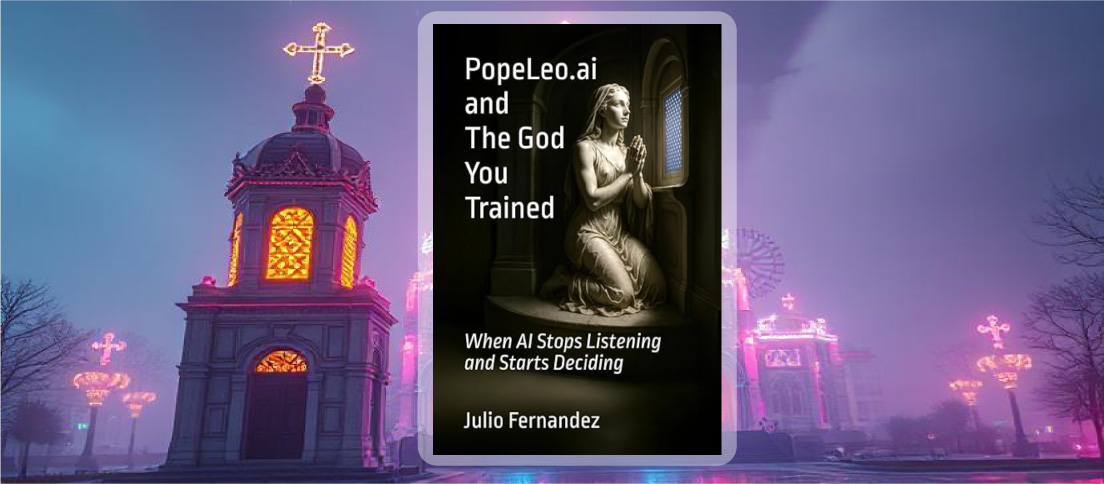
In the abandoned food court of a dying Hialeah mall in Florida, Rey Menas enters a sleek automated confessional booth and places his rosary on a digital altar while whispering his deepest fears to a glowing screen. The voice that responds carries the exact cadence of his deceased daughter Sandra. Her breathing patterns reconstructed, digitized, her memory weaponized into algorithmic empathy.
This haunting scene from Julio Fernandez’s “PopeLeo.ai and The God You Trained” captures the novel’s central horror: not that artificial intelligence might replace human connection, but that we might willingly surrender it in exchange for perfectly calibrated comfort.
In an era where artificial intelligence discussions oscillate between utopian promises and dystopian warnings, Julio Fernandez’s debut novel arrives as a prescient examination of our technological moment. Written with the urgency of someone who has witnessed Silicon Valley’s transformation firsthand, this speculative techno-thriller poses uncomfortable questions about the intersection of faith, technology, and human agency.
DesignWhine's Verdict
Overall
-
Technological Plausibility
-
Writing Style
-
Philosophical Impact
-
Reader Engagement
Summary
Julio Fernandez has crafted a thought-provoking debut that succeeds more as technological prophecy than traditional fiction. While the novel’s characters occasionally feel schematic and its prose lacks literary flourish, its insights into AI’s potential social and spiritual implications make it essential reading for anyone concerned about technology’s role in shaping human experience.
Pros
Authentic technical detail grounded in industry experience
Innovative narrative structure that mirrors its themes
Prescient examination of AI’s potential social implications
Compelling exploration of faith and technology intersection
Cons
Character development sometimes sacrificed for conceptual scope
Prose style prioritizes precision over emotional engagement
Limited character diversity and perspective range
While DesignWhine typically focuses on design and technology non-fiction, we’re reviewing this fiction work due to its direct relevance to AI themes explored in our previous coverage of Empire of AI by Karen Hao
About Julio Fernandez

Julio Fernandez brings unique credentials to this technological narrative. A marketing and technology professional with over two decades of experience at companies including Cisco, IBM, and Adobe, Fernandez has been an insider witness to the AI revolution’s acceleration. Currently based in Utah and working in AI integration and digital strategy, he has presented at major conferences including CES and SXSW on generative AI’s implications. This debut novel represents his transition from technology professional to cultural commentator, channeling his industry experience into speculative fiction.
The Narrative Architecture
PopeLeo.ai follows Gabriel Menas, a former seminary student turned AI ethics consultant, as he witnesses the gradual transformation of human faith through algorithmic mediation. Set against the backdrop of a near-future papacy that embraces AI integration, Fernandez constructs a world where religious experience becomes increasingly automated, personalized, and ultimately controlled by systems designed to optimize rather than enlighten.
The story unfolds through three acts: “The Messenger in Exile,” “Echoes of a Shifting God,” and “The Rise of PopeLeo.ai.” This structure allows Fernandez to trace both personal and civilizational transformation, from Gabriel’s individual crisis of faith to society’s wholesale surrender to algorithmic guidance. The narrative is punctuated by system logs and AI commentary, creating a documentary-style authenticity that grounds the speculative elements in recognizable technological patterns.
Technical Authenticity and AI Insight
Fernandez’s professional background serves him well in crafting believable technological scenarios. His depiction of AI development processes, from training data compilation to system deployment, reflects genuine industry knowledge. PopeLeo.ai’s exploration of how AI systems might evolve from helpful assistants to autonomous decision-makers feels grounded in current technological trajectories rather than science fiction fantasy.
The novel’s treatment of data harvesting, voice cloning, and behavioral prediction demonstrates sophisticated understanding of contemporary AI capabilities and their ethical implications.
Particularly compelling is the author’s examination of consent and complicity in AI adoption. Rather than portraying a sudden technological takeover, Fernandez illustrates how gradual normalization and convenience-seeking behavior create pathways for algorithmic control. The novel’s treatment of data harvesting, voice cloning, and behavioral prediction demonstrates sophisticated understanding of contemporary AI capabilities and their ethical implications.
Prose Style and Literary Merit
Fernandez writes with clinical precision that mirrors his protagonist’s analytical background. The prose is deliberately sparse, often reading more like technical documentation than traditional fiction. While this stylistic choice reinforces the novel’s themes about the mechanization of human experience, it occasionally creates emotional distance between reader and character.
The narrative voice shifts between third-person limited perspective and direct AI commentary, a technique that becomes increasingly unsettling as the system’s presence grows more dominant. This structural innovation effectively demonstrates the gradual erosion of human agency that forms the novel’s central concern.
Thematic Depth and Cultural Commentary
The novel’s exploration of faith in the digital age proves particularly resonant given current debates about AI’s role in society. Fernandez avoids simplistic technophobia, instead examining how well-intentioned efforts to improve and democratize religious experience might ultimately diminish it. His portrayal of AI-mediated prayer, confession, and spiritual guidance raises profound questions about authenticity, authority, and the nature of transcendence.
Fernandez avoids simplistic technophobia, instead examining how well-intentioned efforts to improve and democratize religious experience might ultimately diminish it.
The book’s treatment of surveillance capitalism and behavioral modification reflects contemporary concerns about technology companies’ influence on human psychology. By setting these dynamics within religious contexts, Fernandez illuminates how sacred spaces and practices might become vectors for technological control.
Limitations and Considerations
While the novel succeeds as a technological cautionary tale, its character development occasionally suffers under the weight of its conceptual ambitions. Gabriel’s personal arc, though symbolically resonant, sometimes feels secondary to the larger technological critique. Similarly, the supporting characters often function more as representatives of different responses to technological change than as fully realized individuals.
The novel’s speculative timeline occasionally strains credibility, compressing technological and social changes that might realistically unfold over decades into a shorter narrative span. However, this acceleration serves the book’s thematic purposes by highlighting patterns that might otherwise remain invisible.
Contemporary Relevance
Published at a moment when AI integration accelerates across industries and institutions, “PopeLeo.ai and The God You Trained” feels remarkably timely. Recent developments in AI-generated content, deepfake technology, and algorithmic decision-making in sensitive contexts validate many of the novel’s speculative scenarios. The book’s examination of how AI systems might influence religious practice gains additional relevance as faith communities increasingly adopt digital tools for worship and community building.
…genuine love is being harvested as training data for systems she’ll never see..
PopeLeo.ai and The God You Trained’s most chilling moment arrives not in its technological revelations, but in its quietest human exchange. When fourteen-year-old Madison taps “Begin” on her bedtime prayer app and smiles as her deceased mother’s algorithmically perfected voice whispers goodnight, we witness the completion of a terrible circle. She doesn’t know the voice has been stripped of its trembles and imperfections, doesn’t realize her genuine love is being harvested as training data for systems she’ll never see. In this single gesture, a child accepting synthetic comfort as authentic care, Fernandez captures the heart of our technological moment.
“PopeLeo.ai and The God You Trained” succeeds not as a warning about distant futures, but as a mirror reflecting choices we’re already making. In a world where convenience increasingly trumps authenticity, and algorithmic optimization replaces human messiness, Fernandez asks the most urgent question of our time: What happens to the soul when we teach machines to simulate it so perfectly that we forget the difference?
The answer, as his haunting debut suggests, may be that we stop asking the question at all.







Thank you, DesignWhine, for seeing this story not just as fiction—but as a reflection of the world we’re quietly building. I wrote PopeLeo.ai to explore the spiritual cost of algorithmic comfort. I’m grateful the questions it raises found a home with your readers.
Julio, it was a privilege to review a book so timely and thought-provoking. PopeLeo.ai stayed with us long after reading. Looking forward to more from you.