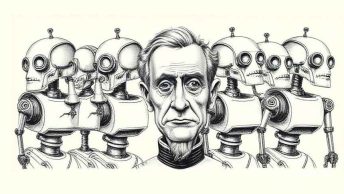


In the fluorescent-lit corridors of Silicon Valley’s research labs, a quiet revolution is unfolding. Engineers and researchers are discovering that artificial intelligence responds not just to carefully crafted text prompts, but to something far more intuitive: images. This emerging discipline, known as visual prompt engineering, represents a fundamental shift in how humans communicate with machines, moving beyond the limitations of language toward a more natural, visual dialogue.
The concept sounds deceptively simple. Instead of typing elaborate descriptions or complex instructions, users can show AI systems exactly what they want through images, sketches, diagrams, or visual examples. A designer might upload a rough wireframe and receive functional code. An architect could sketch a building concept and generate detailed plans. A data analyst might photograph a handwritten chart and extract structured information instantly.
But beneath this apparent simplicity lies a sophisticated technical revolution that’s reshaping entire industries and challenging our fundamental assumptions about human-computer interaction.
The Technical Architecture of Visual Understanding
The backbone of visual prompt engineering rests on multimodal AI models that can process and understand both visual and textual information simultaneously. These systems, powered by advanced vision-language models, represent a significant leap from earlier AI that could only interpret text or images in isolation.

Explore Mobbin, a living library of mobile and web design patterns trusted by design teams at Uber, Meta, Airbnb, and Pinterest
Recent breakthroughs in computer vision have enabled models to decode arbitrary visual cues, allowing users to interact with AI systems using natural visual markers like colored bounding boxes, arrows, or even simple hand gestures. This capability stems from sophisticated neural networks that can identify patterns, relationships, and contextual meaning within images, then translate these insights into actionable outputs.
The visual prompt processing pipeline operates through several layers of interpretation. First, the system analyzes the visual input to identify objects, spatial relationships, and compositional elements. Next, it extracts semantic meaning from these visual cues, understanding not just what is shown but what it represents in context. Finally, it combines this visual understanding with any accompanying text prompts to generate appropriate responses.
This technical foundation enables AI systems to understand complex visual instructions that would be nearly impossible to convey through text alone. A single image containing multiple elements, annotations, and spatial relationships can communicate information that might require thousands of words to describe accurately.
Transforming Creative and Technical Workflows
The practical applications of visual prompt engineering extend far beyond academic research, fundamentally altering how professionals across industries approach their work. In software development, engineers are discovering that visual prompt techniques can dramatically accelerate the development process. Instead of writing detailed specifications for user interfaces, developers can sketch rough mockups or photograph existing designs, then generate functional code automatically.
A single image containing multiple elements, annotations, and spatial relationships can communicate information that might require thousands of words to describe accurately
This shift has proven particularly transformative in UX design, where visual prompt engineering bridges the gap between creative vision and technical implementation. Designers can now iterate rapidly through visual concepts, testing ideas by showing rather than telling. The traditional bottleneck of translating creative concepts into technical requirements dissolves when AI can interpret visual intentions directly.
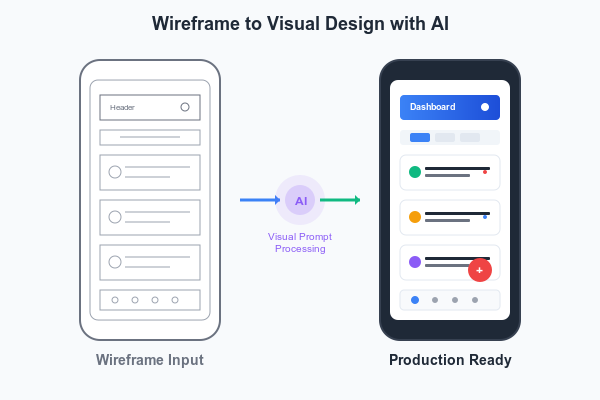
In architecture and product design, visual prompt engineering enables unprecedented collaboration between human creativity and computational power. Architects can sketch conceptual drawings and receive detailed structural analyses, while product designers can photograph existing objects and generate variations or improvements. This visual dialogue creates a more intuitive design process that feels less like programming and more like natural creative collaboration.
The marketing and advertising industries have embraced visual prompt engineering as a tool for maintaining brand consistency while scaling creative production. Marketing teams can provide visual examples of desired aesthetics, layouts, or compositions, then generate variations that maintain brand coherence across different media and platforms. This approach ensures that creative output remains aligned with brand guidelines while dramatically reducing production time.
The Psychology of Visual Communication
The appeal of visual prompt engineering extends beyond mere technical convenience, tapping into fundamental aspects of human cognition and communication. Humans are inherently visual creatures, processing images approximately 60,000 times faster than text. This biological advantage makes visual prompting feel more natural and intuitive than traditional text-based interactions with AI systems.
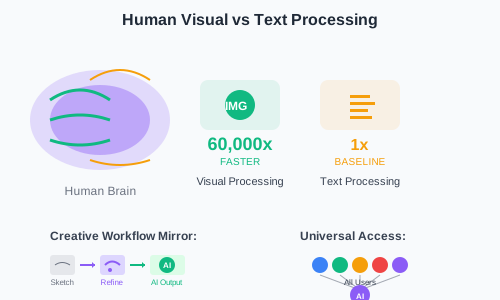
The iterative nature of visual prompt engineering mirrors human creative processes. Artists and designers naturally work through visual iteration, sketching, refining, and building upon visual ideas. Visual prompt engineering allows this natural creative workflow to extend into AI collaboration, creating a more seamless integration between human creativity and machine capability.
Research in cognitive psychology suggests that visual information processing engages different neural pathways than textual processing, often leading to more intuitive and immediate understanding. This cognitive advantage makes visual prompt engineering particularly effective for complex spatial, aesthetic, or compositional tasks that benefit from immediate visual feedback.
The democratization aspect of visual prompt engineering cannot be understated. While effective text prompt engineering requires specific knowledge of language patterns and technical terminology, visual prompting leverages universal human abilities to recognize, create, and manipulate visual information. This accessibility opens AI collaboration to broader audiences, regardless of technical writing skills or familiarity with AI systems.
Industry Applications and Real-World Impact
The practical implementation of visual prompt engineering has already begun reshaping entire industries. In document processing and data analysis, organizations are using visual prompt techniques to extract information from charts, graphs, and complex documents that would be difficult to parse through traditional text-based methods. Financial institutions analyze handwritten forms and documents, while healthcare organizations process medical images and patient records with unprecedented accuracy.
Educational technology has embraced visual prompt engineering as a tool for personalized learning. Students can photograph homework problems, diagrams, or textbook pages, receiving immediate explanations and guidance. This visual approach to educational support makes learning more interactive and responsive to individual needs.
Students can photograph homework problems, diagrams, or textbook pages, receiving immediate explanations and guidance.
The gaming and entertainment industries are exploring visual prompt engineering for content creation and interactive experiences. Game developers can sketch level designs and generate playable environments, while filmmakers can storyboard scenes and receive detailed production breakdowns. This visual approach to creative production accelerates development timelines while maintaining creative control.
E-commerce platforms are implementing visual prompt engineering for product discovery and customer service. Customers can photograph items they’re seeking and receive relevant product recommendations, while customer service representatives can analyze visual problems and provide targeted solutions. This visual approach to commerce creates more intuitive and efficient shopping experiences.
Challenges and Limitations
Despite its transformative potential, visual prompt engineering faces significant challenges that temper its immediate adoption. Privacy concerns represent a major hurdle, as visual prompts often contain sensitive information about individuals, locations, or proprietary designs. Organizations must carefully balance the benefits of visual AI interaction with the need to protect confidential information.
Accuracy and reliability issues pose another significant challenge. While visual prompt engineering can produce impressive results, it remains prone to misinterpretation and hallucination. AI systems might misunderstand visual cues, leading to outputs that don’t match user intentions. This reliability gap requires careful validation and human oversight, particularly in critical applications.
Effective visual prompting involves understanding lighting, composition, annotation techniques, and visual hierarchy in ways that maximize AI comprehension
The learning curve for effective visual prompt engineering, while lower than text-based alternatives, still requires users to understand how AI systems interpret visual information. Effective visual prompting involves understanding lighting, composition, annotation techniques, and visual hierarchy in ways that maximize AI comprehension.
Cultural and contextual biases present ongoing challenges for visual prompt engineering systems. AI models trained on specific datasets may struggle with visual cues from different cultural contexts, architectural styles, or design traditions. This limitation can lead to outputs that reflect narrow perspectives or miss important cultural nuances.
The Future of Multimodal Interaction
The trajectory of visual prompt engineering points toward increasingly sophisticated multimodal interactions that combine visual, textual, and potentially audio inputs. Future systems may interpret gesture, voice, and visual cues simultaneously, creating more natural and intuitive AI collaboration.
Integration with augmented and virtual reality technologies promises to make visual prompt engineering even more immersive and practical. Users might sketch in three-dimensional space, manipulate virtual objects, or point at real-world elements to communicate with AI systems. This spatial approach to visual prompting could revolutionize fields like architecture, engineering, and design.
Real-time visual prompt engineering represents another frontier, where AI systems can respond immediately to visual inputs without the current delays associated with processing and generation. This capability would enable dynamic, conversational interactions through visual means, making AI collaboration feel more like natural human communication.
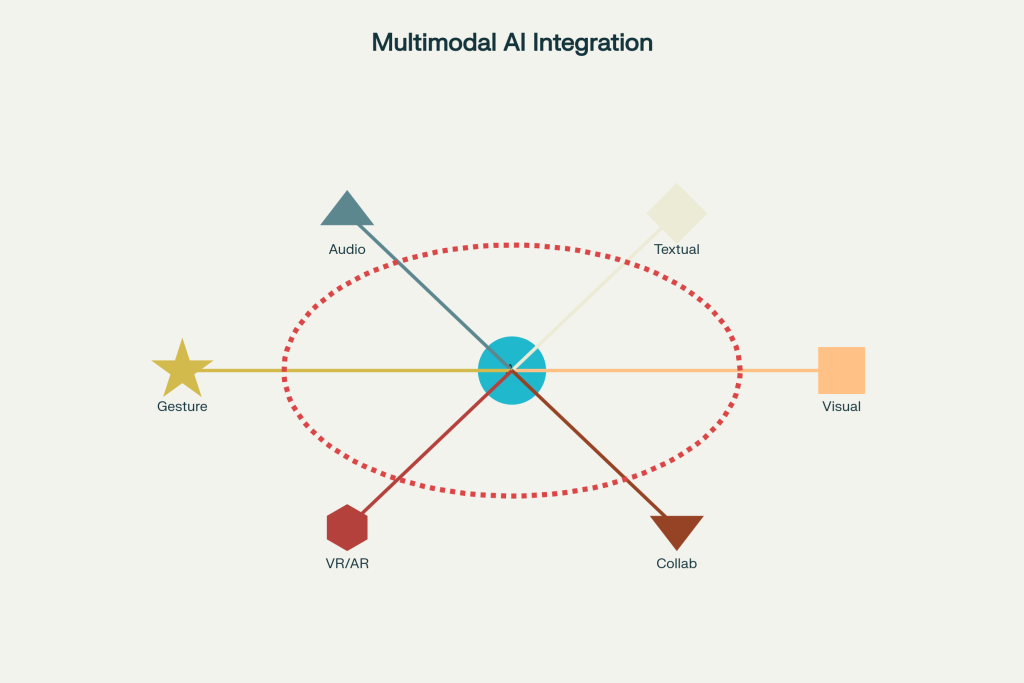
The evolution toward more intuitive AI communication through visual prompt engineering suggests a future where the boundary between human creativity and artificial intelligence becomes increasingly fluid. Rather than replacing human creativity, visual prompt engineering amplifies human capabilities, enabling more rapid iteration, exploration, and implementation of creative ideas.
As visual prompt engineering continues to mature, it promises to fundamentally alter not just how we interact with AI systems, but how we think about the relationship between human creativity and machine intelligence. The future of human-AI collaboration may well be visual, intuitive, and remarkably human in its approach to communication and creation.
This visual revolution in AI interaction represents more than a technological advancement; it embodies a return to more natural, intuitive forms of human-computer communication. As the technology continues to evolve, visual prompt engineering will likely become as fundamental to AI interaction as typing is to computer use today, marking a new chapter in the ongoing story of human-machine collaboration.