

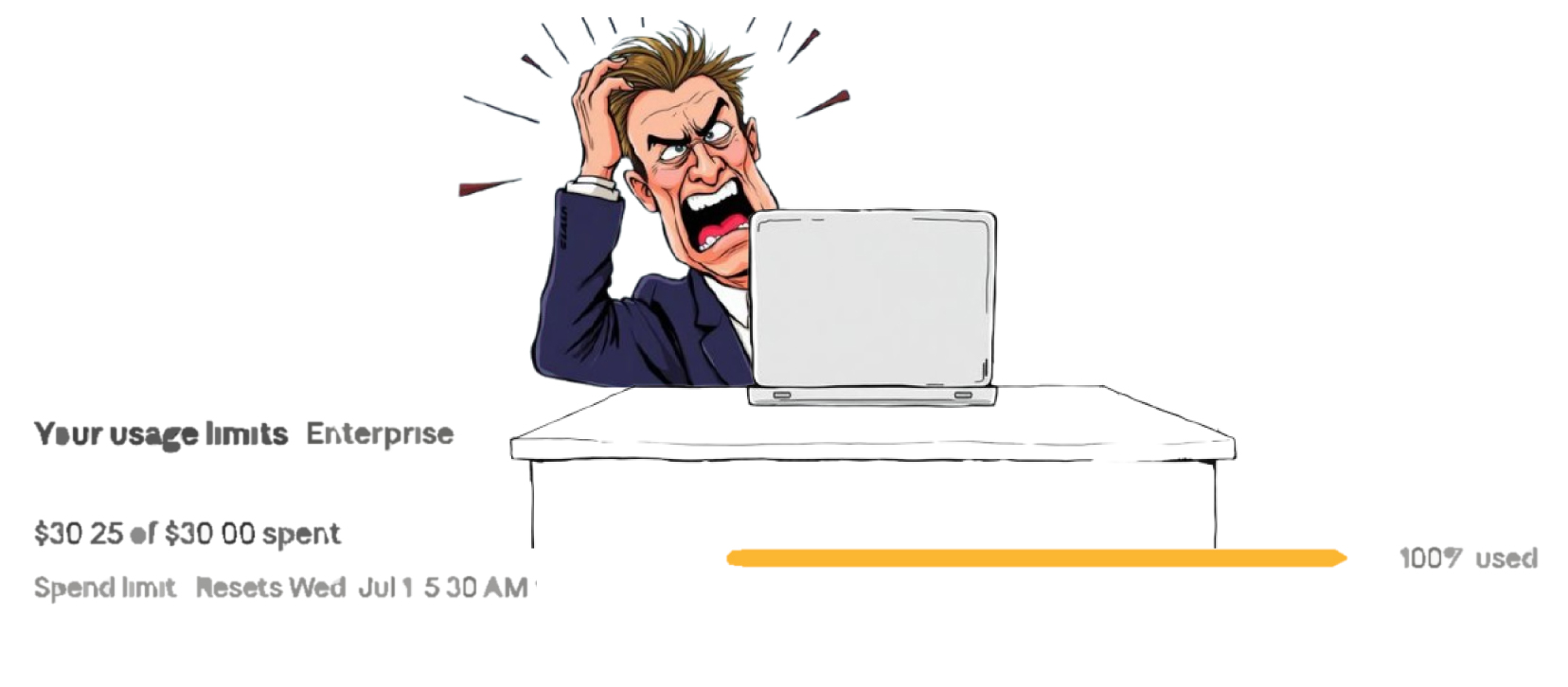
Six months ago, our corporate all-hands meeting felt like an evangelical revival. The message from leadership was uncompromised: we were downsizing the core product design team by thirty percent because artificial intelligence was going to grant the remaining survivors ten-times velocity. We got enterprise licenses to Claude, Cursor, and Perplexity. The directive was to go all-in on AI, loop multiple automated processes in parallel, and build out design systems using brute-force computational scale. We were told that the old world of slow, manual iteration was dead.
Then the AI invoices landed.
The corporate panic that followed was swift and severe. Almost overnight, the executive mandate transformed from manic encouragement to aggressive rationing. To choke back exploding enterprise AI costs, our department was slapped with a hard, unyielding monthly token cap per designer. We went from being heralded as the automated pioneers of the company to being treated like teenagers who had exceeded the data limit on a family phone plan.
The transition revealed a fundamental truth about the current state of enterprise AI technology. If a company forces its design team into a half-assed compromise where they must use artificial intelligence to survive an inflated workload, but caps their access to the models to save pennies, the tool ceases to be an asset. It becomes a net-negative drag on the entire creative process.
The Corporate Theater of Token Rationing
When the budget cuts hit, management did not just limit our access; they introduced a sprawling library of useless best practices designed to optimize our prompt efficiency. Our Slack channels were suddenly flooded with pinned guides instructing us to clear our chat history every three turns to minimize input context, or to switch to lightweight, lower-tier models for layout explorations and reserve premium models only for the final polish.
It makes the entire creative process feel like someone with a strict 1GB mobile data pack trying to watch a high-definition movie. Management’s brilliant advice is effectively instructing you to switch the video playback down to a pixelated 144p for the plot setup and character exposition, and then selectively toggle it up to 1080p for the final three-minute climax of the scene.
When you force designers to micromanage their tools by the kilobyte, you aren’t optimizing workflows; you are actively dismantling the psychological safety required to make creative leaps. If a professional is constantly calculating the financial overhead of clicking an edit button, the interface suffers before a single pixel is even rendered.
Management’s brilliant advice is effectively instructing you to switch the video playback down to a pixelated 144p for the plot setup and character exposition, and then selectively toggle it up to 1080p for the final three-minute climax of the scene
The economic math behind these strategies is completely broken. When leadership looks at the monthly cloud ledger, they see raw API consumption as an isolated variable. They fail to calculate the cost of the human friction required to achieve those minor savings.
To map out what this financial theater actually costs an organization, consider the reality of a standard twenty-person product design team operating under a typical corporate cap. When designers are forced to spend a portion of their day auditing their own prompts, fixing hallucinations from inferior models, and manually reconstructing lost context, the ledger flips from savings to severe loss.
The Math Behind the Madness
If a senior designer spends just 15 to 20 minutes a day trimming prompts, rebuilding context, and cleaning up avoidable AI mistakes, that can add up to roughly 5 to 7 hours a month per person. Across a 20-person team, the labor cost can easily dwarf the tiny amount saved on API usage.
Lest you think these figures come from a non-existent academic paper titled The Macroeconomics of Token Rationing, let me be transparent: this is a back-of-the-napkin engineering estimate. The rough math is simple – designer cost per hour × wasted hours per day × 20 designers × 22 working days, versus API cost at Y tokens per day × 20 designers × Z per million tokens. The scenario is illustrative, the variables are devastatingly real.
If a senior designer spends just 15 to 20 minutes a day trimming prompts, rebuilding context, and cleaning up avoidable AI mistakes, that can add up to roughly 5 to 7 hours a month per person
The math is grounded entirely as an operational cost model built on a standard $150k senior designer salary contrasted against current frontier model API token rates ($3-$5 per million input tokens). It calculates the explicit delta between human labor costs and API computational savings.
When multiplied across a mid-sized team of twenty designers, the company is actively burning $8,800 a month in high-value creative hours just to shave $1,200 off their enterprise API bill. By forcing creative professionals to act like underpaid cloud accountants, leadership destroys the momentum required to build exceptional products.
Living with Token Anxiety
Working under a strict token budget alters a designer’s psychological relationship with exploration. It feels remarkably like trying to build the modern web while using the metered dial-up internet of the late nineties. When you are paying by the minute or by the generation, you stop wandering. You become painfully aware of the invisible ticker tape running in the corner of your screen, and every single interaction carries a silent transaction tax.
True innovation is born from expansive exploration, the messy process of asking an engine to generate five radically contrasting approaches to a dense data matrix, intentionally breaking structural rules, and testing unexpected edge cases.
Contrary to what the execs would say, design is inherently a creative, high-waste process. You have to discard various versions to find the single correct user flow
Contrary to what the execs would say or believe, design is inherently a creative, high-waste process. You have to discard various versions to find the single correct user flow. When you place a meter on that experimentation, you force the designer straight into safe, predictive convergence. It is death by a thousand efficiency metrics. 💬 (2)
When token anxiety sets in, you can no longer afford to let the model explore wide, contrasting concepts because multi-turn interactions with complex design primitives burn through a weekly allotment in a matter of hours. To survive the week without hitting the corporate firewall, designers naturally revert to defensive, single-shot prompting. You ask for one basic, predictable variation, accept whatever mediocre template the model outputs, and manually patch the rest. The tool is stripped of its potential to expand thinking and is reduced to a glorified template generator, flatlining the variance of the entire product.
Shadow IT Stack
The irony of enterprise token rationing is that deadlines do not change just because a budget is capped. If a critical release candidate is due to engineering by Friday, leadership still demands a flawless layout, pieces of context be damned, irrespective of whether a designer’s corporate API allotment ran out on Wednesday morning.
Faced with this bottleneck, an underground technical ecosystem has quietly formed within design teams. To keep up with their workloads and bypass corporate friction, an elite tier of designers is quietly paying out of pocket for personal premium subscriptions to consumer tools.
To keep up with their workloads and bypass corporate friction, an elite tier of designers is quietly paying out of pocket for personal premium subscriptions to consumer tools
The implications for data governance are alarming. In a desperate bid to balance the visible enterprise AI costs on the official IT invoice, corporate leadership has inadvertently incentivized its best talent to move proprietary assets into unvetted, personal history logs. Sensitive user flows, unannounced product roadmaps, and proprietary design system variables are now floating in consumer data pools, completely unmonitored, all because the company treats computing power like a restricted luxury instead of standard utility.
The Rise of “Interface Slop”
When you attempt to run a highly sophisticated design system within a throttled environment, the design debt manifests directly in the user interface. To conserve tokens, teams often stretch single, massive chat threads across days or feed models incomplete context snippets. 💬 (1) This is where the output begins to rot.
As a thread grows compressed or a model is starved of data to keep context costs low, the system suffers from context compaction. It continues to generate layout code or components, but it quietly drops the subtle brand guardrails established dozens of turns prior. It drops the specific accessibility contrast rules for nested form fields or the subtle, system-wide border-radius consistency that keeps the entire product feeling like a cohesive, singular brand.
If an enterprise is unwilling to commit to the long-term infrastructure costs required to run uncapped, deep, multi-turn generative workflows, it should not force its design teams into an AI-first paradigm
The result is what I call interface rot, where the structural integrity of a design system dissolves because the model was denied the tokens it needed to remember the global variables. The supposed speed advantage of generative tools is completely cannibalized by the agonizing hours human designers must spend manually auditing and cleaning up AI-generated interface slop.
The Productivity Paradox
Squeezing token budgets to patch a quarterly ledger is a fundamental failure of foresight. It exposes a profound misunderstanding of what generative technology represents. Artificial intelligence is not a static SaaS license, nor is it a premium stock imagery subscription to be metered when times get tough. It is foundational infrastructure, akin to electricity or internet bandwidth.
If leadership treats intelligence as a scarce, rationed commodity, the team will build scarce, uninspired experiences. You cannot expect a hundred-times product velocity while micro-managing the electricity bill of the design studio.
The strategic verdict is simple. If an enterprise is unwilling to commit to the long-term infrastructure costs required to run uncapped, deep, multi-turn generative workflows, it should not force its design teams into an AI-first paradigm.
If leadership treats intelligence as a scarce, rationed commodity, the team will build scarce, uninspired experiences
When we commodify the sandbox, we do not get better architecture; we just get shorter walls. The corporate world is currently filled with platforms that feel identical, interfaces that lack friction but also lack soul, built by teams who were told to reach for the stars on a five-dollar data plan. In the race to eliminate the expense of human error, companies are paying a far higher price: the complete elimination of human surprise.
Long after the quarterly cloud invoices are settled, the only remaining artifact will be a digital landscape that is perfectly optimized, profoundly efficient, and entirely unmemorable.







Honestly yeah, the ‘save tokens’ advice often turns into weird workflow hacks that just slow everyone down. If the model needs all this micromanagement, maybe we’re not ready for the expensive AI yet.
As a designer I sure miss the “manual” days
Honestly, I can relate to it. And this is not because the tools are bad (well in most cases), but because once you start watching every output like it costs you something, you stop experimenting and start settling.
I use multiple tools, all the research goes in ChatGPT, the synthesis goes to Magicpatterns and overall just being careful about using longer prompts, less back-and-forth, and trying not to waste tokens on stuff that probably didn’t need AI in the first place…