
As the UX field continues to evolve and digital products become increasingly sophisticated, one question persistently emerges in design communities: Do UX designers need to learn coding? This comprehensive guide examines the relationship between coding skills and UX design success, exploring when programming knowledge enhances your career and when it might not be necessary.
Whether you’re just starting your UX journey or you’re a seasoned designer considering expanding your skill set, this article will provide the clarity you need to make informed decisions about learning to code.
- The Great Debate: A Simple Analogy
- Insight #1: Understanding Your Core Responsibilities First
- Insight #2: The Four Key Benefits of Coding Knowledge
- Insight #3: Essential Programming Languages for UX Designers
- Insight #4: Real-World Scenarios Where Coding Shines
- Insight #5: When Coding Knowledge Can Be Counterproductive
- Insight #6: Industry Expert Perspectives
- Insight #7: Strategic Learning Approach
- Frequently Asked Questions
- Making Your Decision
- Conclusion
The Great Debate: A Simple Analogy
Think of it this way: Do pilots need to understand air traffic control systems? While pilots don’t need to be air traffic controllers, understanding how the system works makes them better at their job. Similarly, UX designers don’t need to be programmers, but coding knowledge can significantly enhance their effectiveness and career prospects.
Insight #1: Understanding Your Core Responsibilities First
Before diving into whether UX designers should learn coding, it’s crucial to understand what UX design fundamentally entails. A UX designer’s primary responsibilities include:
- User Research: Understanding user needs, behaviors, and pain points
- Information Architecture: Organizing content and features logically
- Wireframing and Prototyping: Creating blueprints for digital experiences
- Usability Testing: Validating design decisions with real users
- Design Strategy: Aligning user needs with business objectives

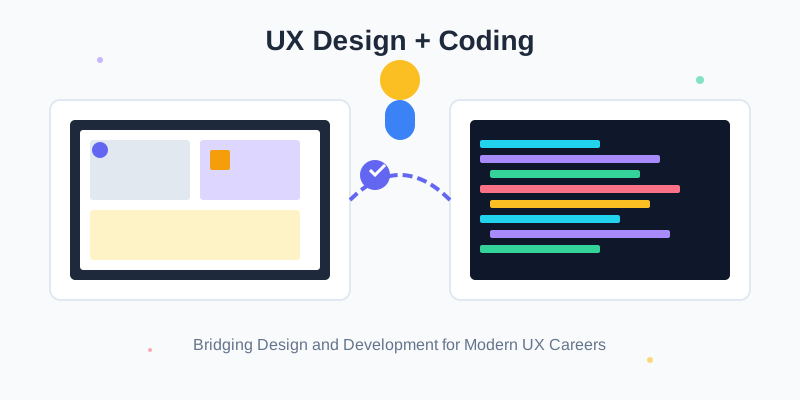
Coding is not inherently part of these core functions. However, programming knowledge can serve as a powerful multiplier for these activities, enabling designers to communicate more effectively with development teams and create more realistic prototypes.
Insight #2: The Four Key Benefits of Coding Knowledge
Enhanced Developer Communication
When UX designers understand basic coding principles, the notorious “designer-developer handoff” becomes exponentially smoother. Instead of vague requests like “make it pop,” designers can provide specific, actionable feedback using technical terminology that developers immediately understand.
For example, knowing CSS allows you to communicate layout intentions precisely: “Let’s use flexbox for this component with justify-content: space-between” versus “Can you spread these elements out evenly?”
Competitive Advantage in the Job Market
The modern job market increasingly values versatile professionals. Many companies, particularly startups and lean organizations, actively seek “unicorn” designers who can bridge multiple disciplines. Job postings frequently mention preferences for candidates with front-end knowledge, and salary data consistently shows that UX designers with coding skills command higher compensation.
Functional Prototype Creation
While tools like Figma and Adobe XD excel at static design, they have limitations when it comes to demonstrating complex interactions. Designers who know HTML, CSS, and JavaScript can create functional prototypes that behave exactly like the final product, leading to more accurate user testing and stakeholder feedback.
Improved Feasibility Assessment
Understanding technical constraints early in the design process prevents costly revisions later. Designers with coding knowledge can anticipate implementation challenges and create solutions that are both user-friendly and technically feasible, reducing friction between design and development phases.
Insight #3: Essential Programming Languages for UX Designers
The Holy Trinity: HTML, CSS, and JavaScript
HTML (HyperText Markup Language) forms the structural foundation of all web content. Understanding HTML helps UX designers create properly structured content hierarchies, which is essential for accessibility and SEO. You’ll better understand how screen readers interpret content and how search engines index information.
CSS (Cascading Style Sheets) controls the visual presentation of web content. CSS knowledge enables designers to understand responsive design principles, create accurate style guides, and communicate visual specifications effectively. You’ll grasp concepts like the box model, flexbox, and grid systems that directly impact how your designs translate to code.
JavaScript adds interactivity and dynamic behavior to web applications. While deep JavaScript expertise isn’t necessary, understanding basic concepts helps designers create realistic interactive prototypes and better communicate animation and interaction requirements.
Specialized Languages for Specific Contexts
Python becomes valuable for designers working on data-driven products. Understanding Python basics allows you to analyze user behavior data, create custom visualizations, and better collaborate with data science teams on user research initiatives.
SQL (Structured Query Language) proves essential when designing dashboard applications or analytics tools. Basic SQL knowledge enables designers to query databases independently, understand data relationships, and design more effective data visualization interfaces.
Insight #4: Real-World Scenarios Where Coding Shines
Startup and Lean Environments
In resource-constrained environments, wearing multiple hats isn’t just appreciated—it’s essential. Consider Sarah, a UX designer at a fintech startup who learned basic React. When the company needed to quickly iterate on their mobile app’s onboarding flow, Sarah could implement design changes directly, reducing the feedback loop from days to hours and significantly accelerating product development.
Freelance and Consulting Work
Independent designers with coding skills can offer end-to-end services, commanding higher rates and maintaining greater creative control. They can take projects from initial concept through full implementation, providing clients with complete solutions rather than just design artifacts.
The Rise of UX Engineering
UX Engineer roles represent the evolution of design-development collaboration. These hybrid positions require substantial coding skills alongside design expertise, typically focusing on design systems, component libraries, and front-end architecture. UX Engineers often earn 20-30% more than traditional UX designers due to their technical depth.
Insight #5: When Coding Knowledge Can Be Counterproductive
The Scope Creep Trap
Coding skills can inadvertently expand your responsibilities beyond design. Organizations may expect you to handle development tasks, potentially diluting your focus on user research and design strategy. It’s crucial to establish clear boundaries and ensure that technical skills enhance rather than replace your core design responsibilities.

Creativity Constraints
Designers without coding knowledge often propose innovative solutions unconstrained by technical limitations. While feasibility matters, some of the most breakthrough designs emerged from “impossible” ideas that forced technical innovation. Knowing too much about current technical constraints might unconsciously limit your creative exploration.
Insight #6: Industry Expert Perspectives
Recent surveys reveal interesting trends in the relationship between coding and UX careers:
- 40% of hiring managers prefer UX designers with some coding knowledge, particularly in agile environments
- Companies using design systems show 60% higher preference for technically-skilled designers
- Remote-first organizations increasingly value designers who can collaborate effectively in distributed development teams
However, leading design voices like Don Norman emphasize that coding should supplement, not replace, fundamental design skills. The goal is enhanced collaboration, not role confusion.
Insight #7: Strategic Learning Approach
Start with Fundamentals
Begin with HTML and CSS to understand web structure and styling. These languages have gentler learning curves and immediately applicable benefits for UX work. Dedicate 2-3 hours weekly for 2-3 months to build foundational knowledge.
Progress to Interactivity
Once comfortable with HTML/CSS, explore basic JavaScript for animations and interactions. Focus on understanding concepts rather than achieving programming mastery—you’re learning to communicate, not to become a developer.
Specialize Based on Context
Choose additional languages based on your career focus:
- Data-heavy products: Learn Python and SQL basics
- Design systems work: Explore React or Vue.js components
- Mobile applications: Consider Swift or Kotlin fundamentals
Frequently Asked Questions
Q: Do UX designers need to learn coding to get hired? A: While not mandatory, coding knowledge significantly expands job opportunities and can differentiate you in competitive markets. Focus on roles that align with your interests and career goals.
Q: What’s the minimum coding knowledge needed for UX designers? A: Understanding HTML structure, basic CSS styling, and fundamental JavaScript concepts provides substantial value without overwhelming time investment.
Q: Can I learn coding alongside UX design as a beginner? A: Yes, but prioritize core UX skills first. Once comfortable with design fundamentals, gradually incorporate coding knowledge to enhance your capabilities.
Q: Which coding bootcamps or resources work best for UX designers? A: FreeCodeCamp, Codecademy, and Mozilla Developer Network offer excellent starting points. Focus on front-end development tracks with UX-relevant projects.
Q: Will AI tools eliminate the need for UX designers to code? A: AI tools are making code generation easier, but understanding coding principles becomes more valuable for effectively directing and reviewing AI-generated code.
Making Your Decision
The question “Do UX designers need to learn coding?” doesn’t have a universal answer—it depends on your career goals, work environment, and personal interests. Consider these factors when making your decision:
Learn coding if you:
- Work in startup or lean environments
- Want to freelance or consult independently
- Aspire to UX Engineering or design systems roles
- Enjoy technical problem-solving
- Want to command higher salaries
Focus purely on design if you:
- Work in large organizations with dedicated development teams
- Prefer deep specialization in user research and strategy
- Have limited time for skill development
- Find coding tedious or unfulfilling
Conclusion
Coding knowledge can significantly enhance a UX designer’s effectiveness, career prospects, and earning potential. However, it should complement, not replace, fundamental design skills. The most successful approach involves understanding your career goals and choosing to learn coding strategically rather than feeling pressured by industry trends.
Remember: great UX design centers on understanding users and solving their problems elegantly. Whether you achieve this through pure design expertise or enhanced technical collaboration, your focus should remain on creating meaningful, user-centered experiences.
Start small, learn consistently, and let your career goals guide your technical learning journey. The future belongs to designers who can bridge multiple disciplines while maintaining their core focus on user advocacy and design excellence.