

Updated September 2026: South Korea’s UX education landscape has moved well beyond a handful of design courses. Today, someone entering UX in Korea can come through industrial design, visual communication, HCI, computer science, psychology or an interdisciplinary graduate programme. The more useful question is no longer simply “where can I study UX?” but which route matches the kind of UX work I want to do?
That distinction matters because the Korean market itself is broad. Current hiring spans Product Designer, UI/UX Designer, UX Designer, UX Researcher and interaction-design roles, often with overlapping responsibilities. If you are still separating those labels, our guide to UI UX 차이 in the Korean market is the best place to start.
This guide focuses on graduate-level and professional routes that can actually build a foundation for UX work in South Korea, with an emphasis on programmes and resources that connect design, research and technology.
Three Routes Into Korean UX
Korean UX education does not sit neatly inside one academic department. The strongest routes generally fall into three groups: design-led programmes, HCI or engineering-led programmes, and interdisciplinary programmes that combine technology, behaviour and product thinking.
The best Korean UX programme is not necessarily the one with “UX” in its title. It is the one that teaches you to understand users, make decisions and test what you build.
Design-Led Programmes
Seoul National University remains an obvious place to investigate for designers interested in visual communication and interaction. The university’s design ecosystem gives students access to research that crosses visual communication, digital media and interaction rather than treating UX as a software-tool discipline.

Hongik University is another important design-led route. Its graduate programmes in digital media and interaction sit closer to the traditional design-school path, which can suit students who want to retain a strong visual and interaction-design foundation while moving toward digital products.

HCI And Engineering Routes
For students who want deeper technical or research grounding, Korea’s HCI ecosystem is particularly strong. Seoul National University’s HCI Lab currently works across human-computer interaction, human-data interaction and human-AI interaction. Its recent projects include multimodal UI generation and AI-assisted interface work, making it a useful example of how Korean UX research is moving into AI-era interaction problems.
KAIST’s HCI programme similarly spans foundational HCI, wearable interfaces and user-centred design methodology. The important thing here is methodological depth: students learn how to design, prototype and evaluate interfaces, not merely how to operate design software.
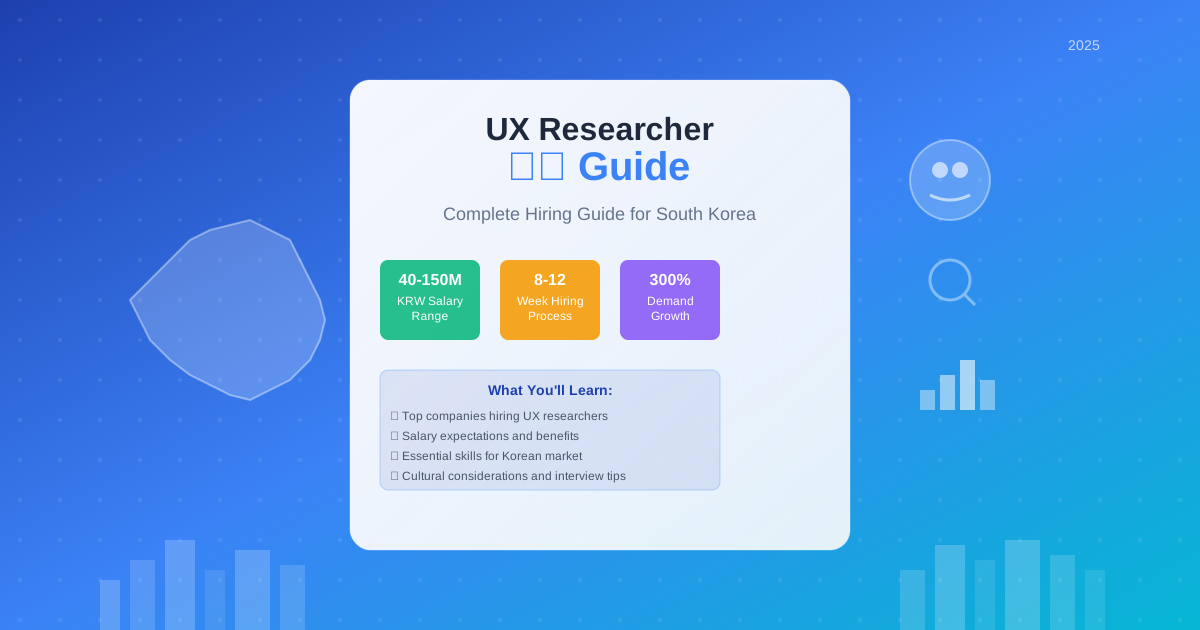
For a future UX researcher, that distinction is important. Research roles in Korea increasingly expect competence across interviews, usability testing, surveys, quantitative analysis and stakeholder communication. Our separate guide to UX Researcher 채용 in South Korea looks at what employers are currently asking for.
Interdisciplinary Programmes
Some of the most interesting Korean UX education happens between departments. Seoul National University’s convergence programmes and Yonsei University’s graduate ecosystem are useful places to investigate if your interests sit between design, technology, business and behavioural research.
This route can be especially valuable for people aiming at Product Designer or research-heavy product roles, where employers increasingly care less about whether your degree says “design” and more about whether you can frame problems, gather evidence and work with product and engineering teams.
What To Look For
Programme names are poor proxies for programme quality. Before applying, inspect the actual faculty, labs and recent student work. A strong UX route should expose you to several of the following: user research, interaction design, prototyping, usability evaluation, behavioural methods, accessibility, data analysis, service design and increasingly human-AI interaction.
Also check the programme structure. Some Korean graduate schools are designed for full-time study, while specialised programmes may work better for professionals who want to study alongside employment. Admissions requirements, language expectations and thesis requirements change, so applicants should verify the latest details directly with each institution rather than relying on an old programme summary.
The Professional Learning Layer
Formal education is only one part of Korean UX. Much of the practical learning happens through product companies, conferences, pattern libraries and professional communities.
Toss has been particularly influential in making product-design practice visible. Its design talks and public writing show how Korean teams think about product design, research and UX 라이팅 (UX Writing). For students, this kind of material is valuable because it shows what professional practice looks like after the classroom.
Pattern libraries such as WWIT and Designus also make it easier to study Korean mobile conventions in context. They are useful references, but they should not become templates to copy. The learning value comes from asking why a pattern is common in a specific product category and what user expectation it serves.
For academic research, the Korean Society of Design Science and its Archives of Design Research remain useful for following design-research work coming out of Korea.
A Korean UX education is strongest when the classroom, the research lab and the product market are treated as one connected system.
Education And Salary
A degree can open doors, but it does not determine the salary band by itself. Korean design compensation changes sharply with role scope, seniority and employer type. A first-year UI/UX designer and a Product Designer at a large Seoul technology company can sit in completely different compensation markets.
For current figures, see our 2026 guide to UX designer salary in South Korea, which separates 신입 (entry-level), 경력 (experienced), UX/UI and Product Designer pay rather than presenting one misleading national average.
How To Choose Your Route
If you want to become a visual or interaction-heavy Product Designer, a design-led programme may give you the strongest craft foundation. If you want to become a UX Researcher, HCI and behavioural methods matter more. If your goal is product strategy, service design or human-AI interaction, an interdisciplinary route may be more useful.
The common thread is evidence. Korean employers increasingly expect designers to do more than make polished screens. They need people who can understand users, work with data and research, communicate across disciplines and explain why a design decision should exist.
That makes South Korea an interesting place to study UX in 2026. Its strongest programmes are not simply feeding a local design industry. They are sitting inside one of the world’s most demanding digital-product markets, where design education is constantly tested against products used at enormous scale.





wow thank you it was very helpful!
Hello Aiaru, glad you found our article helpful!
Hi! I’m Daniela from Colombia 🙂 I will apply for the GKS scholarship soon and I want to study a Master in UX Design. In fact, it was really hard to find information about masters in UX in South Corea because everything was in korean and I am still learning it. However, I’m gladly I found this incredible article that has helped me a lot in order to find the masters that I wanted.
PD : If I have my degree in another field of study different from Design or Engineering, can I still apply for the masters program that you’ve mentioned on the article?
Thank you so much!
Hello Daniela, apologies for the late reply! Yes, even if you have a degree in any other area as an undergrad, you can still go ahead for a design degree.