

Updated September 2026: UX 라이팅, the Korean term commonly used for UX Writing, sits in an interesting place inside South Korea’s product-design market. It is writing, but the work is not simply about producing better sentences. A UX Writer has to understand the product, the user’s task, the constraints of the interface and the behaviour a piece of copy is trying to support.
That is why the discipline increasingly overlaps with Product Design, content design, research and design systems. A button label, an error message or a financial explanation may contain only a few words, but each one affects comprehension, trust and whether a user completes the task.
For readers mapping the broader Korean design market, our guide to UI UX 차이 explains how UI, UX and Product Designer roles overlap, while our UX salary guide for South Korea shows how those role differences can affect compensation.
What Is UX 라이팅?
UX Writing is the practice of designing words inside a digital experience. It includes navigation labels, form instructions, onboarding, empty states, errors, confirmations, permissions, notifications and the language that explains complex product behaviour.
The useful distinction from marketing copy is intent. Marketing copy is often trying to persuade someone to enter a product. UX Writing is usually trying to help someone understand what is happening once they are already inside it.
Good UX Writing is not the art of making an interface sound nicer. It is the work of making the next decision easier to understand.
Why It Matters In Korea
Korean digital products often operate in categories where language carries unusually high stakes: banking, payments, commerce, mobility, identity verification and government services. A visually clean interface can still fail if the language around a fee, permission or error leaves the user uncertain about what will happen next.
Korean also creates its own localisation and tone challenges. Formality, sentence endings, spacing, borrowed English terms and the choice between technical and everyday vocabulary can change how trustworthy or approachable a product feels. That means translating English microcopy word for word is rarely enough.
Toss Made Writing A System
Toss is one of the clearest Korean examples of UX Writing becoming a product discipline. In its public writing about the role, Toss describes UX Writers as working closely with Product Designers, simplifying difficult financial language, maintaining voice and tone, testing copy variants and building writing principles that can scale across the product.
A Toss UX Writer job description has also framed the work as part of the Design chapter, collaborating with Product Designers and a Design Platform team while using A/B testing to identify effective language patterns. That is a more useful model than treating writers as a service desk that receives finished screens and fills in the blanks.
The deeper lesson is that writing becomes more valuable when it is systematised. A team that defines principles, patterns and reusable language decisions can improve hundreds of screens without debating every sentence from scratch.
Where Writing Meets UI And UX
UX Writing is one of the best examples of why UI and UX cannot be separated cleanly. The words are physically part of the interface, so typography, hierarchy and available space matter. But the writer is also shaping the broader experience: what a user understands, what they expect to happen and whether they trust the product enough to continue.
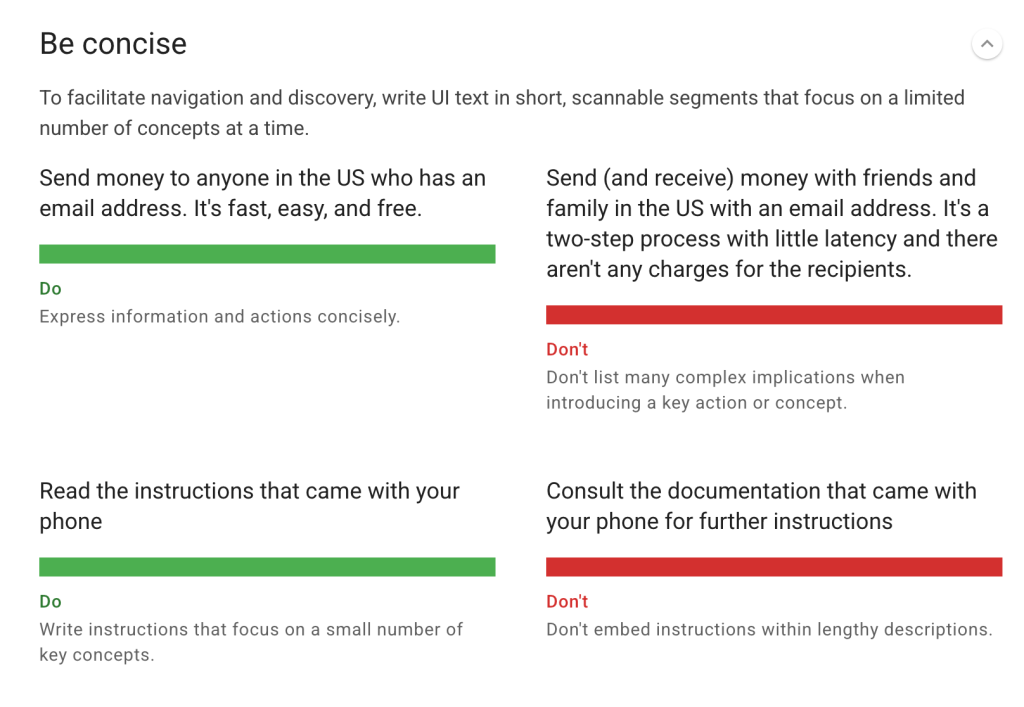
This is also why strong UX Writers need to understand design systems. A writing pattern for errors, confirmations or empty states can become part of a component system just as surely as spacing or colour tokens can.
The Core Skills
The strongest UX Writers combine language craft with product judgement. Five skills matter especially:
- Clarity: reducing ambiguity without removing necessary information.
- Product understanding: knowing what the system is actually doing before trying to explain it.
- Research: testing whether users interpret language as intended instead of relying on internal preference.
- Systems thinking: creating reusable patterns, terminology and voice rules across a product.
- Collaboration: working with Product Designers, researchers, engineers, legal teams and marketers without turning every wording decision into a turf war.
Research literacy matters more than many writers expect. If a team disagrees over whether one phrase is clearer than another, the strongest answer may be a usability test or behavioural experiment rather than another round of opinions. Our guide to UX Researcher 채용 in Korea explains how research capability is becoming more integrated with product work.
AI Changes The Mechanics
Generative AI can now produce dozens of interface-copy variants in seconds. That makes first-draft generation cheaper, but it does not make the UX Writing problem disappear. The difficult work was never typing three alternative button labels. It was understanding the user’s uncertainty, the product state, the legal or operational constraint and the consequences of choosing the wrong wording.
AI is useful for variation, consistency checks, terminology audits, translation support and exploring tone. Human judgement remains essential for deciding whether the output is accurate, culturally appropriate and safe to ship.
AI makes interface copy easier to generate. It makes product judgement more important, not less.
Korean Localisation Is Product Design
For global teams entering Korea, localisation should happen before the final translation pass. Korean text can change layout density, button width, reading rhythm and the perceived formality of an interaction. A term that is technically correct may still feel bureaucratic, overly casual or unfamiliar to users.
The UX Writer therefore becomes part translator, part interaction designer and part policy interpreter. The job is to preserve meaning while making the product feel as though it was designed for Korean users rather than converted for them afterward.
How To Build A Portfolio
A strong UX Writing portfolio should show decisions, not a gallery of polished sentences. Take one flow and explain the user problem, the original language, the alternatives you considered, the constraints, how you validated the change and what happened afterward.
If you are moving into UX Writing from journalism, marketing or copywriting, demonstrate that you can work inside a system rather than only create standalone copy. If you come from product design, show how language changed a flow, reduced confusion or improved task completion.
For formal study routes into the wider discipline, see our updated guide to UX design education in South Korea. UX Writing itself may not require a specific degree, but HCI, research and product-design foundations are increasingly useful.
Is UX Writing A Career?
Yes, but candidates should search broadly. Korean companies may use titles such as UX Writer, Content Designer, 콘텐츠 디자이너, content strategist or roles where writing sits inside Product Design. Dedicated positions are less numerous than general Product Designer openings, so the underlying capability can be more common than the exact title suggests.
That also makes salary comparisons difficult. A dedicated writer at a large fintech, a content designer inside a global company and a Product Designer who owns interface language may all sit in different compensation structures. For the broader design market, our 2026 Korean UX salary guide is the better benchmark.
The Role Is Bigger Than Words
The most useful way to understand UX 라이팅 in 2026 is as interface decision-making through language. The writer is not there simply to make the product friendlier. They are helping the user understand the system well enough to act with confidence.
That makes UX Writing particularly important in Korea’s dense digital-service landscape, where products routinely ask users to navigate payments, identity, permissions and complex service rules. The fewer words an interface has, the more responsibility each one can carry.