
Automation often looks effortless from the outside. Behind every impressive AI workflow lies a hidden layer of human judgment, context, and design work that rarely appears in product demos. This article explores the invisible labour that continues to shape intelligent systems—and why understanding it matters more than ever.
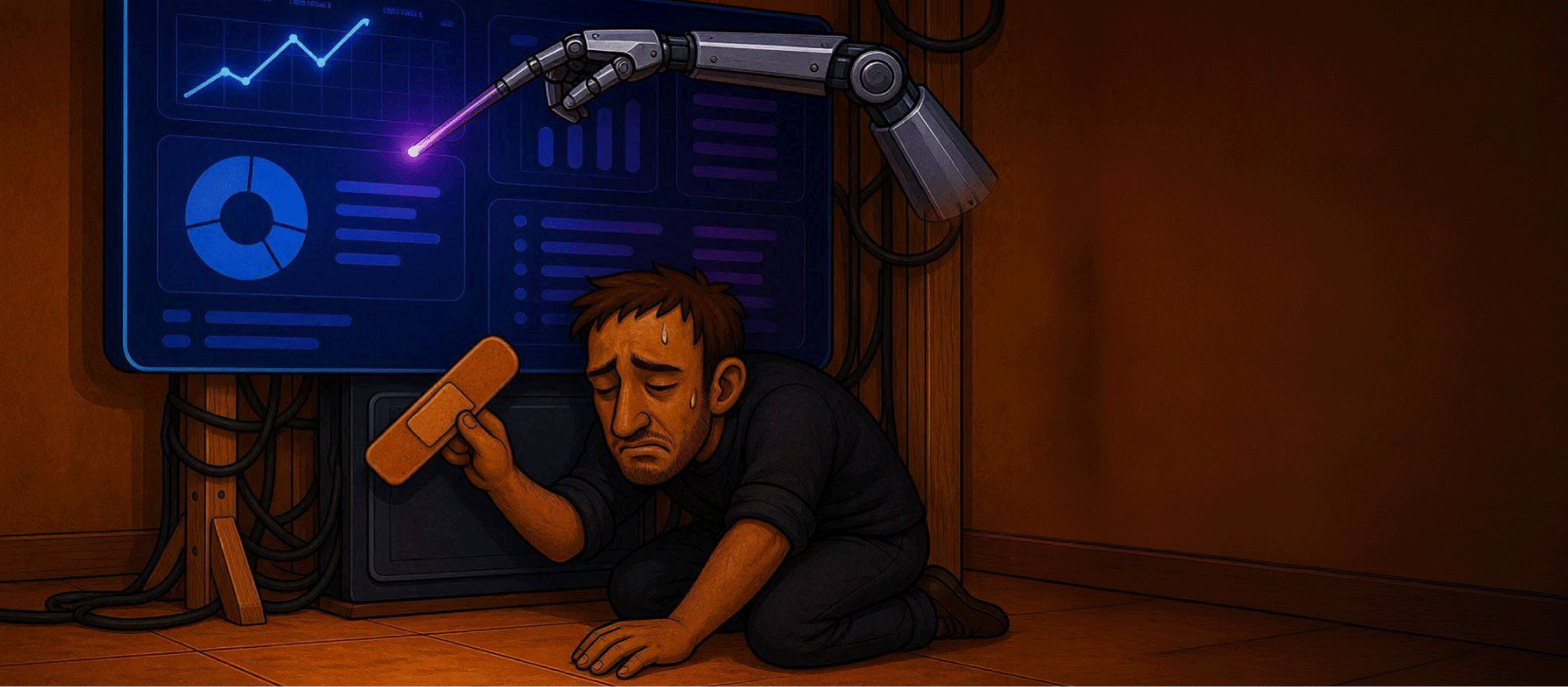
At first glance, the illustration on this issue’s cover seems almost self-explanatory. A robotic hand points confidently at an immaculate dashboard, suggesting precision, intelligence and effortless automation. Beneath it, however, crouches a weary designer with a bandage wrapped around one finger, still untangling cables beneath the interface. It is an image that rewards a second look because the person in the frame is not operating the machine. They are cleaning up after it.
That, more than any benchmark or product announcement, feels like an accurate portrait of artificial intelligence in 2026.
The past two years have been defined by extraordinary demonstrations. Language models write convincing essays, generate production-ready code, summarise research papers and reason through complex problems. Image generators create artwork in seconds. Design tools produce polished interfaces from a few lines of text. Video models can now generate scenes that would once have required entire production teams.
It would be difficult to argue that these advances are anything other than remarkable. The mistake lies elsewhere. Somewhere between the conference keynote and the daily workflow, many organisations have begun to confuse a successful demonstration with a completed solution. The result is an expectation that automation should not merely accelerate work but remove it altogether.
That expectation has quietly become one of the defining misconceptions of the AI era.
The reality inside product teams is considerably less dramatic and, in many ways, more interesting. AI has not eliminated work nearly as often as it has redistributed it. Tasks that once consumed hours can now be completed in minutes, but the time saved rarely disappears. It simply reappears elsewhere in the process as verification, refinement, debugging, review and judgement. The work survives, although it changes shape.
This is not a failure of artificial intelligence. It is a misunderstanding of what automation has always been good at.
Every Demo Ends at the Same Moment
Technology demonstrations are carefully constructed performances. They are not dishonest, but they are selective.
A presenter opens an application, enters a thoughtfully prepared prompt and, moments later, produces an impressive result. The audience sees the transformation from idea to output and naturally concludes that they have witnessed the entire workflow. In reality, they have seen only the part that is easiest to demonstrate.
The next few hours rarely make it onto the keynote stage.
Tasks that once consumed hours can now be completed in minutes, but the time saved simply reappears elsewhere in the process
Nobody demonstrates the awkward edge case that breaks the workflow. Nobody pauses to explain why the generated code passed the first test but failed under production traffic. Nobody spends fifteen minutes discussing accessibility fixes, stakeholder revisions or the uncomfortable meeting where legal asks for fundamental changes to the product.
These moments are not omitted because companies are trying to deceive anyone. They are omitted because they make for terrible demonstrations. Watching an engineer spend an afternoon reviewing AI-generated code or a designer adjust spacing across twenty screens is not compelling theatre. Yet those are precisely the activities that determine whether a product succeeds.
Artificial intelligence excels at creating convincing beginnings. Products, however, are judged by how they behave long after the beginning has passed.
The Invisible Half of Knowledge Work
There is an old observation in engineering that systems often appear simpler to the people using them than to the people maintaining them. Every polished experience rests upon countless invisible decisions that users never see.
Software development has always depended on this hidden layer of labour. Designers debate hierarchy long before an interface appears on screen. Engineers anticipate failure before customers encounter it. Product managers spend weeks negotiating priorities so that a roadmap appears coherent to everyone else.
Artificial intelligence has not removed this invisible work. If anything, it has made it more visible by accelerating everything around it.
A designer using AI may receive a homepage concept in thirty seconds, yet still spend the afternoon refining typography, aligning components with an existing design system and ensuring that the interface behaves consistently across dozens of screens.
An engineer might ask an AI assistant to generate several hundred lines of code, only to invest the next few hours reviewing security implications, simplifying unnecessary abstractions and rewriting sections that technically function but remain difficult for colleagues to maintain.
In 2025, Klarna acknowledged that it had leaned too heavily on automation and began expanding its human support capacity again, with CEO Sebastian Siemiatkowski admitting that cost had become “too predominant” a consideration
A researcher may summarise fifty documents in minutes while spending considerably longer verifying that the summary has not overlooked the one paragraph capable of changing the entire conclusion.
The pattern repeats across professions. Generation becomes cheaper. Judgement becomes more valuable.
It is tempting to describe this as a limitation of AI, but that would miss the larger point. Most professional work has never been difficult because of the first draft. It has been difficult because reality rarely resembles the first draft.
A recent example illustrates the point. In 2025, Klarna became one of the most cited success stories in AI-powered customer support after announcing that its AI assistant was handling millions of customer conversations, doing work equivalent to hundreds of agents while dramatically reducing response times. A year later, however, the company acknowledged that it had leaned too heavily on automation and began expanding its human support capacity again, with CEO Sebastian Siemiatkowski admitting that cost had become “too predominant” a consideration. The lesson was not that AI had failed. It was that routine interactions had become easier while the remaining conversations demanded more judgement, empathy and context than automation alone could provide.
The Paradox Was Identified Long Before AI
One of the more surprising aspects of today’s conversation is how familiar it sounds to people who study automation.
In 1983, the cognitive psychologist Lisanne Bainbridge published a paper that has since become something of a classic within human factors research. She argued that highly automated systems often leave humans responsible for exactly the situations automation struggles with most. As machines assume routine tasks, people become supervisors of increasingly rare, unpredictable and complex problems.
The implication was subtle but profound. Automation does not necessarily eliminate human responsibility. In some cases, it concentrates that responsibility into fewer but more consequential moments.
More than four decades later, the observation feels unexpectedly contemporary.
Modern AI writes the routine email. Humans still decide whether it should have been sent.
Highly automated systems often leave humans responsible for exactly the situations automation struggles with most
Lisanne Bainbridge, 1983
AI generates a dashboard. Designers determine whether anyone can actually use it.
AI drafts a legal document. Lawyers remain accountable for every clause.
The technology has changed dramatically. The underlying relationship between people and automation has not.
Perhaps this is why so many professionals feel simultaneously optimistic and exhausted. The repetitive work is shrinking, but the cognitive burden of oversight continues to grow. As automation becomes more capable, the remaining human decisions become increasingly significant because there are fewer opportunities to correct mistakes before they reach the real world.
Product Design & AI Automation
If there is one profession that seems uniquely positioned to expose the limits of AI automation, it is product design.
Not because designers are resistant to new technology. On the contrary, few disciplines have embraced AI as enthusiastically. Designers use language models to brainstorm, image generators to explore visual directions, AI-powered prototyping tools to accelerate ideation and coding assistants to bridge the gap between design and implementation. In many studios, AI has become as commonplace as Figma or Notion.
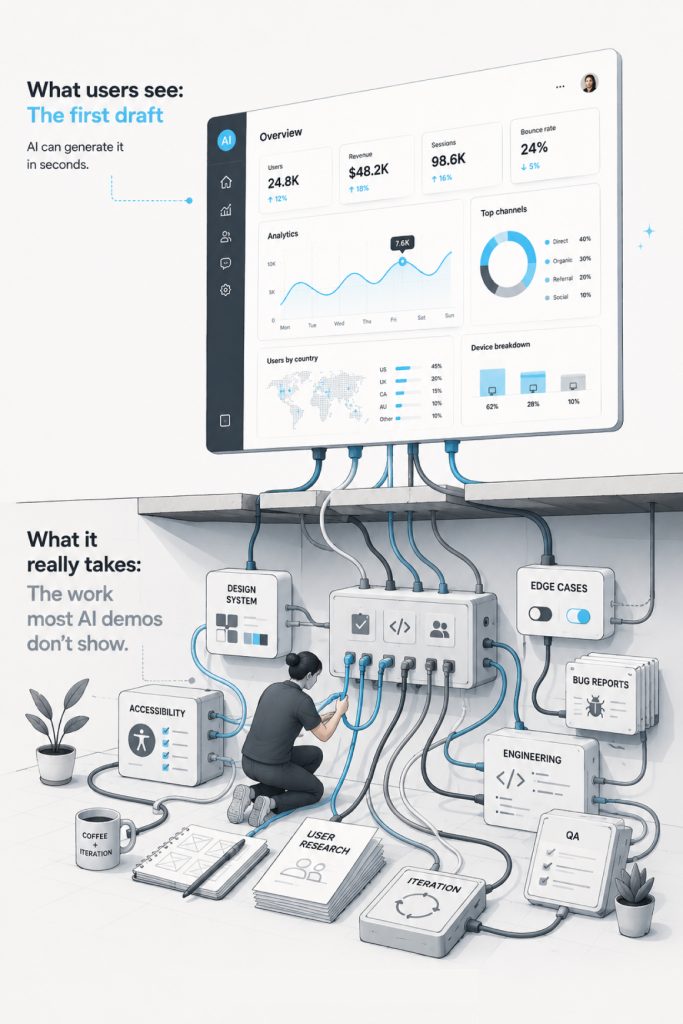
Yet the same designers who celebrate these tools are often the first to point out where they fall short. The observation is remarkably consistent. Creating a screen is no longer the difficult part. Creating a product still is.
That distinction matters because products are systems, not collections of interfaces. Every new feature inherits assumptions from dozens of earlier decisions. Typography reflects a brand’s personality. Components establish expectations that users gradually learn to trust. Navigation patterns become habits. Accessibility standards influence everything from colour contrast to keyboard navigation. A seemingly minor change to one part of the experience can ripple across dozens of screens in ways that no prompt can fully anticipate.
The first generation of AI design tools demonstrated that interfaces could be generated from natural language. The next generation will almost certainly be judged by a different standard. Can they preserve consistency? Can they understand the relationships between components? Can they help teams evolve products instead of simply creating new screens?
These questions receive less attention than spectacular demonstrations because they are less visually exciting. They are also the questions that determine whether AI becomes an everyday tool or remains an occasional source of inspiration.
The New Bottleneck
One of the more revealing conversations taking place inside technology companies concerns the changing definition of productivity.
For years, productivity meant producing more output. More wireframes. More code. More documentation. More prototypes.
Artificial intelligence has made abundance almost trivial. A designer can now explore ten homepage concepts instead of two. An engineer can prototype several implementations before lunch. A product manager can transform meeting notes into detailed specifications within minutes.
Product teams are discovering that they have not escaped decision making. They have simply accelerated the arrival of decisions
Ironically, abundance creates a different problem.
Every additional option still requires evaluation. Every generated screen still requires judgement. Every proposed architecture still needs someone to ask whether it is solving the right problem in the first place.
Product teams are discovering that they have not escaped decision making. They have simply accelerated the arrival of decisions.
This subtle shift explains why many experienced practitioners no longer describe AI as replacing expertise. Instead, they describe it as amplifying it. Good designers appear faster because they recognise which suggestions deserve to survive. Experienced engineers reject problematic code more quickly because they understand the trade-offs the model cannot see. Skilled researchers identify misleading conclusions because they already possess the contextual knowledge required to challenge them.
The technology rewards discernment more than obedience.
That may prove to be one of the defining characteristics of professional work in the years ahead. The competitive advantage will belong less to those who can generate content and more to those who can recognise quality.
Automation Works Best When It Knows Its Limits
History offers an interesting lesson here.
The most successful forms of automation rarely announce themselves as revolutions. They quietly disappear into everyday life.
Spellcheck did not replace writers. It removed unnecessary friction.
GPS did not eliminate the need for drivers. It reduced the cognitive effort required to navigate unfamiliar roads.
Version control did not automate software development. It made collaboration dramatically more reliable.
The common thread is not autonomy. It is assistance.
These technologies succeed because they automate predictable tasks while leaving consequential decisions to the people best equipped to make them.
For instance, tools like Moonchild focus on your design system; already having the pieces, it assembles them into consistent and polished designs automatically
Artificial intelligence appears to be following the same trajectory. The tools that are gaining lasting traction inside organisations are often those that fit naturally into existing workflows rather than attempting to replace them entirely. They reduce repetitive effort, preserve context and help teams maintain momentum without demanding that every established process be reinvented.
This philosophy is beginning to influence the way newer design tools are being built.
Rather than treating every project as a blank canvas, some platforms are placing greater emphasis on existing design systems, reusable components and product context. For instance, tools like Moonchild focus on your design system; already having the pieces, it assembles them into consistent and polished designs automatically. The objective is not simply to generate another interface but to generate one that belongs within a product that already exists. That may sound like an incremental improvement, yet it reflects a profound change in priorities. The goal is shifting from creativity in isolation to consistency at scale.
It is a quieter vision of AI, but perhaps a more realistic one.
Beyond the Illusion
The title of this essay may sound pessimistic, but it is intended to suggest the opposite.
Automation is not an illusion.
The illusion is that meaningful work disappears simply because parts of it become easier.
Every significant technological shift has reduced one form of labour while increasing another. The Industrial Revolution reduced physical effort while increasing the need for coordination and logistics. Personal computers eliminated countless manual calculations while creating entirely new professions. The internet made information abundant while making attention increasingly scarce.
Artificial intelligence belongs to that same lineage.
It removes friction from tasks that were previously expensive. It accelerates experimentation. It lowers the cost of exploration. It gives individuals capabilities that once required entire teams.
None of those achievements should be understated.
That is why the designer beneath the dashboard on this issue’s cover is not a symbol of failure. Quite the opposite. The designer below represents everything that still gives products their integrity
What deserves equal attention, however, is the work that remains. Judgement. Taste. Context. Responsibility. Trust. These are not relics waiting to be automated away. They become more valuable precisely because machines can now perform everything surrounding them with astonishing speed.
That is why the designer beneath the dashboard on this issue’s cover is not a symbol of failure. Quite the opposite.
The robot above represents what technology has become exceptionally good at. It can assemble information, generate interfaces and impress us with breathtaking efficiency.
The designer below represents everything that still gives products their integrity. They ask whether the interface reflects the needs of real people. They notice the inconsistency no benchmark would measure. They fix the invisible problems that never appear in promotional videos but quietly determine whether software earns trust over months and years.
Those moments rarely become conference demonstrations. They are difficult to compress into a keynote presentation or a thirty-second product video. They are slow, iterative and occasionally frustrating.
They are also where great products are made.
Perhaps that is the real lesson of the AI era. The future will not belong to organisations that automate everything. It will belong to those that understand what should never have been automated in the first place.