
There is a word Amber Case refuses to use. It appears constantly in the vocabulary of technology design right now, on conference slides and in product briefs and in the manifestos of well-meaning startups. The word is “invisible.” As in: the best technology is the technology you cannot see.
Case, who has spent the better part of two decades studying the relationship between humans and machines as a cyborg anthropologist, finds the premise not just wrong but actively dangerous. Her TED talk “We Are All Cyborgs Now” has been watched over a million times. Her book Calm Technology – a framework for building interfaces that inform peripherally without competing for focal attention – formalized a framework for designing interfaces that respect human attention rather than compete for it.
In 2024, she founded the Calm Tech Institute, which certifies products that meet her principles of low-distraction design. She has consulted for Jaguar, Microsoft, and Virgin. She has been a fellow at both MIT’s Center for Civic Media and Harvard’s Berkman Klein Center. She has spent years building the vocabulary and the institutional infrastructure to argue that most of what the technology industry calls progress is in fact a retreat.
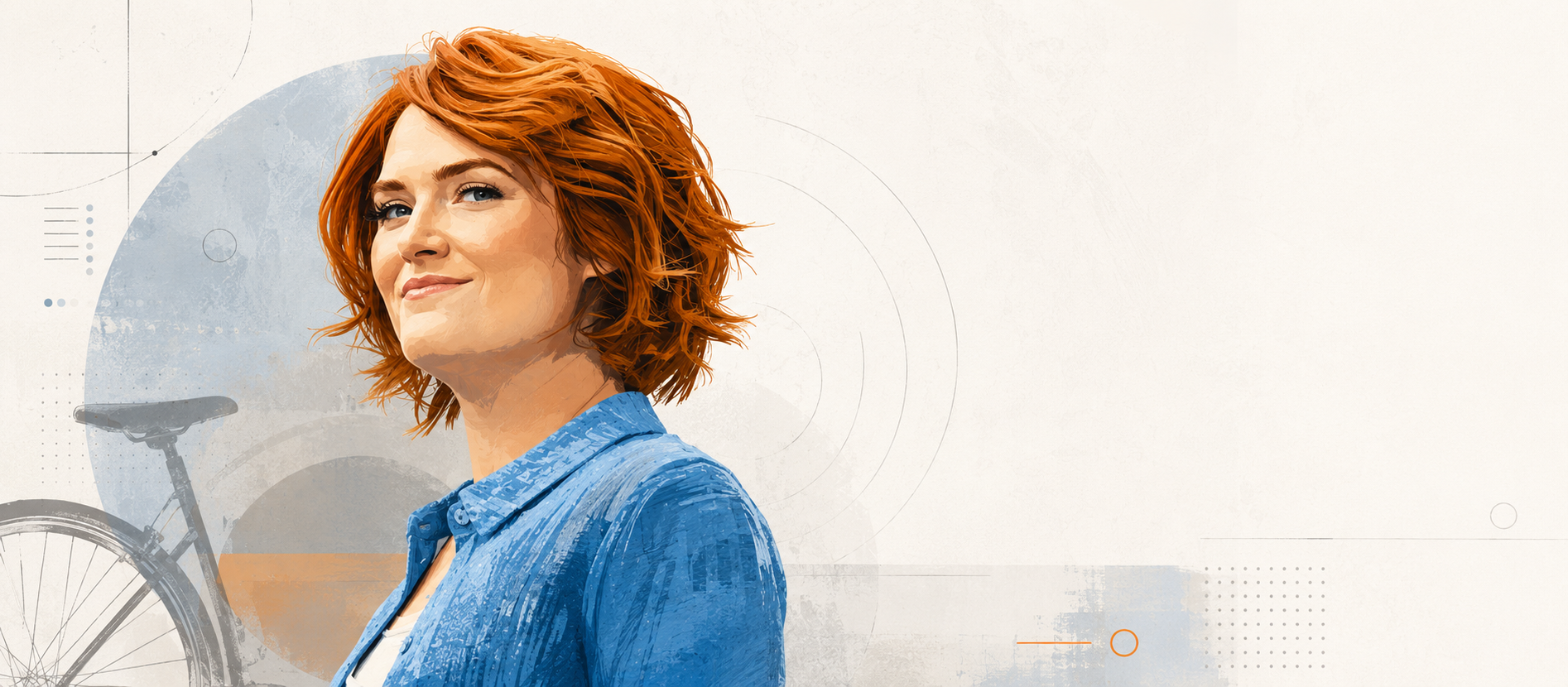
And she has a bicycle story that explains almost all of it.
What Dissolves Is Not the Same as What Disappears
When DesignWhine asked Case about the AI and interface design developments that excite or concern her most, she did not reach for a product name or a market trend. She reached for a metaphor that has been central to her thinking for years and that has grown more urgent as AI agents, voice assistants, and ambient computing have accelerated the trajectory she has been watching.
“When you ride a bicycle, you don’t think about the bicycle,” she says. “But that’s not because it’s invisible or automated. It’s because it responds so immediately to your body that it becomes an extension of your experience of the world. You feel the road through the handlebars. You adjust your balance based on continuous physical feedback. The bike dissolves into the activity of riding because the interface is so direct, so responsive, and so legible that there’s no cognitive gap between intention and action.”
The distinction she is drawing is precise and consequential. A bicycle is not invisible. You can see it, touch it, feel when something is wrong with it. What dissolves through use is not the object itself but your need to consciously attend to it. The technology becomes part of the activity rather than an obstacle between you and the activity. That, Case argues, is the design target that the industry has fundamentally misread.
“A bicycle is not invisible. What dissolves through use is not the object itself but your need to consciously attend to it.”
What we are building instead, she says, is the opposite. She describes the structure of a typical voice assistant interaction with pointed clarity: you have to stop what you are doing to invoke the system, wait for acknowledgment, speak your request in the correct syntax, hope it understood, and then wait for a response. “At no point do you feel in control,” she says. “At no point does the technology dissolve. Instead, it constantly reminds you that you’re interacting with a system, that you’re dependent on it understanding you, that you’re hoping it will do what you want.”
The bicycle, by contrast, gives you continuous feedback through multiple channels simultaneously. You feel the resistance in the pedals. You hear the tires on the road. You sense the angle of your own body without having to check anything. None of this information demands focal attention. It flows through your existing senses, peripherally, while your mind stays on where you are going. That is the standard Case holds technology to, and by that standard, almost everything being celebrated in the current AI moment fails.
The Texture Famine
For Case, the trajectory that concerns her most has a specific inflection point: the iPhone.
This is a complicated position for someone who wrote her undergraduate senior thesis at Lewis and Clark College analyzing the social consequences of the device the year it was released. She has not turned against the phone so much as she has named precisely what it traded away. “The iPhone was the inflection point,” she says. “It was sold as ‘intuitive,’ but what it actually created was a texture famine. Muscle memory has nowhere to anchor because the surface is completely smooth. You have to look at the screen to do anything, which means you can’t do two things at once, can’t operate it while paying attention to the world around you.”
The contrast she draws is with the physical controls in older cars. “You could reach down and adjust the radio volume without looking because the knob was always in the same place, had a specific texture, turned in a predictable way. With tactile differentiation between buttons, your visual channel was opened up to focus on the road. You could drive a car, talk to a friend, and change the radio station, all at the same time.”
“The iPhone was the inflection point. It was sold as ‘intuitive,’ but what it actually created was a texture famine.”
What replaced that physical literacy is something Case calls perpetual visual scanning. Every interaction with a touchscreen requires your eyes. Your fingertips, which have an extremely high-resolution perceptual range, can no longer feel what anything does. The result is that the technology cannot dissolve, no matter how well designed the screen itself might be, because the act of using it always competes with whatever else you are trying to do.
This is the context in which she reads the AI moment. Each new feature is not just adding capability; it is adding what she calls “an interaction tax.” Every assistant that wants to be consulted, every notification that wants to be acknowledged, every automated workflow that wants to show you its work is inserting itself as an intermediary between you and the task at hand. “We’re building systems that want to be consulted,” she says, “that insert themselves as intermediaries, that create a new interaction tax.”
A Glowing Light on a Wing Mirror
Asked to name an example of ambient intelligence that genuinely works without adding complexity, Case pushed back on the question before answering it. “Invisible is the wrong goal,” she said. “What makes technology disappear isn’t hiding it. It’s making it so responsive, so legible, so well-matched to human capability that you can stop attending to the interface and focus on what you’re trying to do.”
The example she offered was specific and unglamorous: the blind spot indicator in her car’s wing mirror. A small orange light, placed exactly where a driver’s eyes are already directed when considering a lane change, that activates when a vehicle enters the blind zone. No sound. No vibration. No alert asking for acknowledgment. Just a subtle glow at the edge of perception, in the right location, at the right moment.
“This light is taking something formerly invisible, my blind spot, and making it visible,” she says. “And in this case, it’s more information, not less, that makes an interaction calming. It’s not an AI that shouts at you that the ‘path is clear’ or even a loud beep. It’s just a subtle glowing light that’s right at the edge of our perception.”
“More information can result in less decision-making while remaining legible and controllable. Smarter humans, not smarter machines.”
What makes it work, she explains, is a combination of things that most technology actively avoids: it requires no setup, no maintenance, no active consultation. It always appears in the same place. It is hardware, built into the physical experience of the vehicle. You are still going to look, of course. The system does not make decisions for you. But it adds information to your environment without asking anything in return.
She contrasts this with a kitchen timer on a smartphone. You have to unlock the device, find the app, fight the touchscreen, start the timer, and then have no ambient awareness of it until it goes off, by which point you may have been pulled into a notification from somewhere else entirely. The mechanical wind-up timer on a kitchen counter, meanwhile, ticks audibly, can be glanced at from across the room, and rings with a sound that lets you finish your sentence before responding. “The technology dissolves because every part of the interaction is legible,” she says. “You’re able to be in the task at hand and reminded of it when you need to pay attention.”
The principle she is articulating is not about simplicity for its own sake. It is about systems that make you smarter rather than systems that replace your thinking. “More information can result in less decision-making while remaining legible and controllable,” she says. “Smarter humans, not smarter machines.”
The Attention Economy Has No Off Switch
When the conversation turned to how designers and product teams should rethink attention, interruption, and cognitive load in an era of AI wanting to be everywhere, Case identified what she sees as the structural contradiction at the heart of the current moment.
“Current AI development optimizes for engagement, utilization, and stickiness,” she says. “These metrics directly oppose the goal of technology that dissolves through use. If your success metrics are measuring how much time people spend looking at your interface, you’re not building something that gets out of the way. You’re building something that demands perpetual attention.”
She laid out a set of alternative design principles, each built around a bicycle-like standard of feedback and legibility.
The first is to stop measuring time-in-product. “A good map gets you to your destination, and then you put it away,” she says. “You’re not scrolling through the map app admiring its features. A good timer counts down silently and alerts you when time’s up. You’re not checking it constantly to see if it’s working. These tools dissolve because they do their job and then get out of the way.”
“A good map gets you to your destination, and then you put it away.”
The second is to expose state continuously rather than on demand. She describes what this means in physical terms: when you are riding uphill on a bicycle, you do not need to check a screen to know you are working harder. You feel it in your legs, in your breathing, in the resistance of the pedals. “Good technology works the same way,” she says. “When you set a pot of water on the stove, you can hear it starting to simmer. You can see the steam. You can feel the heat if you get close. All of this information flows peripherally. You can be doing something else and still know when the water’s about to boil.”
The third is to use peripheral senses rather than alerts that demand acknowledgment. There is a meaningful difference, she says, between a sound you can hear from another room and a notification that requires you to stop what you are doing and tap a button. “When I’m working and I hear my tea kettle starting to whistle, I can finish typing my sentence and then get up,” she says. The sound gives you the information. It does not demand that you act on it immediately.
And the fourth is to respect muscle memory and kinesthetic knowledge. Professional pilots, musicians, and DJs all work with physical interfaces that have tactile differentiation, because physical controls let you reach for something without looking because it is always in the same place, moves in a predictable way, and confirms through your fingertips that you have engaged it. “A bike doesn’t have modes,” she says. “Unless something is wrong, the brakes always brake. The pedals always pedal. The relationship between your action and the result is constant and predictable. This predictability is what lets the interface dissolve.”
Technology That Fails Visibly
Looking ahead at how calm technology might evolve alongside increasingly capable AI and ubiquitous computing, Case is direct about her expectations. She does not see the two forces converging. She sees them in tension, and she believes that tension is necessary.
“I don’t see Calm Technology evolving alongside AI and ubiquitous computing,” she says. “I see it as a necessary counterweight.”
Her central concern is what she calls ambient anxiety: the low-grade, persistent uncertainty that accumulates when you cannot see or feel what a system is doing. “When we can’t feel what a system is doing, when we can’t directly manipulate it, the relationship between cause and effect becomes opaque,” she says. “We develop ambient anxiety. We’re never quite sure if things are working correctly. We can’t trust our own ability to intervene if something goes wrong. The technology doesn’t dissolve because we’re constantly having to check on it, wonder about it, troubleshoot it.”
“I don’t see Calm Technology evolving alongside AI and ubiquitous computing. I see it as a necessary counterweight.”
She is currently writing a book about this specific friction, examining how the removal of physical texture from modern interfaces creates psychological fragility. When everything is mediated through screens and cloud services, you lose not just tactile feedback but the capacity to maintain, repair, and understand your own tools. “The moment we get accustomed to them, they disappear,” she says of the subscription services and cloud-dependent systems that increasingly structure daily life. “We don’t know where our information is going and what it’s getting used for, and you don’t own any of the tools.”
The products she certifies through the Calm Tech Institute are evaluated precisely against these concerns: the Time Timer, the Aura Frame, the reMarkable tablet. She looks for physical controls that work without connectivity, failure states that are as legible as success states, and local operation that does not depend on a server that might go down or a subscription that might lapse. “Smart devices fail silently,” she says. “They look identical whether they’re working or broken. When failure is opaque, the technology can never dissolve.”
Why Amber Case Rejects “Humane” Tech
When DesignWhine asked for the single piece of guidance she would give designers and product teams trying to build technology that feels more intuitive, humane, and backgrounded, Case did something characteristic: she objected to the question’s vocabulary before answering it.
“Using the term humane annoys me,” she said. “It reminds me of how we analyze the treatment of chickens who are penned in and being raised for meat. We should not be chickens on a chicken farm having ourselves penned in by our own consciousnesses.”
The word she prefers is “pass-through.” Technology that does not insert itself between you and your goal. Technology that is completely legible because you can see what it does, feel what state it is in, and directly manipulate it. Technology where the interface is so well matched to human capability that your attention flows to what you are trying to accomplish rather than being captured by the mechanics of the interface.
“Using the term humane annoys me. It reminds me of how we analyze the treatment of chickens who are penned in and being raised for meat.”
Her practical advice to designers is to begin with a physical object as the design reference. Not a metaphor for a physical object, but an actual mechanical device. “What would the controls feel like? How would you know it was working? What would break and how would you fix it?” This question, she argues, forces designers to think about tangibility in a way that screen-based thinking does not. It forces them to consider affordances: handles that suggest pulling, buttons that suggest pressing, knobs whose form suggests turning. Physical form that tells you its function before you touch it.
She mentions her hobby of building miniatures and dioramas in this context, not as a charming aside but as genuine research. “Working at small scale forces you to think about how things feel,” she says, “about tactile feedback, about the importance of texture and physical response.”
The bicycle returns, as it always does in Case’s thinking, as the final standard. You are in charge. You are getting continuous feedback. You are focused on where you are going, not on the mechanics of how you are getting there. “That’s what calm technology really means,” she says. “It’s not about being ambient, automatic or invisible, but pass-through.”
In an industry currently celebrating systems that do more for you, hide more from you, and ask you to trust more of what you cannot see, that is a genuinely radical position. Case has been holding it, with consistency and increasing urgency, for the better part of twenty years. She does not appear to be changing her mind.
Calm Technology & AI: Frequently Asked Questions
As AI becomes part of modern product design workflows, these are some of the most common questions teams ask about calm technology, invisible interfaces, texture famine, and cognitive load in AI-driven interfaces.
What is calm technology, and how does it apply to AI?
Calm Technology is a design framework originally formalized by Amber Case that prioritizes human attention by creating interfaces that inform through peripheral senses rather than demanding constant focal attention. In the context of AI, Calm Technology advocates for “pass-through” systems—tools that operate predictably in the background and expose their state continuously, rather than intrusive AI agents that require constant visual prompts, confirmation steps, and active management.
Why is making technology “invisible” a flawed design goal?
While the tech industry often preaches that “the best technology is invisible,” Amber Case argues that hiding how a system works creates “ambient anxiety”—a state of persistent uncertainty where users cannot tell if a system is working, failing, or manipulating data. Instead of invisible technology, effective systems should dissolve through use (like a bicycle), where the interface remains legible and controllable, but disappears from conscious thought because it responds instantly to human intent.
What is “texture famine” in modern UI design?
Coined by Amber Case, “texture famine” refers to the loss of tactile feedback caused by the transition from physical controls (knobs, switches, textured buttons) to smooth glass touchscreens. Because touchscreens lack physical anchors, users are forced into “perpetual visual scanning”—looking at the screen for every single interaction—which prevents multi-tasking and constantly drains cognitive bandwidth.