
For years, companies chose workplace software by asking familiar questions: Is it easy for employees to use? Does it integrate with the tools we already have? Will people actually adopt it?
Meta has just added another question to the list: how well can AI agents work inside it?
According to Business Insider, Meta is moving its internal communications from Google Chat to Slack. In a memo to employees, Meta AI chief Alexandr Wang reportedly pointed to Slack’s conversational interface, mature developer tooling and third-party integrations as reasons it is better suited to building and working with AI agents.
On the surface, this is an enterprise-software switch. Underneath it is a more interesting product story. One of the world’s biggest AI companies is apparently choosing a workplace interface not only for the humans using it, but for the software actors expected to join them.
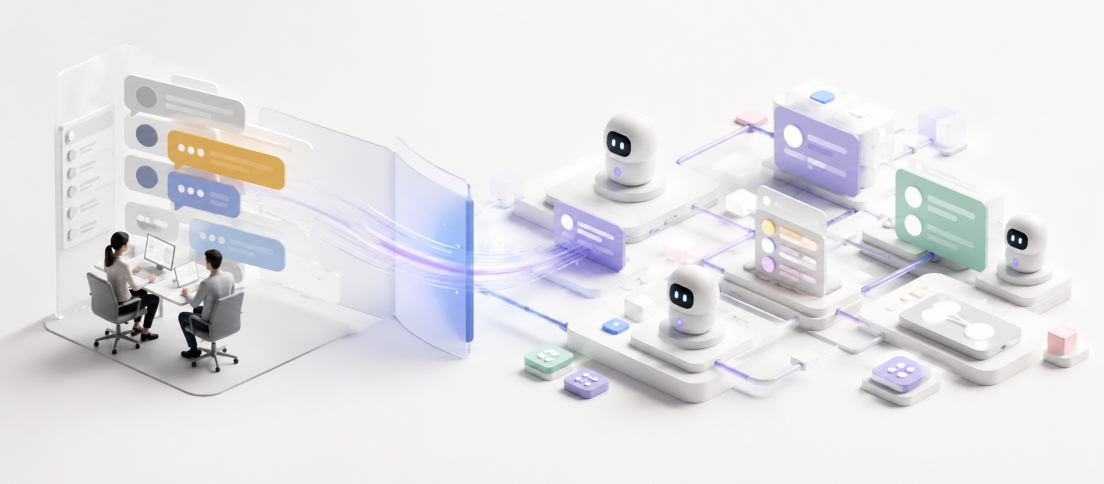
The next enterprise UX may need to work equally well for two kinds of users: people and agents.
Slack Has Been Preparing for This
The decision does not come out of nowhere. Salesforce has spent the past year positioning Slack as an operating layer for agentic work. It calls Slack an “agentic OS”, where people, apps, company data and AI agents can share the same conversational surface. More recently, Salesforce introduced Slack Code, bringing agents such as Claude Code, Devin, GitHub Copilot and ChatGPT into shared code channels where teams can watch plans, diffs and live output together.
Jack Dorsey’s Block has been chasing a similar idea with Buzz, a workplace chat product built specifically around teams of humans and agents. The direction is becoming difficult to dismiss as a feature trend.
We have already been watching this shift from the design side. Our guide to making design systems AI-ready is ultimately about the same problem: information once organised for human collaborators now also has to be legible to machines.
The Interface Is Becoming Infrastructure
This is where Meta’s choice gets more consequential. Chat software used to be the place where employees talked about work happening elsewhere. In an agent-heavy organisation, the chat layer can become where the work itself is requested, delegated, inspected and approved.
Conversation is particularly useful to agents because it already contains the messy context that conventional enterprise software often hides across tabs, records and dashboards. A channel contains decisions, exceptions, files, informal knowledge and the people responsible for them. That makes chat unusually rich terrain for an agent trying to understand not only what task exists, but why it exists.
The flip side is that conversational software suddenly carries more responsibility. If an agent can act from a message, permissions, provenance and visibility become UX decisions rather than back-office plumbing. A human needs to know what the agent saw, what it inferred and what it changed.
When agents become colleagues, the conversation window stops being a messaging product and starts becoming an operating system.
That changes the design brief. A good workplace interface must expose enough context for an agent to understand what is happening, enough structure for it to take useful action, and enough visibility for humans to understand what the agent did. The UX problem shifts from navigation toward orchestration.
It also explains why the current obsession with “AI-native” teams is not merely about giving everyone a chatbot. As we argued in our AI-native UX team guide, the harder work is deciding what machines should own, what humans must review and how context travels across the workflow.
Software May Compete on Agent UX
For software companies, Meta’s move suggests a new competitive axis. Products have spent decades improving onboarding, usability and integrations for humans. They may now need equally thoughtful infrastructure for agents: APIs, MCP servers, permissions, persistent context, action logs and clear handoffs back to people.
That does not make human UX less important. It makes the system more complicated. We have previously described the messy reality of AI in UX: intelligence alone does not create a coherent workflow. The surrounding product still decides what the AI knows, what it can do and whether the human can trust the result.
As we argued in our AI-native UX team guide, the harder work is deciding what machines should own, what humans must review and how context travels across the workflow.
Meta switching chat platforms would once have been an IT story. In 2026, the reason for the switch makes it a design story too. The workplace interface is no longer being designed exclusively around the employee sitting in front of it.
The agents are getting seats at the table. Software vendors now have to design the table.







If AI agents become active participants in workplace software, should we start thinking about “agent UX” as seriously as employee UX?