

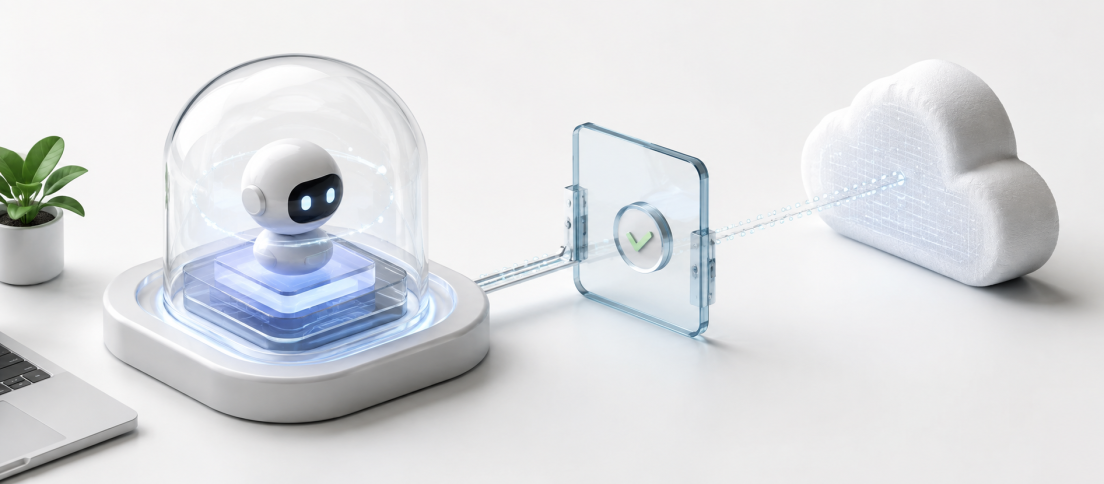
Most AI products ask users to trust the cloud first and think about data boundaries later. Perplexity is trying a different default.
Its new Portable Computer is an agentic AI system designed to run on hardware the user owns, keeping the model, files and much of the work on-device. When a task genuinely needs a stronger cloud model, the system can escalate that step, but only after the user authorises it.
That small interaction may be the most interesting part of the product.
Perplexity says Portable Computer can analyse local files, search documents and code, take actions on the device and run long-lived jobs while keeping private data local. It launches first on Nvidia’s DGX Spark and Linux systems with Nvidia GPUs, with broader RTX and Windows support planned. Work completed locally does not consume Perplexity credits.
VentureBeat describes it as one of the more aggressive attempts yet to move serious agent workloads off the cloud. Nvidia, meanwhile, is positioning DGX Spark as a desktop machine built for always-on autonomous agents.
The most consequential privacy feature may not be where the AI runs. It may be the moment the AI has to ask before your data leaves.
Local AI Changes the Default
Local processing is not new, but agentic AI raises the stakes. An assistant answering a question sees a prompt. An agent may read folders, inspect codebases, search files, connect to apps and keep working long after the initial instruction. The more capable the agent becomes, the more consequential its data boundary becomes too.
There is an economic shift here as well. Cloud AI made intelligence feel like a metered utility, with every serious task carrying a token or credit cost somewhere in the stack. Local models make some forms of persistent, high-volume agent work cheaper to leave running. That matters because an agent designed to monitor, organise or process private material continuously is much easier to justify when both the data and much of the compute can stay on the desk.
That is why local-first architecture feels particularly relevant now. We have already written about the shift from AI assistants to agentic systems. Autonomy makes convenience more powerful, but it also multiplies the number of decisions the software makes without the user directly supervising every step.
Permission Becomes Part of the UX
The more interesting design question arrives when Portable Computer cannot finish something locally. Perplexity says a user can permit the agent to escalate to cloud-based frontier reasoning while sensitive information remains on the device.
That creates a visible boundary between local and remote intelligence. Done well, the permission moment can help users understand where their information is going and why. Done badly, it becomes another consent dialog that people approve reflexively because the product has already made “yes” the easiest path forward.
A privacy boundary only works as a design feature if the user can understand the consequence of crossing it.
This is especially important because agent interfaces make data exposure difficult to visualise. Our coverage of AI-browser security risks has already shown what changes when software can act across websites and private context. The threat model is no longer limited to what the user deliberately types into a box.
Privacy Could Become a Product Advantage
For years, privacy controls have often been designed as compliance layers sitting around the product. Local-first agents offer the possibility of making privacy part of the product architecture and, crucially, something a user can perceive through the interaction.
That does not automatically make Portable Computer safe. Agents that can execute tools and access files still create risk even when they operate locally. Perplexity says code and tool execution run inside isolated sandboxes with controlled access, but any powerful agent still needs careful permissions, logs and recovery mechanisms.
The caution is familiar. When Gartner urged organisations to restrict AI browsers, we examined why autonomous software expands the security surface. Local execution reduces one category of exposure. It does not erase the need to design trustworthy agency.
Our coverage of AI-browser security risks has already shown what changes when software can act across websites and private context.
Still, the default matters. An AI agent that begins on your machine and asks before it reaches outward establishes a very different relationship from one that begins in the cloud and asks users to trust everything behind the curtain.
If powerful agents become ordinary workplace tools, “where did my data just go?” cannot remain a question users are expected to answer from a privacy policy. It needs to become part of the interface itself.





Would you trust an AI agent more if every move from local processing to the cloud required a visible permission step, or would those prompts eventually become another consent banner people ignore?