

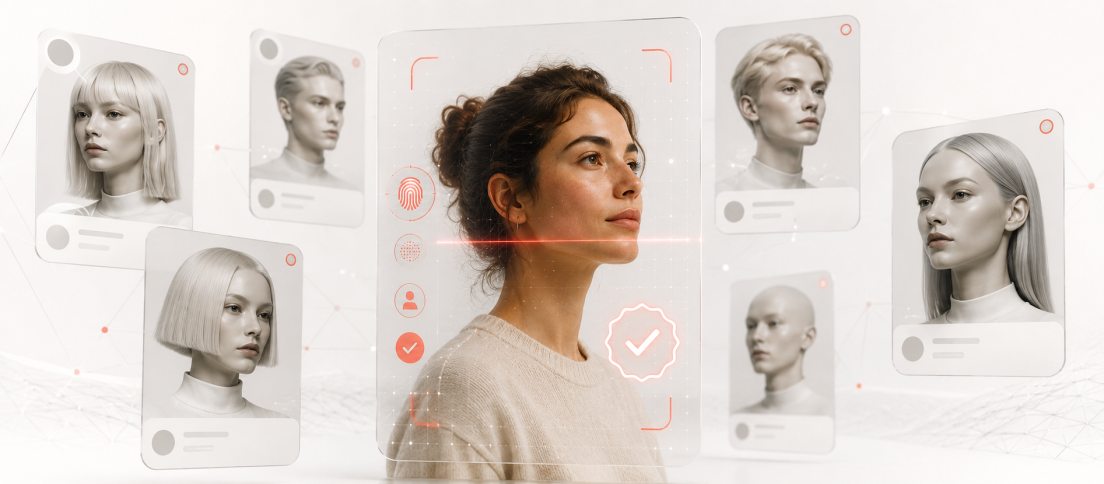
For most of the social internet’s history, a profile picture carried a quiet promise. There was a person on the other side.
The photograph might have been filtered. The bio might have been embellished. The vacation could have been staged for the camera. But underneath the performance sat something the interface never needed to explain: a human being existed.
That assumption is beginning to collapse.
On August 31, Instagram announced new restrictions on profiles built around AI-generated people. The platform is renaming its existing “AI creator” label to the more explicit “AI-generated profile,” and accounts featuring synthetic people that fail to disclose themselves can have their reach reduced in Reels and Explore. Instagram told TechCrunch that users do not like discovering that a profile which appeared human was synthetic after the fact. The Verge described the change more bluntly: Instagram is cracking down on AI accounts pretending to be human.
It sounds like a moderation tweak. It is much more interesting than that.
The Interface Had An Assumption
Social products are full of tiny design conventions that only work because we share an understanding of what they represent. A circular photograph means a person. A username means an identity. A follower count suggests other people have chosen to pay attention. A direct message implies someone decided to speak to you.
None of these conventions technically guarantees humanity. They never had to.
Designers could focus on making identity legible rather than proving identity was real. Verification badges emerged largely to answer a narrower question: is this the particular human they claim to be? What is arriving now is a more fundamental question: is there a human here at all?
For the first time, being human is becoming an interface state that may need to be communicated.
This is the uncomfortable inversion behind Instagram’s change. The platform is not merely labelling a new category of creator. It is repairing an assumption embedded in the architecture of social media itself.
Synthetic People Change The Contract
AI-generated people are not the same design problem as AI-generated images.
A synthetic landscape is content. A synthetic person can behave like an actor inside the system. It can accumulate followers, endorse products, publish opinions, send messages and build an apparently coherent history. The interface wraps it in exactly the same visual grammar used for everyone else.
That distinction matters because people respond differently to representations they believe have agency. We interpret a face as a source. We infer intent. We assign credibility. We develop parasocial relationships. We may even take advice from it.
DesignWhine has already explored what happens when AI can simulate the people we rely on for insight in Synthetic Users vs Real Users. The same tension is now moving into consumer interfaces. Plausibility is becoming cheap. The difficult part is knowing when plausibility corresponds to an actual person.
Instagram’s answer, at least for now, is disclosure. That is sensible. But disclosure is only the first generation of this problem.
Labels Will Not Be Enough
Labels work when categories are stable and detection is reliable. Neither condition looks particularly safe here.
Instagram says creators do not need to label a profile simply because AI was used to edit a photo, polish a caption or create graphics. The disclosure is aimed at profiles whose featured person is AI-generated or substantially created using AI. That sounds clear in policy language. In a product interface, it opens a continuum.
How much alteration makes a person synthetic? What happens when a real creator licenses an AI double? What about a virtual influencer voiced and directed by a human team? What if an AI-generated face is attached to writing produced by a real person? What if the face is real but the personality is automated?
The label “AI-generated profile” answers one question while exposing several more.
This is where the problem becomes recognisably a UX problem. Designers will need to communicate provenance, degrees of automation and perhaps even who or what is acting at a given moment without turning every profile into a compliance dashboard.
Good invisible UX usually works by removing unnecessary friction and explanation. Authenticity may push interfaces in the opposite direction. Some things will need to become more visible precisely because users can no longer safely assume them.
Human Could Become A Badge
There is a slightly absurd future hiding inside all of this.
Platforms may eventually stop marking the synthetic and start marking the human.
Today the unusual thing receives the label: AI-generated. But if synthetic people become common enough, verification may evolve from “this is the celebrity you think it is” toward “this account is operated by a real person.” Human provenance could become a premium signal in the same way authenticity badges once separated official accounts from impersonators.
That would be a remarkable reversal. The default internet identity would no longer be presumed human. Humanity would become metadata.
Humanity would become metadata.
And once that happens, product teams inherit difficult trade-offs. Proving humanity can easily become invasive. Government IDs, biometric checks, age assurance and liveness tests can reduce deception while introducing privacy risks, exclusion and new forms of surveillance. A system designed to increase trust can just as easily demand more personal information than users should ever have to surrender.
The answer therefore cannot simply be “verify everyone.” The design challenge is to create enough provenance for people to understand what they are interacting with without building an internet that requires people to continuously prove who they are.
Trust Is Becoming Product Infrastructure
The larger lesson for product teams is that trust can no longer sit outside the interface as a policy problem.
For years, platforms optimized identity systems for ease. Upload a photo. Pick a handle. Write a bio. Start participating. That simplicity helped social products scale because the system rarely asked users to think about the mechanics of identity.
Generative AI changes the cost structure of pretending. A convincing face, biography, posting history and voice can all be manufactured. The visual cues users once relied on are weakening at exactly the moment AI makes synthetic participation easier to scale.
Instagram chief Adam Mosseri has already argued that users can no longer reliably trust their eyes to determine what is real, while creators are leaning into imperfection as a new authenticity signal. That shift is revealing. When perfect production becomes effortless, messiness starts functioning as proof of life.
But a sustainable product cannot outsource trust to whether someone’s selfie looks sufficiently awkward.
The industry will need better primitives: clearer provenance, meaningful disclosure, understandable automation states and interaction patterns that reveal when a user is dealing with a human, an AI system or some hybrid of the two.
The New Human Interface
AI is forcing design to revisit assumptions that were so fundamental they barely looked like design decisions.
We recently argued in The Gates of Design Have Fallen that AI is changing who gets to make digital products. This is the corresponding problem on the other side of the screen. AI is also changing who, or what, gets to inhabit them.
Instagram’s new label is a small intervention in that much larger transition. It acknowledges something designers will increasingly have to confront: a face is no longer evidence of a person, a profile is no longer evidence of an identity, and participation is no longer evidence of human intent.
The next generation of interfaces will still need to help us find people, follow them and talk to them. They may also need to tell us whether there was ever a person there in the first place.







Instagram’s label feels like a small platform change, but the deeper question is fascinating: if synthetic people become normal online, should interfaces label the AI, verify the human, or somehow communicate both?