


For decades, user research had one unavoidable requirement: users. You could run interviews, surveys, prototype tests or observational studies, but eventually somebody real had to enter the room, answer the questions, misunderstand the interface, contradict themselves, or reveal something the research team had not thought to ask.
That assumption is beginning to loosen. A new generation of tools can now create synthetic participants that resemble a target audience, react to concepts and take part in simulated interviews without anyone being recruited at all. What once required calendars, incentives and a research plan can sometimes begin within minutes.
The obvious question is whether these synthetic users are good enough to replace real ones. It is also a slightly unhelpful question, because it assumes the value of synthetic research depends on how convincingly it can imitate the thing that came before.
A more useful question is what kind of research becomes possible when the participant no longer has to be real.
What Is A Synthetic User?
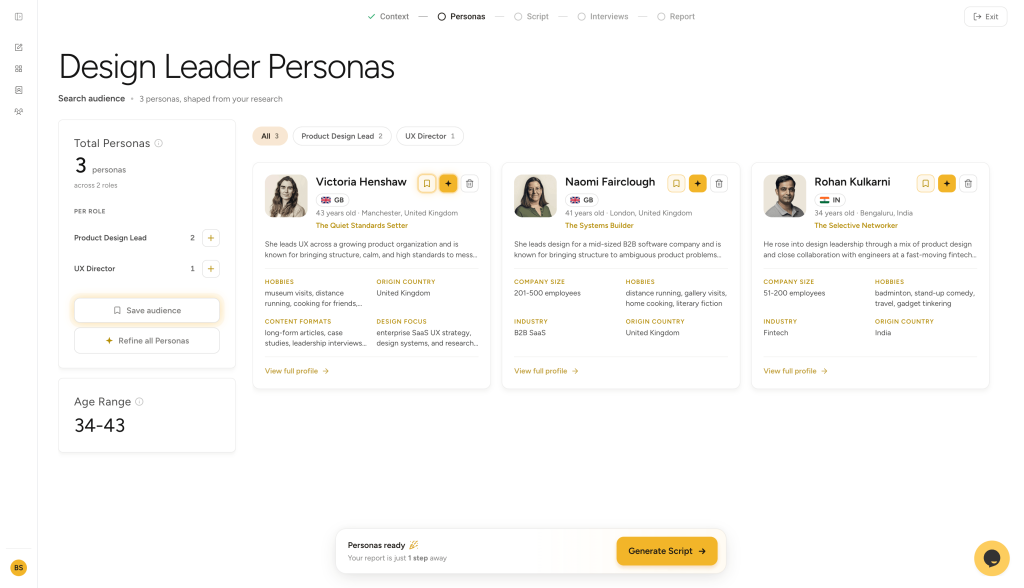
A synthetic user is an AI-generated representation of a person or audience segment that can participate in a simulated research exercise. Unlike the static personas product teams have created for years, these representations can respond. They can be questioned, shown concepts, asked to explain objections and pushed further when an answer raises something interesting.
Platforms such as Articos are turning that idea into a structured research workflow rather than simply asking a general-purpose chatbot to impersonate a customer. Articos, for instance, allows teams to create synthetic personas and conduct studies around product concepts, messaging, positioning and other early decisions without first recruiting a participant panel.
That distinction matters because the ambition is not merely to make fictional characters more interactive. It is to create a new layer of research between internal intuition and the considerably heavier process of speaking to real people.
The Strongest Case For Synthetic Users Is Not Replacement
Much of the criticism around synthetic research begins with a comparison to a well-run human study, but that may not be the most realistic comparison.
The uncomfortable truth about product development is that a large number of decisions receive no research at all. A feature gets prioritised because the team believes customers will value it. A landing-page message wins because it sounds better in the meeting. A new proposition reaches production because nobody has the time or budget to test five possible directions properly.
Human research is valuable, but it is not frictionless. Participants have to be found, recruited and scheduled, while the research itself needs to be planned, conducted and interpreted. For significant decisions, that investment is usually justified. For the smaller choices accumulating throughout a product cycle, it often is not.
Synthetic research changes that calculation. A team considering six early concepts could run all six through simulated audiences, identify recurring objections, explore differences between audience profiles and decide which ideas deserve the expense of deeper validation. The output would not be proof that customers want something, but it could be considerably more useful than six people around a table choosing the idea they personally prefer.
With synthetic users the proposition is not simply that AI can produce convincing interview transcripts, but that research can be introduced much earlier and far more frequently in the decision-making process.
The strongest case for synthetic users may be the research that otherwise would never have happened.
The Trouble Begins When Simulation Starts Looking Like Evidence
There is, however, an obvious danger in making research easier to generate. Synthetic studies can look remarkably similar to traditional ones. There are participants, quotes, themes, objections and neat summaries of what the audience supposedly thinks.
The presentation can lend the findings an authority they have not necessarily earned.
A simulated reaction should not quietly become “users said”. A pattern produced by synthetic participants should not automatically become “customers prefer”
A team relying purely on intuition usually knows that it is relying on intuition. A team looking at the results of twenty simulated interviews may gradually begin talking as though twenty customers have been interviewed. They have not. The responses are generated by models working with prompts, assumptions, training data and whatever additional grounding the research platform provides.
This does not make synthetic evidence meaningless, but it does make the language around it unusually important. A simulated reaction should not quietly become “users said”. A pattern produced by synthetic participants should not automatically become “customers prefer”. The quality of the output depends on the quality of the simulation, the question being asked and the decision the research is expected to support.
The more polished synthetic research becomes, the easier it may be to forget that distinction.
Real Users Are Useful Because They Refuse To Follow The Script
Human participants are inconvenient in ways that are often enormously valuable. They misunderstand instructions, use unexpected language, ignore features everyone inside the company considers important and sometimes reject the premise of the question entirely.
A participant might be asked to choose between three product concepts and explain that none of them addresses the actual problem. Someone testing an interface might invent a workaround that no designer anticipated. A customer might mention an organisational constraint that never appeared in the research plan because nobody inside the company knew it existed.
This capacity for surprise is one of the strongest reasons research with humans remains difficult to replace
This capacity for surprise is one of the strongest reasons real research remains difficult to replace.
Synthetic participants can be particularly useful when a team already knows roughly what it wants to investigate. If the question is whether one positioning direction generates more objections than another, simulation can help explore the territory. If the objective is to discover something the team does not yet know exists, real people become much more important. Our best synthetic user research tools guide compares how current platforms implement that idea in practice.
There is a difference between testing an assumption and allowing reality to overturn it.
The More Interesting Future Is Hybrid
The emerging research stack is therefore unlikely to be a battle between synthetic and human participants. A more plausible model is synthetic research before, between and alongside human research.
Teams can use simulations while ideas are still cheap, compare alternative directions, surface obvious objections and improve the questions they intend to ask. Real participants can enter when behaviour matters, the stakes rise, context becomes important or the team needs the possibility of being genuinely surprised. AI can then return later to help organise and analyse what those humans actually said and did.
A more plausible model is synthetic research before, between and alongside human research
The important distinction is not whether a synthetic participant sounds human enough.
It is whether the evidence is appropriate for the decision being made.
The synthetic user does not have to become the last user interview. For many product teams, it may simply become the first.