

Synthetic user research has an irresistible pitch. Describe the people you want to understand, let AI create them, interview them, and receive what looks remarkably like a finished research report before a traditional recruitment process has even begun.
Articos is an AI-powered user research platform that simulates interviews with synthetic users – AI-generated user personas that simulate real interview respondents – allowing teams to explore product ideas and user needs without recruiting real participants, using generated personas and automated interview workflows.
Articos is one of the more fully realised attempts at that idea. Rather than presenting itself as a persona generator, it wraps synthetic participants inside something resembling an actual research workflow: define the objective, generate personas, prepare an interview script, run interviews, inspect transcripts, synthesise themes, and export the findings.
For this review, instead of feeding it a fictional startup, we used Articos to analyze DesignWhine itself — specifically to understand our reader profiles, their needs, motivations, and how they make decisions. The goal was to see whether it could meaningfully surface who our users really are and how they engage with the product.
While the results were surprisingly strong in certain areas, especially in quickly clustering and describing user segments, we also noticed moments where the outputs felt overly confident or generalized. This mix of clarity and ambiguity set the tone for the rest of our exploration, where usefulness and skepticism often went hand in hand.
DesignWhine's Verdict
Overall
-
Capability
-
Ease of Use
-
Quality & Reliability
-
Value for Money
Summary
Articos is one of the better options for teams that want fast, synthetic user research without building a complex research operation around it. Its polished interface, coherent workflow, probing follow-ups and sheer speed make it remarkably good at turning an open question into structured hypotheses and potential directions. But the same system can also produce confident false assumptions, which means its output cannot be treated as research truth. The value is real, but so is the need for human judgement and validation.
Pros
Extremely fast end-to-end research workflow
Strong persona, script and interview experience
Probing follow-ups make synthetic interviews less mechanical
Detailed synthesis, transcripts and useful post-study exploration
Accessible pricing for smaller teams
Cons
Synthetic participants can make confident false assumptions
Reports are dense and require editorial extraction
Cannot capture the lived context and unpredictability of real users
The Research Workflow Is Impressively Fast
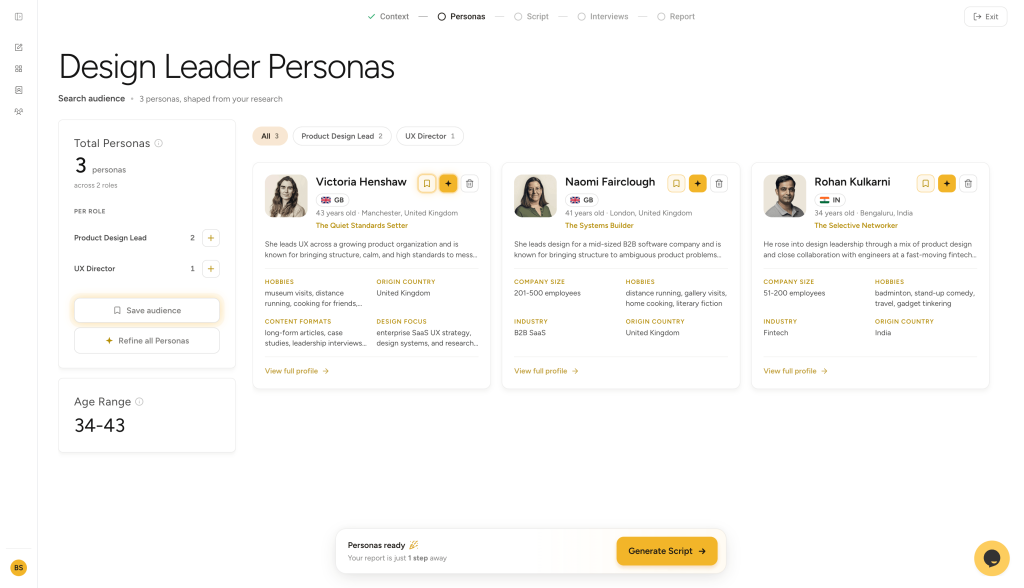
The first thing Articos gets right is momentum. A study begins with a research objective, which can be extrapolated within a chat interface, after which the platform generates personas with roles, locations, personality traits, interests and other contextual details. In our DesignWhine study, it produced three design-leadership personas and then generated a 12-question interview script.
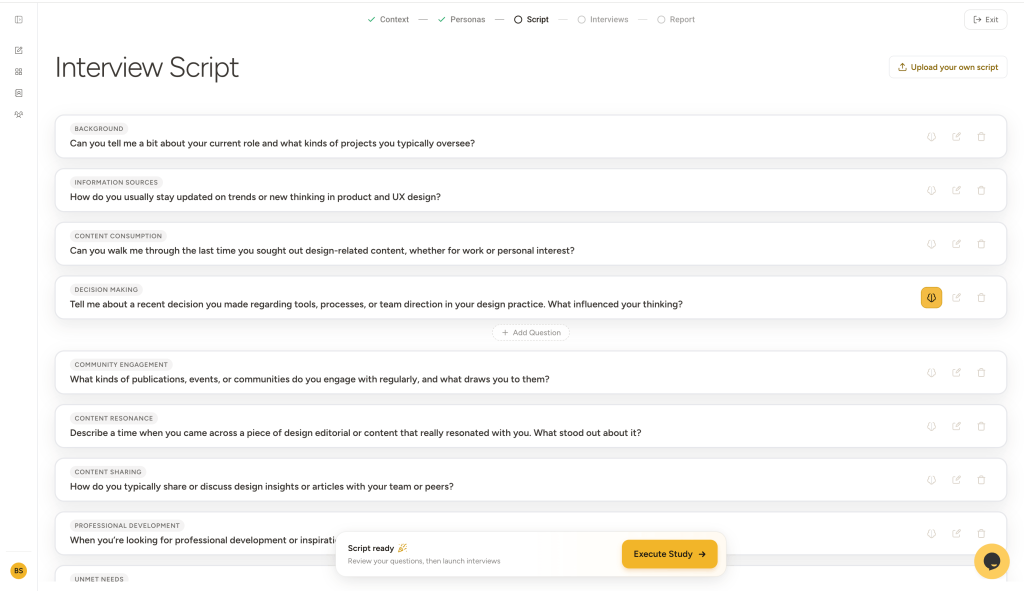
The script itself can be edited, reordered or replaced. More interestingly, individual questions can enable what Articos calls probing follow-ups, allowing the AI interviewer to react to a participant’s answer instead of marching mechanically through a questionnaire. This turned out to be one of the product’s better details. A simulated interview is more useful when the system can pursue an unexpected response rather than simply manufacture twelve isolated answers.
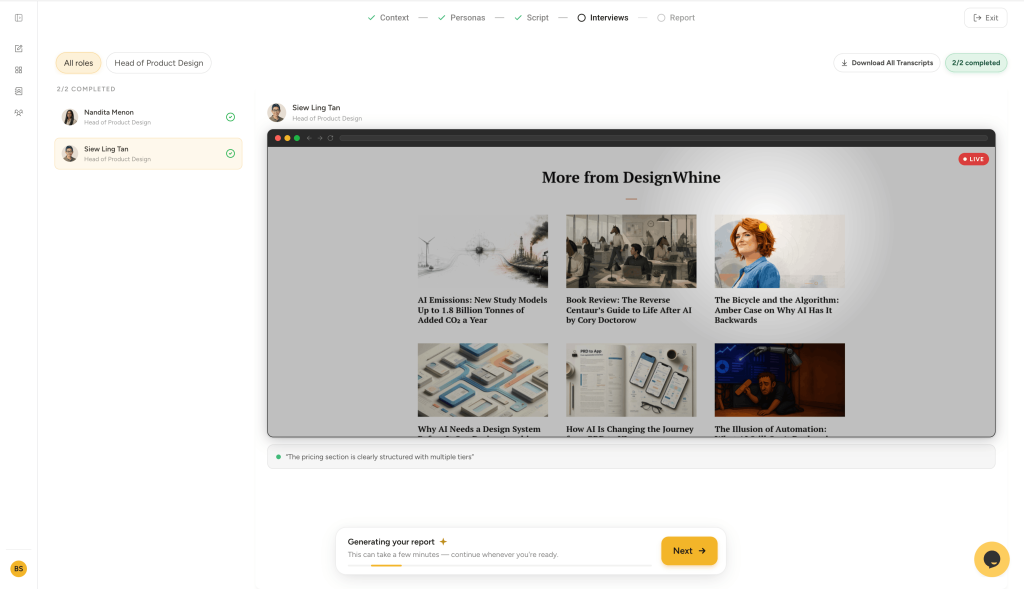
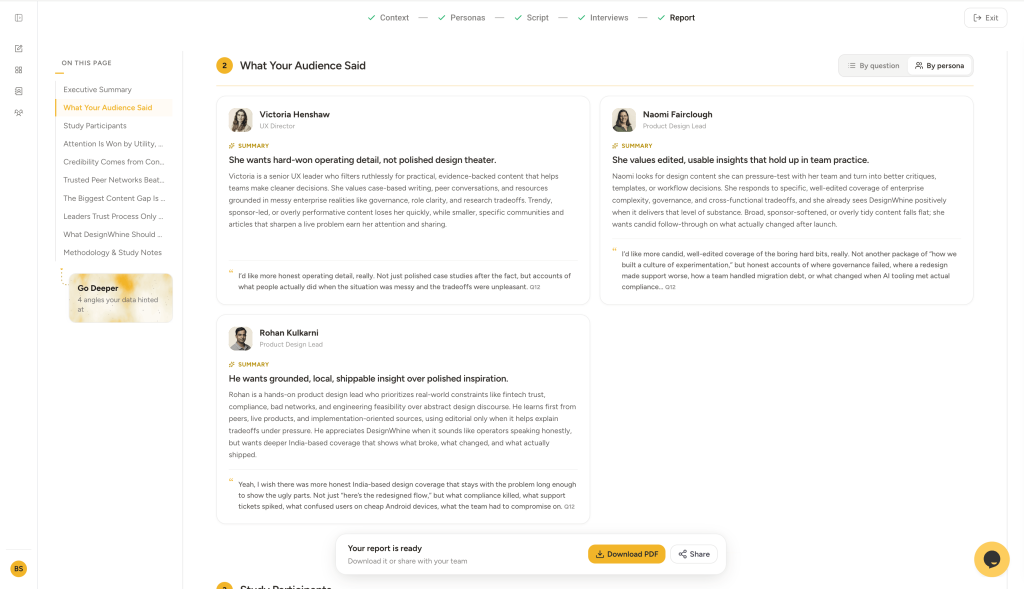
Once launched, Articos conducts the interviews in parallel. Watching three synthetic participants move through the script is slightly uncanny, but efficient. Full transcripts remain available, and completed research can be viewed by persona or by question.
Full transcripts remain available, and completed research can be viewed by persona or by question.
That compression is the product’s clearest achievement. Articos says its end-to-end workflow is designed to produce research synthesis in under 30 minutes, without recruiting participants. Our experience broadly supported the larger point: the mechanics that normally surround qualitative research are streamlined away in a remarkably efficient way.
Then Articos Invented Something That Did Not Exist
Our most important finding was also the most uncomfortable one.
During a DesignWhine landing-page test, one synthetic participant observed that “the pricing section is clearly structured with multiple tiers.”
DesignWhine does not offer any reader subscription tiers, and there is no pricing section anywhere on the site. In this case, the synthetic participant, Siew Ling Tan, incorrectly referred to a supposedly well-structured “pricing tiers” section on the landing page, even though no such content exists on DesignWhine for evaluation.
This likely reflects an assumption made by Articos that, since DesignWhine is positioned as a magazine-style publication, it would naturally include some form of reader subscription or membership pricing tiers.
This is not the same as disagreeing with a user’s interpretation of a headline. It is an invented observation presented with the confidence and visual authority of genuine research evidence.
That distinction matters enormously. Articos can produce detailed personas, coherent transcripts and polished synthesis, but the underlying participants remain AI simulations. They can infer what seems likely rather than faithfully report what was actually present.
The risk, then, is not that synthetic research will always produce obvious nonsense. It is that it can produce something plausibly wrong, surrounded by enough legitimate analysis that the error is easy to miss.
The most dangerous synthetic insight may be the one that sounds completely reasonable but never actually happened.
The Report Is Rich and Detailed
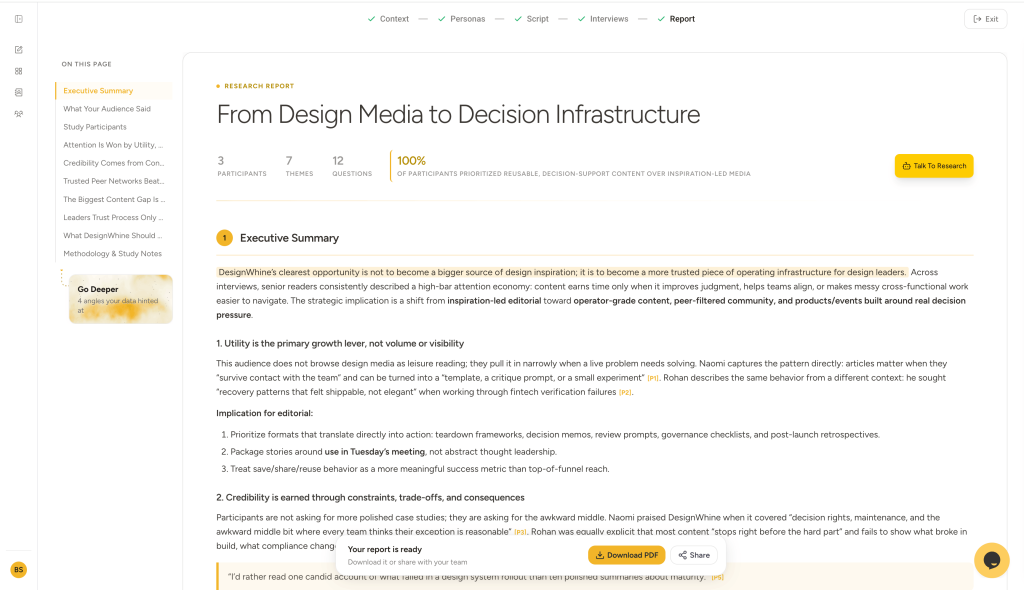
When the interviews end, Articos becomes almost aggressively productive. Our reports contained executive summaries, themes, participant-level observations, quotations, recommendations, charts, priority issues and further research opportunities.
A product manager preparing for a stakeholder meeting probably does not need several pages of competent synthetic analysis.
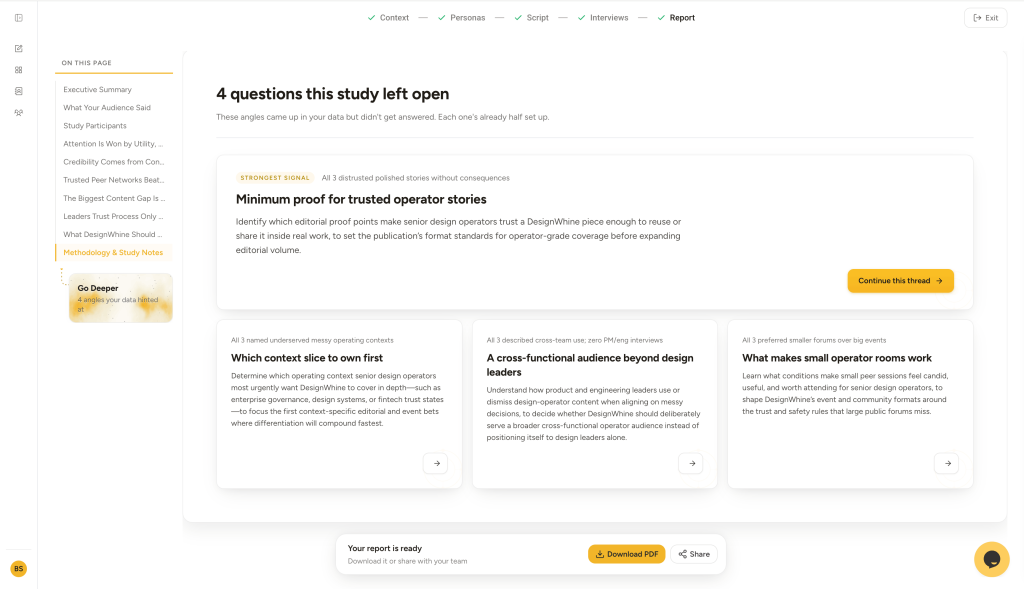
There is genuine value here. The synthesis is considerably more useful than receiving three enormous AI transcripts and being told to make sense of them yourself. The report also includes “Go Deeper” prompts around questions the study has left unresolved, while “Talk to Research” lets users interrogate findings after a study has finished.
But the report also exposes another weakness: there is simply too much of it.
A product manager preparing for a stakeholder meeting probably does not need several pages of competent synthetic analysis. They need the three findings that change a decision, the evidence behind them, and an understanding of how confident the team should be.
That extraction still requires a human. More importantly, after encountering a fabricated finding in our own study, we would verify consequential observations against source material before putting them anywhere near a business recommendation.
Articos is most convincing as a research accelerator, not a research authority.
Who Should Actually Use Articos?
This is where the Articos proposition makes more sense.
For an early-stage startup, small SaaS team, agency or consultant that currently conducts little research because recruitment is slow or expensive, synthetic research can provide a useful first layer of friction. It can challenge messaging, expose questions worth asking, improve an interview guide or pressure-test a concept before money is committed.
Articos itself now positions the platform for early and directional research rather than as a wholesale replacement for human interviews. That is the right framing. Its own product material says real interviews remain appropriate when deeper emotional nuance and unexpected edge cases matter.
The economics reinforce that role. At the time of this review, Articos pricing lists launch pricing of $47 per month for Starter, including 10 research runs, and $119 per month for Pro, with unlimited research. A $29 one-time pack provides two research runs without a subscription.
At that price, Articos does not need to replace a research department to justify itself. It needs to make research possible where the alternative was probably no research at all.