
Maze built its reputation on a wonderfully practical proposition: designers should not have to wait until a product ships to discover that people cannot use it.
Connect a prototype, define a task, put it in front of users and watch the numbers come back. For product teams accustomed to arguing over Figma screens in meeting rooms, the appeal was obvious. Maze turned usability testing into something closer to a design workflow than a research project.
But Maze in 2026 is considerably more ambitious than that original proposition. Prototype testing now sits alongside surveys, live website testing, mobile testing, moderated interviews, card sorting, participant recruitment and an increasingly conspicuous layer of AI. The company no longer wants to be merely the thing you connect to Figma after finishing a prototype. It wants to become the place where product teams conduct research.
That expansion has made Maze more capable. It has also created its most interesting problem: when research becomes this easy to run, does it become easier to mistake running a study for doing good research?
DesignWhine's Verdict
Overall
-
Capability
-
Ease of Use
-
Quality & Reliability
-
Value for Money
DesignWhine's Verdict
Maze has grown from an excellent prototype-testing tool into a much broader research platform without losing the accessibility that made it useful in the first place. Its biggest strength is reducing the operational friction around research, from study creation and recruitment to analysis and increasingly AI-moderated interviews. Its limitation is equally important: Maze can make research easier to run, but it cannot make weak methodology trustworthy. For product teams that want frequent, lightweight research without building a heavyweight research operation, Maze is one of the strongest options available.
Pros
Excellent prototype and usability testing workflow
Broad, increasingly integrated research toolkit
Strong AI-assisted research capabilities
Cons
Advanced features increasingly sit behind Enterprise
Easy workflows can encourage overconfidence in weak studies
Less suited to highly specialised research programmes
DesignWhine's Verdict
Overall
-
Capability
-
Ease of Use
-
Quality & Reliability
-
Value for Money
DesignWhine's Verdict
Maze has grown from an excellent prototype-testing tool into a much broader research platform without losing the accessibility that made it useful in the first place. Its biggest strength is reducing the operational friction around research, from study creation and recruitment to analysis and increasingly AI-moderated interviews. Its limitation is equally important: Maze can make research easier to run, but it cannot make weak methodology trustworthy. For product teams that want frequent, lightweight research without building a heavyweight research operation, Maze is one of the strongest options available.
Pros
Excellent prototype and usability testing workflow
Broad, increasingly integrated research toolkit
Strong AI-assisted research capabilities
Cons
Advanced features increasingly sit behind Enterprise
Easy workflows can encourage overconfidence in weak studies
Less suited to highly specialised research programmes
Maze Still Makes The Most Sense Beside A Prototype
The clearest reason to use Maze remains the one that made it popular in the first place.
Its prototype testing workflow connects directly with Figma and can turn a clickable design into a structured usability test without requiring teams to rebuild the experience elsewhere. Maze can then measure behaviour through paths, interactions, heatmaps and usability metrics, alongside whatever participants actually tell you.
That combination is important.
Design teams are surrounded by opinions. Prototype research works because it replaces some of those opinions with observable friction. The interesting question is not whether somebody says the checkout is intuitive. It is whether they find the checkout, how they get there, and where their route diverges from the one the designer imagined.
Maze is particularly good at turning those behaviours into something legible. Rather than leaving teams with a pile of recordings to interpret, it can reduce a test into paths, completion data and visual patterns that make usability problems easier to discuss.
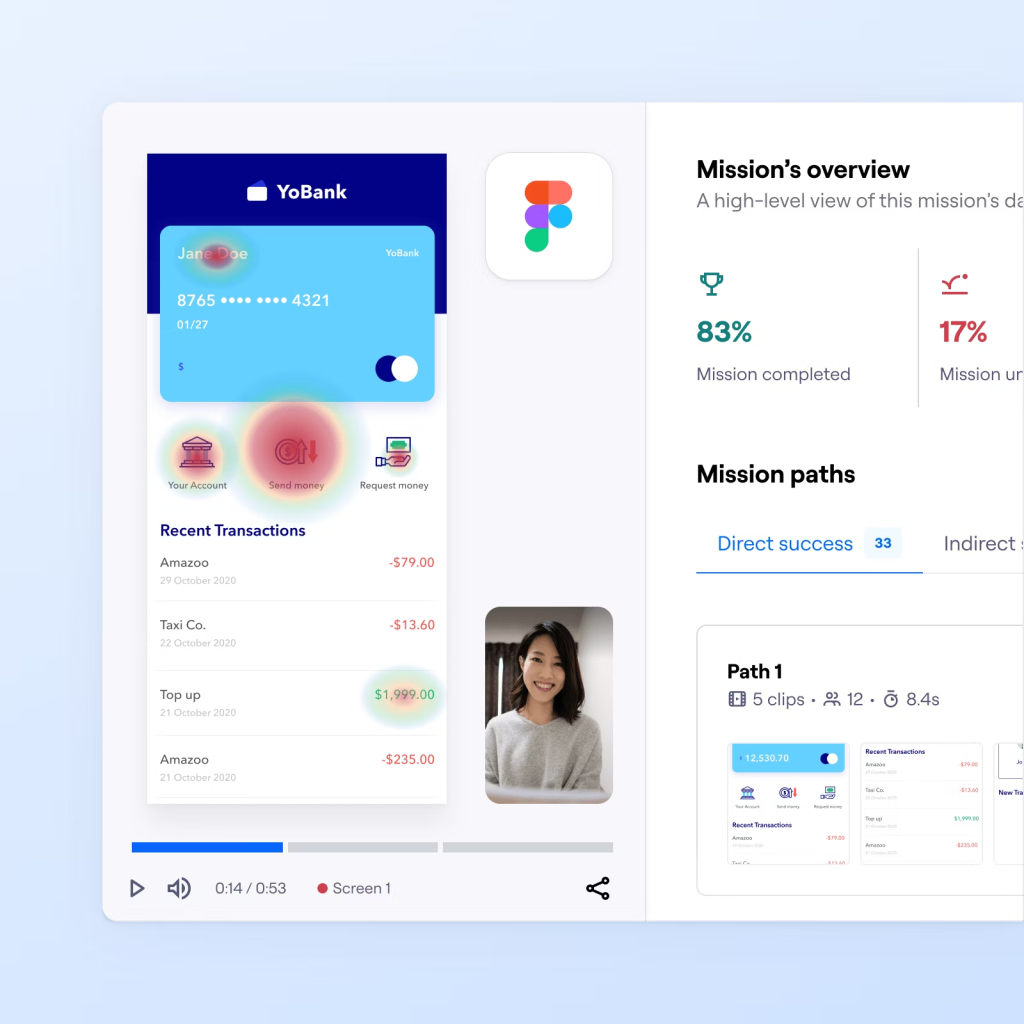
There is a trade-off here. Quantifying behaviour can give weak research an undeserved air of certainty. A usability score may look wonderfully objective while still reflecting the task, sample and assumptions that produced it. Maze gives teams measurement. It does not absolve them from understanding what they measured.
The danger with frictionless research is that the dashboard can start looking more authoritative than the study behind it.
Quantifying behaviour can give weak research an undeserved air of certainty.
Maze Has Quietly Become A Much Bigger Research Platform
The 2026 version of Maze reaches considerably further than prototype validation.
Its current platform spans surveys, usability testing, information-architecture testing, card sorting, live website and mobile testing, moderated interviews, participant recruitment and qualitative analysis. Maze can also manage interview scheduling and turn sessions into transcripts, themes and shareable reports.
Recruitment has become a larger part of that proposition. Maze says its Panel provides access to more than five million participants, while its current documentation shows that panel recruitment is supplied through specialist providers including Prolific, Bilendi, Respondent and Terac.
That distinction matters. Maze has integrated recruitment into the experience, but it has not built some magical proprietary civilisation of testers. It is orchestrating access to established research panels.
For most product teams, that may be exactly what they want. The software takes responsibility for the workflow while specialist providers supply the humans.
For niche research, we would still scrutinise recruitment carefully. Having millions of potential participants sounds reassuring, but audience size is not audience relevance. A procurement manager choosing enterprise accounting software and a twenty-something buying trainers are not interchangeable simply because both can complete an online usability test.
AI Is Turning Maze From A Testing Tool Into A Research Assistant
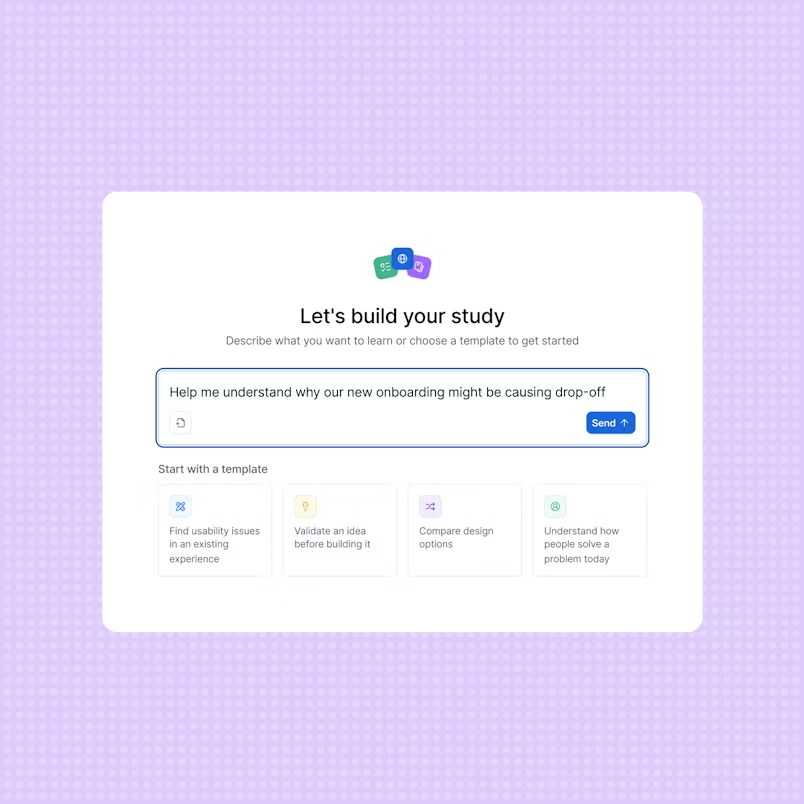
Maze now has an AI Study Builder that takes a research objective and generates the questions, structure and settings for a study. It is an attractive idea, especially for designers and product managers who know what they want to learn but may not know how to turn that curiosity into a defensible research plan.
More consequential is the company’s AI Moderator. Rather than simply summarising completed research, Maze can conduct interviews, ask follow-up questions based on participant responses and subsequently return transcripts, themes and reports. In 2026, Maze expanded this system further into evaluative research, and AI-moderated studies can now probe beyond a fixed questionnaire.
Maze says every AI-moderated conversation is evaluated against 25 quality metrics, with safeguards intended to reduce leading questions and keep conversations grounded in the original research objectives. The feature remains an Enterprise add-on.
This might be the most important direction Maze has taken.
It is also where DesignWhine would be most cautious.
A good moderator notices more than words. Hesitation, contradiction, discomfort and the strange detours people take while trying to explain themselves are often the interesting parts of an interview. AI can make interviewing vastly more scalable. Whether it makes an interview equally perceptive is a different question.
Maze’s AI makes the strongest case when it removes repetitive labour while keeping humans responsible for interpretation. The moment an automatically generated study flows into an automatically conducted interview and ends as an automatically generated report, the researcher risks becoming the person who merely presses Start.
It is research nobody involved has actually spent much time thinking about.[/comment_nudge]
The uncomfortable endpoint of automated research is not bad research. It is research nobody involved has actually spent much time thinking about.
Maze Is Increasingly Designed For People Who Are Not Researchers
That may actually be the product’s most important strategic choice.
The AI Study Builder explicitly targets designers and product managers, while the wider Maze platform makes research methods accessible without requiring specialist tooling for each one.
There is something admirable about that. Research teams are rarely large enough to investigate every product decision. Giving designers the means to validate a navigation structure or giving a PM the means to test a proposition can prevent many avoidable mistakes.
But democratizing research has always contained a contradiction. Making a research tool easier does not make research methodology easier.
Maze increasingly solves the operational problem: constructing studies, finding participants, collecting behaviour, organising interviews and summarising evidence. It cannot solve the epistemological one: whether you asked the right people the right question and interpreted what happened correctly.
That is not really a criticism of Maze. It is the reason teams should treat Maze as infrastructure rather than expertise.
The Free Plan Is Generous Until You Need Maze Seriously
Maze is easier to evaluate than UserTesting because you can actually start without speaking to a salesperson. If those are the two products on your shortlist, our Maze vs UserTesting comparison goes deeper into the trade-off between product-team speed and enterprise research infrastructure.
Its Free plan currently includes one study per month, five seats, essential prototype testing, surveys and pay-per-use panel access. New accounts also receive a 30-day trial of premium features without a credit card.
The trouble comes when Maze becomes central to a research practice.
Many of the features that make the 2026 platform genuinely interesting, including AI-moderated interviews, the AI Study Builder, moderated interview studies, richer reporting and several advanced testing capabilities, sit on the Enterprise side of the product. Maze does not publish a simple enterprise price on its main pricing page.
That creates an awkward middle.
Maze is unusually approachable for somebody wanting to experiment with research, but teams that outgrow occasional testing can move quickly from a useful free product into an enterprise purchasing conversation.
For a serious research organisation, that may be reasonable. For a small product team that simply wants more than one study each month, the gap is harder to ignore. That is also where narrower Maze alternatives can become more attractive.