
Remote user testing no longer feels novel. A designer can put a prototype in front of strangers before lunch, feed transcripts into an AI model by mid-afternoon, and arrive at tomorrow’s stand-up armed with something resembling research. What used to require a lab, a recruiter and several weeks of coordination has become another browser tab.
The question is no longer whether UserTesting works. It plainly does. The more relevant question is whether one of UX research’s most established platforms still earns its place when lighter tools can run prototype tests cheaply, recruitment platforms can supply participants separately, and AI promises to compress much of the tedious work between watching a session and extracting an insight.
Our answer is that UserTesting still makes a compelling case, particularly for organisations where research is continuous rather than occasional. But its greatest strength, that it tries to put almost the entire research operation inside one platform, is also what makes it difficult to recommend universally.
- Usertesting Is No Longer Just A Usability Testing Tool
- The Best Thing About Usertesting Is Still Surprisingly Simple
- The Participant Network Is Both The Advantage And The Risk
- Usertesting’s AI Is Useful Precisely When You Stop Treating It As A Researcher
- Figma Is Where Usertesting Suddenly Feels Very Current
- The Pricing Question Does Not Disappear
- Usertesting Is Strongest When Research Is A Habit
DesignWhine's Verdict
Overall
-
Capability
-
Ease of Use
-
Quality & Reliability
-
Value for Money
DesignWhine's Verdict
UserTesting remains one of the most complete ways to put human behaviour back into product decisions. Its recruitment infrastructure, testing depth and growing analysis layer make it particularly convincing for organisations conducting research continuously, while its 2026 investment in AI and Figma shows a product that is adapting rather than merely trading on reputation. But more capability does not automatically mean more value. UserTesting is at its best when several parts of the research machine need to work together. For lighter usability testing, the platform can feel like hiring an orchestra when you needed a guitarist.
Pros
Exceptionally broad UX research capability
Recruitment built into the research workflow
Mature recordings, transcripts and behavioural analysis
AI meaningfully reduces research administration
Figma integration brings testing closer to design
Cons
Pricing is difficult to evaluate without entering a sales process
Large research panels still require thoughtful screening
AI synthesis cannot substitute for researcher interpretation
Likely excessive for teams running only occasional tests
Usertesting Is No Longer Just A Usability Testing Tool
Calling UserTesting a remote usability testing platform now undersells it.
The UserTesting platform stretches from prototype and website testing to moderated conversations, surveys, information-architecture research and participant recruitment. Researchers can move from individual session recordings and transcripts into click paths, sentiment analysis and other aggregated views designed to reveal where people hesitate or behave differently from one another.
Its expansion has also been literal. UserTesting combined with UserZoom in 2023 and acquired User Interviews in January 2026, bringing one of the better-known research recruitment businesses into the same orbit.
That breadth changes the buying decision. You are not really choosing a clever little UX utility. UserTesting increasingly wants to be the infrastructure through which an organisation asks questions of customers.
The User Interviews acquisition also strengthens what was historically a more difficult part of large research panels: finding genuinely specialised and B2B participants.
The Best Thing About Usertesting Is Still Surprisingly Simple
For all the product expansion, UserTesting’s most persuasive idea has barely changed: put the thing you are building in front of another human being and watch what happens.
There is an important distinction here. Analytics can tell you that people abandoned a flow. A survey can tell you they disliked it. Watching somebody hover over the correct button three times without recognising it tells you something qualitatively different.
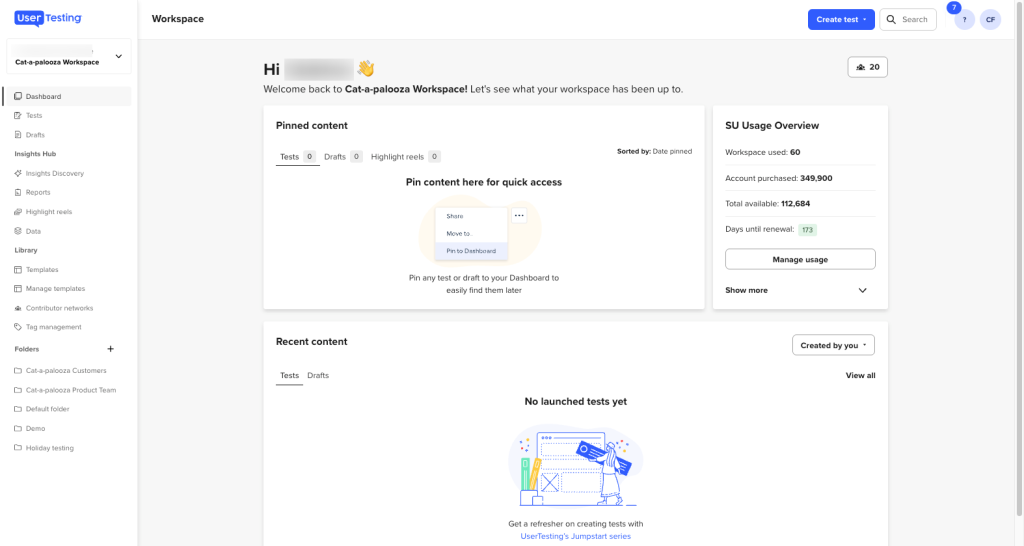
UserTesting has spent years reducing the logistical friction around getting that moment. You can construct a study, define who should participate, give them tasks, and receive recordings of people working through an experience while speaking aloud. That basic loop remains remarkably useful because product teams still have an extraordinary capacity to rationalise interfaces they already understand.
This is where UserTesting feels most mature. The value is not any one research method. It is how little ceremony is required to move from a question to observable behaviour.
The more routinely a company tests, the more valuable that becomes.
For a lightweight DesignWhine test, for instance, we would not attempt an artificial research programme. We would simply ask a first-time visitor to open DesignWhine, explain what they believe the publication is about, and then find a tool that could help them with a UX or AI-related task. One session of somebody misunderstanding a navigation label can tell us more about the product than twenty screenshots of UserTesting settings ever could.
The Participant Network Is Both The Advantage And The Risk
Recruitment is where UserTesting becomes harder to separate from cheaper testing tools.
Being able to specify an audience and have the platform help find participants removes one of the least glamorous parts of research. The more routinely a company tests, the more valuable that becomes. Recruiting five ordinary consumers is one problem. Repeatedly finding people with particular jobs, behaviours or purchasing habits is another.
But a panel should never be confused with ground truth.
The structural risk with any large testing network is that repeated participation can create unusually test-literate users. Someone who spends substantial time completing studies may behave differently from the person who encounters your interface cold. Screeners can improve targeting, but a finely tuned screener does not automatically produce a representative human being.
UserTesting’s scale therefore deserves to be treated as infrastructure rather than magic. For broad usability questions, convenient access to participants can be enormously useful. For consequential research involving specialist professionals or very specific customers, we would still want to know exactly who was being recruited and why their behaviour should influence a product decision.
A large participant network makes research easier to run. It does not automatically make the research better.
Usertesting’s AI Is Useful Precisely When You Stop Treating It As A Researcher
The inevitable 2026 question is what AI has done to the product.
Quite a lot. UserTesting’s April 2026 release introduced AI-powered test creation and expanded AI-generated insight summaries. Instead of constructing every study from scratch, a researcher can describe what they want to learn and use AI to generate a starting structure. On the other side of the study, UserTesting can analyse verbal, written and behavioural information to surface themes and potential findings.
This is a sensible application of AI because research produces an awful lot of material that nobody particularly enjoys organising.
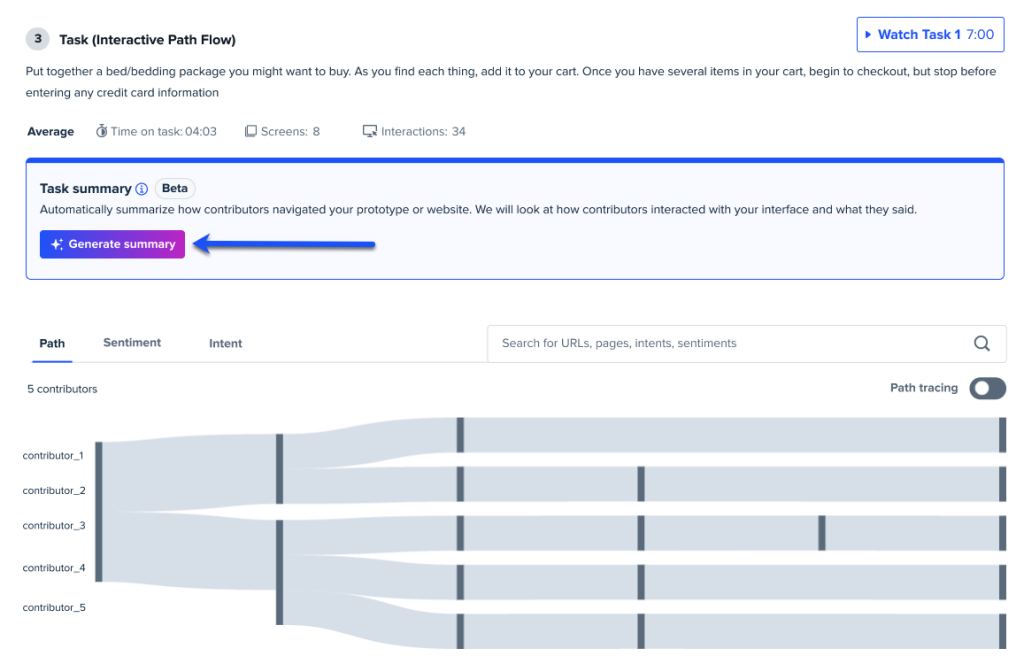
Where we would resist UserTesting’s framing, or that of any AI research platform, is the point where synthesis starts masquerading as interpretation. Frequency is not significance. A participant saying something repeatedly does not necessarily make it important, and what somebody says can contradict what they visibly do.
The useful AI research product therefore does not save you from watching users. It helps you decide what deserves watching.
That distinction matters. If an AI summary merely gives researchers faster access to the moments that require judgement, it is genuinely valuable. If teams begin distributing summaries without revisiting the underlying evidence, research has become faster at exactly the point where it should remain slow.
The dangerous promise of AI research is not that it gets things wrong. It is that a plausible summary can make us feel that interpretation has already happened.
Figma Is Where Usertesting Suddenly Feels Very Current
Putting a testing workflow beside the design itself reduces that separation.
The most interesting UserTesting feature for designers may not live inside UserTesting at all.
The UserTesting for Figma plugin, released as part of its 2026 product push, lets designers create tests and collect feedback around prototypes from within Figma. The integration also brings results such as success metrics, behavioural themes, video clips and visual success-path tracking back into Figma.
This sounds like a small workflow improvement. It is actually strategically important.
Research frequently loses influence not because teams dislike evidence, but because evidence arrives somewhere else, later. The prototype lives in Figma. The product decision happens in Slack. The research repository sits in another system waiting for somebody to open it.
Putting a testing workflow beside the design itself reduces that separation. It also pushes UserTesting beyond dedicated researchers and towards designers who need to validate something without turning every question into a formal study.
This is perhaps UserTesting’s smartest response to the new generation of UX tools. Instead of simply making research faster, it is trying to make research harder to avoid.
The Pricing Question Does Not Disappear
UserTesting’s biggest weakness is easier to describe than any feature.
You cannot open its website, choose the capabilities you want, see a simple monthly figure and decide whether to subscribe. Its current plans include test-based consumption and other subscription models, with access and pricing structured according to organisational requirements.
There are legitimate reasons enterprise platforms sell this way. Research programmes differ enormously in volume, recruiting requirements, permissions and governance.
But opaque pricing changes how smaller teams evaluate the product. UserTesting is no longer competing only with another enterprise research suite. It is competing with a collection of inexpensive specialised tools and, increasingly, with the question of whether a team needs a research platform at all. Our UserTesting alternatives guide breaks that decision down by what a team is actually trying to replace.
That is where the economics become uncomfortable. If you conduct research continuously, consolidation can be valuable. If you test a prototype every few months, buying an entire research operating system to do it is difficult to justify. For teams specifically weighing a lighter product-team workflow against UserTesting’s infrastructure, our Maze vs UserTesting comparison is the more direct buying guide.
Usertesting Is Strongest When Research Is A Habit
The best customer for UserTesting is not simply a UX researcher. It is an organisation that repeatedly needs evidence.
For those teams, recruitment, testing, recordings, analysis and sharing living inside a common system can remove considerable operational friction. UserTesting’s maturity matters because research at scale involves considerably more than putting five people in front of a prototype.
For smaller product teams, independent designers and startups, the conclusion is less straightforward. There are now plenty of ways to answer a narrow usability question without committing to this much platform.
And that is perhaps the defining tension of UserTesting in modern workflows. It has successfully evolved beyond the simple remote-testing product it helped popularise. In doing so, it has also become something many teams may not need.