
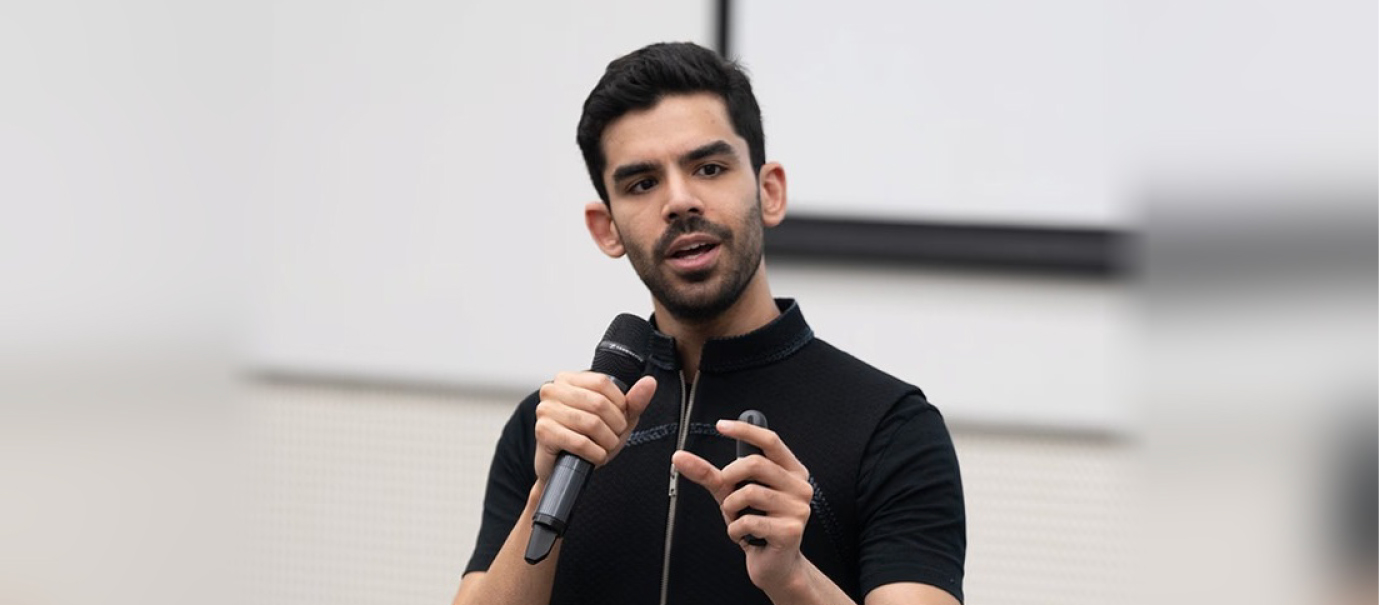
Ansh Mehra doesn’t fit the typical profile of a design influencer. He started as a computer science engineer, took an internship at Swiggy, moved into product design at Y Combinator-backed Zuddl, and then pivoted to teaching. Today, he runs The Cutting Edge School, where he trains enterprise teams at Microsoft, Intel, Lenskart, and Dubai Future Foundation on integrating AI into their design workflows. His free platform, Learn UIUX, hosts a 7-week UX design syllabus that has drawn over half a million followers across YouTube and Instagram.
But his current focus isn’t on teaching Figma shortcuts or portfolio reviews. It’s on something more fundamental: what happens to a designer’s role when AI can execute most of the work?
DesignWhine reached out to Mehra to discuss how AI is reshaping design practice, where human judgment still matters, and why he thinks taste is about to become the profession’s most valuable currency.
Beyond Pixels
Mehra’s starting point is straightforward. AI is collapsing the traditional handoffs between designers, product managers, and engineers. The result? Designers are no longer confined to visual execution. When asked how AI is changing the way designers approach problem-solving today, he put it plainly.
“First of all, designers will no longer be restricted to just thinking in pixels. They will now get opportunities to act both as a product manager and as a high-fidelity designer. Their vocabulary, and the vocabulary of technical people and PMs in the business, will now have much more overlap because AI will help them to start from a higher baseline and reach the front end way faster than ever. So I think a lot of designers will now have more bandwidth to think about business outcomes and to speak the language of business and development.”
Designers will now have more bandwidth to think about business outcomes and to speak the language of business.
This isn’t just about speed. It’s about scope. When AI handles the mechanical parts of design, the question becomes what designers choose to do with the freed-up capacity.
The Average Problem
There’s a catch, though. Mehra is careful to point out that AI draws from the average of what exists. For designers without strong fundamentals, that creates a risk: mistaking AI output for finished work. On balancing foundational skills versus relying on AI for execution, he drew a clear line.
“When we talk about balancing foundational principles versus relying on AI for execution, AI in general takes inspiration from the average. So if a person has not studied their first principles and fundamentals, they will always end up using AI results as their finish line, not the baseline. If you’re studying pattern finding, vocabulary, aesthetics, typography, and empathy, these are the things that you have to learn on your own, through observation, usage patterns, and studying.
AI can easily help you with any part of your design process where things are deterministic.
But when you are trying to make a design system, instead of declaring all the typography, colours, and palettes from scratch, you can use AI to get the baseline, and then you can build on top of it. So the thumb rule here is that AI can help you do deterministic things, but not non-deterministic ones like creating user flows and information architecture. AI can easily help you with any part of your design process where things are deterministic, which means when there is a clear, blind prescription or a step-by-step checklist.”
His distinction between deterministic and non-deterministic work is useful. AI excels at the former: generating color palettes, writing component documentation, producing variant screens. It struggles with the latter: framing the right problem, mapping user flows, making judgment calls about what to build.
Communication as Leverage
One of the less discussed shifts is how AI is changing the way designers communicate with stakeholders. Static mockups are being replaced by interactive prototypes, and designers are finding themselves better equipped to articulate business rationale. When asked how AI is changing the way designers communicate ideas to stakeholders and teams, Mehra pointed to faster fidelity and better alignment.
AI can support the research processes, so now, they can use AI to understand how to convince stakeholders, create better roadmaps, and make better decisions.
“When it comes to communication, instead of statics, designers can now show high-fidelity prototypes faster than before. Instead of speaking only the vocabulary of a designer or just UX, a designer can now better visualise what the business needs are and speak that language with the help of LLMs. AI can support the research processes, so now, they can use AI to understand how to convince stakeholders, create better roadmaps, and make better decisions.”
For Mehra, this is less about better slides and more about credibility. Designers who can connect their work to business outcomes are more likely to influence product direction.
The New Differentiator
So what should designers focus on now to stay relevant? Mehra’s answer is to stop obsessing over prompt engineering and start thinking about skill engineering: defining SOPs, workflows, and quality assurance systems for AI-augmented work.
“We have already created a bunch of content on our free website learnuiux.in, where we talk about creating human-in-the-loop workflows. Anytime a human is thinking about a product, they should first recognise and prioritise the right problems, then use AI for competitive research. When prompting, spend less time writing complicated prompts and more time setting the right context and practising context engineering.
AI can never automate taste and judgment, and that’s why these two components will be the moat for a good designer.
At this point, with tools like Perplexity Computer and Claude Cowork, even context engineering is becoming skill engineering, where a large part of your work is defining SOPs and workflows, how you design, how you execute systems, and how you do quality assurance. AI can never automate taste and judgment, and that’s why these two components will be the moat for a good designer. So if you’re a designer reading this, spend a lot of time developing your taste and judgment, because they will become far more valuable when everyone has Agentic tools and workflows built for them.”
This is the core of his argument. In a world where AI can generate infinite variations, the designer’s unique perspective becomes the differentiator. Not their ability to use tools, but their ability to recognize what’s worth building.
The Educator’s Bet
Mehra’s work reflects this philosophy. Through his website Learn UI/UX, he offers a free UX design syllabus aimed at beginners without coding or design backgrounds. His YouTube channel breaks down AI workflows into practical tutorials, and his corporate trainings help enterprises navigate the transition to agentic systems.
His trajectory from Swiggy intern to corporate AI consultant is less relevant than the bet he’s making: that designers who learn to orchestrate AI will outperform those who either ignore it or rely on it too heavily.
What Remains
As AI tools become more autonomous, Mehra sees designers moving from execution to orchestration. The work shifts from making screens to setting context, defining constraints, and curating outcomes.
Whether that future arrives depends less on the tools and more on whether designers invest in the things AI can’t replicate: taste, judgment, and the ability to frame problems worth solving.