
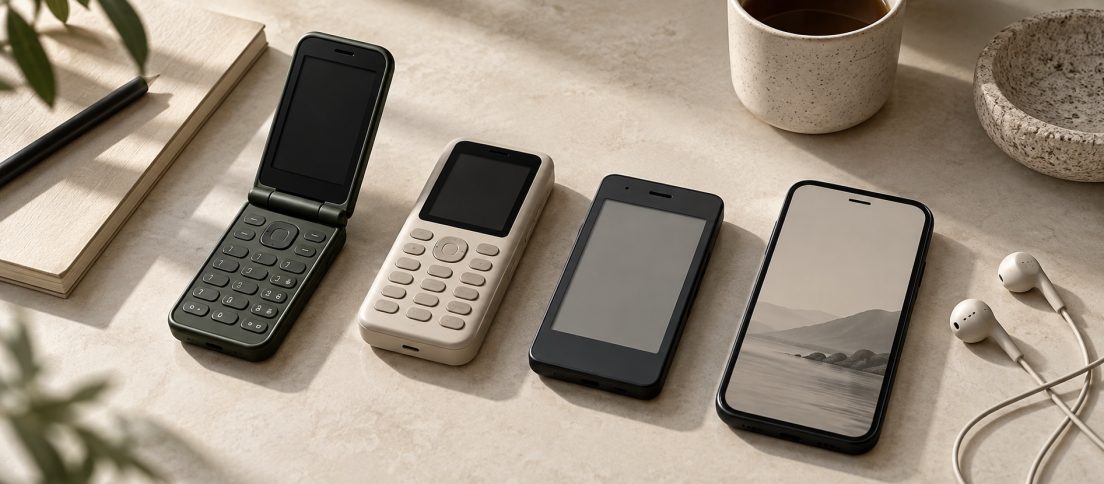
For most of the smartphone era, buying a new phone meant buying more. More cameras, more apps, more screen, more intelligence, more reasons to pull the thing from your pocket. The strangest phone category of 2026 is built on the opposite proposition: what if a better phone is one that deliberately does less?
That question has moved well beyond nostalgia. Light, Mudita, Punkt, Techless, Sunbeam, Balance, Dumber OS and a new generation of flip-phone makers are all attacking the same problem from different directions. Some remove the browser and app store entirely. Some keep WhatsApp, maps and banking but make everything else inconvenient. Some are little more than old-school feature phones with 4G. Others are full Android devices wearing minimalism as a software layer.
So this is not another list of phones ranked by megapixels. It is a guide to the best dumb phones in 2026 based on a harder question: which parts of modern phone life can you realistically remove without making the rest of your life worse?
Prices, availability and software support were checked on October 1, 2026. This market changes quickly, especially for small hardware companies and region-specific feature phones, so verify carrier and app compatibility before ordering.
The Short Answer
If you want the cleanest break from smartphone life without giving up maps, a camera, 2FA and basic modern connectivity, the Light Phone III is the most complete premium interpretation of the idea. If an E Ink screen and privacy matter more, Mudita Kompakt is the stronger fit. If you want buttons, almost no apps and a phone that behaves like a tool, the Punkt MP02 remains the purist option, although availability and its older underlying platform deserve attention.
If you still need WhatsApp, Uber, Spotify, maps and modern messaging, the “dumbest” phone may actually be the wrong answer. Wisephone II, Balance Phone and the Dumber Mini approach the problem by restricting a smartphone rather than replacing one.
And if you only want to test whether life with less phone actually suits you, an inexpensive 4G feature phone such as the Nokia 3210 4G or Nokia 2660 Flip is a far cheaper experiment than a $899 minimalist flagship.
The best dumb phone is not the one with the fewest features. It is the one that removes the features you regret using without removing the infrastructure you actually depend on.
Two questions do most of the work in this guide. First: what parts of your smartphone are actually infrastructure in your life? We answer that next with the DesignWhine Hidden Dependency Test. Later, once the devices and their trade-offs are clear, we map which dumb phone actually fits your life, from a clean break to a full-Android compromise.
That second map appears deeper in the guide on purpose. It makes far more sense after you have seen how radically different the word “dumb phone” has become.
The Hidden Dependency Test
Before comparing hardware, do this first: spend one ordinary week noticing every time your smartphone performs infrastructure rather than entertainment. That list matters more than any product review because it tells you whether you need a true dumb phone, a restricted smartphone, or simply a more boring version of the phone you already own.
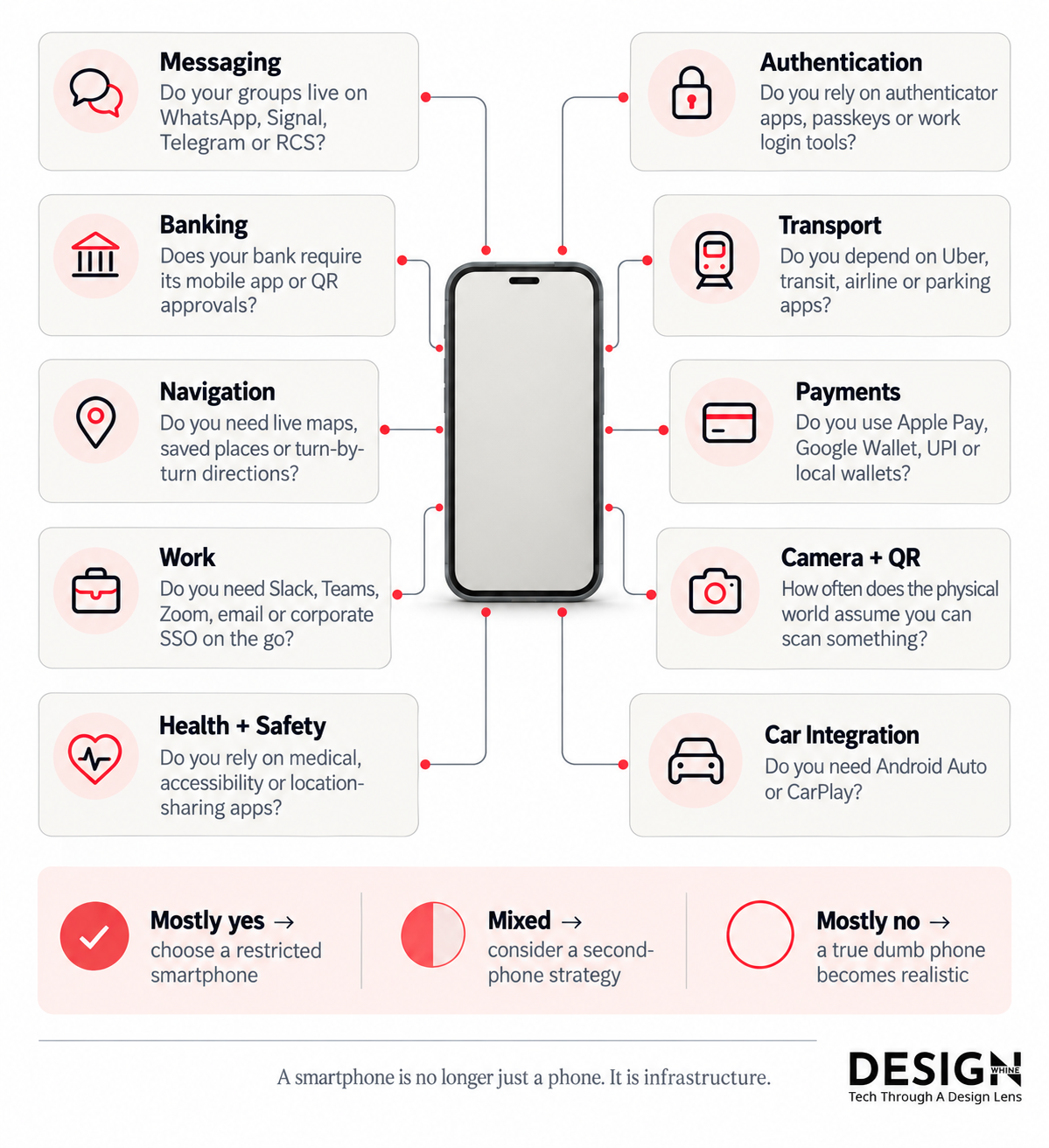
- Messaging: Do your family, school or work groups use WhatsApp, Signal, Telegram or RCS?
- Authentication: Does your employer require Microsoft Authenticator, Okta, Google Authenticator or passkeys?
- Banking: Does your bank require its mobile app for approvals, card controls or QR payments?
- Transport: Do you depend on Uber, Lyft, local transit apps, airline boarding passes or parking apps?
- Navigation: Is basic turn-by-turn enough, or do you need live traffic, saved places and public-transit routing?
- Payments: Do you regularly use Apple Pay, Google Wallet, UPI or a local digital wallet?
- Work: Can you genuinely go without Slack, Teams, Zoom, email and corporate SSO when away from a laptop?
- Camera and QR codes: How often does the physical world assume you can scan something?
- Health and safety: Do you rely on medical, accessibility, location-sharing or emergency apps?
- Car integration: Do you depend on Android Auto or CarPlay?
This is the part of the dumb-phone conversation that nostalgia tends to erase. Smartphones did not merely replace phones. They absorbed the map, wallet, camera, ticket, authenticator, taxi dispatcher, music player, boarding pass, flashlight, notebook and, increasingly, the key to your workplace. Every dependency you mark above narrows the set of phones that will feel liberating rather than merely broken.
The real cost of a dumb phone is not the hardware. It is the infrastructure you have to rebuild outside the smartphone.
What Counts As A Dumb Phone?
The phrase “dumb phone” has become almost uselessly broad. In 2026 it can mean a $50 keypad handset, an $899 premium phone with a custom operating system, or a modern Samsung smartphone whose software has been locked down so aggressively that TikTok simply cannot be installed.
It is more useful to think of the category in four layers.
- True feature phones: calling, SMS, basic camera, radio and perhaps a lightweight browser. Think Nokia/HMD and carrier flips.
- Intentional phones: purpose-built modern hardware with a closed or tightly curated operating system. Light, Mudita and Punkt live here.
- Restricted smartphones: normal Android hardware where the operating system blocks or curates apps. Wisephone and Balance are the clearest examples.
- Smart dumbphones: tiny Android devices with keypads, app access and deliberately awkward screens. Dumber Mini and older Qin devices sit here.
That distinction matters because “I want a dumb phone” can hide very different jobs. One person wants to stop doom-scrolling. Another wants a first phone for a child. Another needs WhatsApp but not Instagram. Another wants privacy. Another wants a weekend device. Another wants a phone that still handles banking and an authenticator app required by work.
The hardware is the easy part. The job-to-be-done is the real category.
The 2026 Dumb Phone Map
| Phone | Type | Modern Essentials | Price | Availability |
|---|---|---|---|---|
| Light Phone III | Intentional phone | Maps, rideshare, authenticator. No WhatsApp or banking apps. | About $899 | Shipping, carrier dependent |
| Mudita Kompakt | E Ink intentional phone | Offline maps; Android sideloading possible but app compatibility varies. | $399 regular | In stock in supported regions |
| Punkt MP02 | Keypad intentional phone | Calls, SMS, tethering and Pigeon. No maps or banking apps. | From CHF 299 | Orderable from Punkt |
| Wisephone II | Restricted Android | WhatsApp, maps, rideshare, Spotify, 2FA and selected utilities. | $399 + fees/subscription | Shipping |
| Sunbeam F1 Pro Aspen | Premium flip | Waze, authenticator, hotspot. No browser or app store. | $359 | Out of stock on official store |
| Dumber Mini | Smart dumbphone | WhatsApp, maps, banking and Android apps on tiny hardware. | £159 | Current preorders extend into 2027 |
| Dumbphone 2 | Companion flip | WhatsApp, Google Maps, Uber and 2FA. | About $20 + service | Available via service |
| Nokia 3210 4G | Feature phone | Calls, SMS and basic regional cloud services. | Region dependent | Available in several markets |
| Nokia 2660 Flip | Feature phone | Calls, SMS and emergency features. | Region dependent | Available in some markets |
| Balance Phone | Restricted Android | WhatsApp, maps, banking and mainstream utilities with category blocking. | €449 | In stock |
| Minimal Phone 2 | Focus-first Android | Full Android app compatibility with stronger behavioral controls. | From $599 preorder | Scheduled for December 2026 |
Notice how quickly the category falls apart once practical dependencies enter the table. The devices that are best at preventing distraction are usually the worst at supporting the services that modern cities, employers and financial systems increasingly assume you carry.
The Purists: Phones That Actually Say No
These are the strongest expressions of the dumb-phone idea. They do not merely encourage restraint. Their hardware or operating systems remove whole classes of temptation, which makes them powerful commitment devices and unforgiving replacements when your life depends on a missing app.
Light Phone III
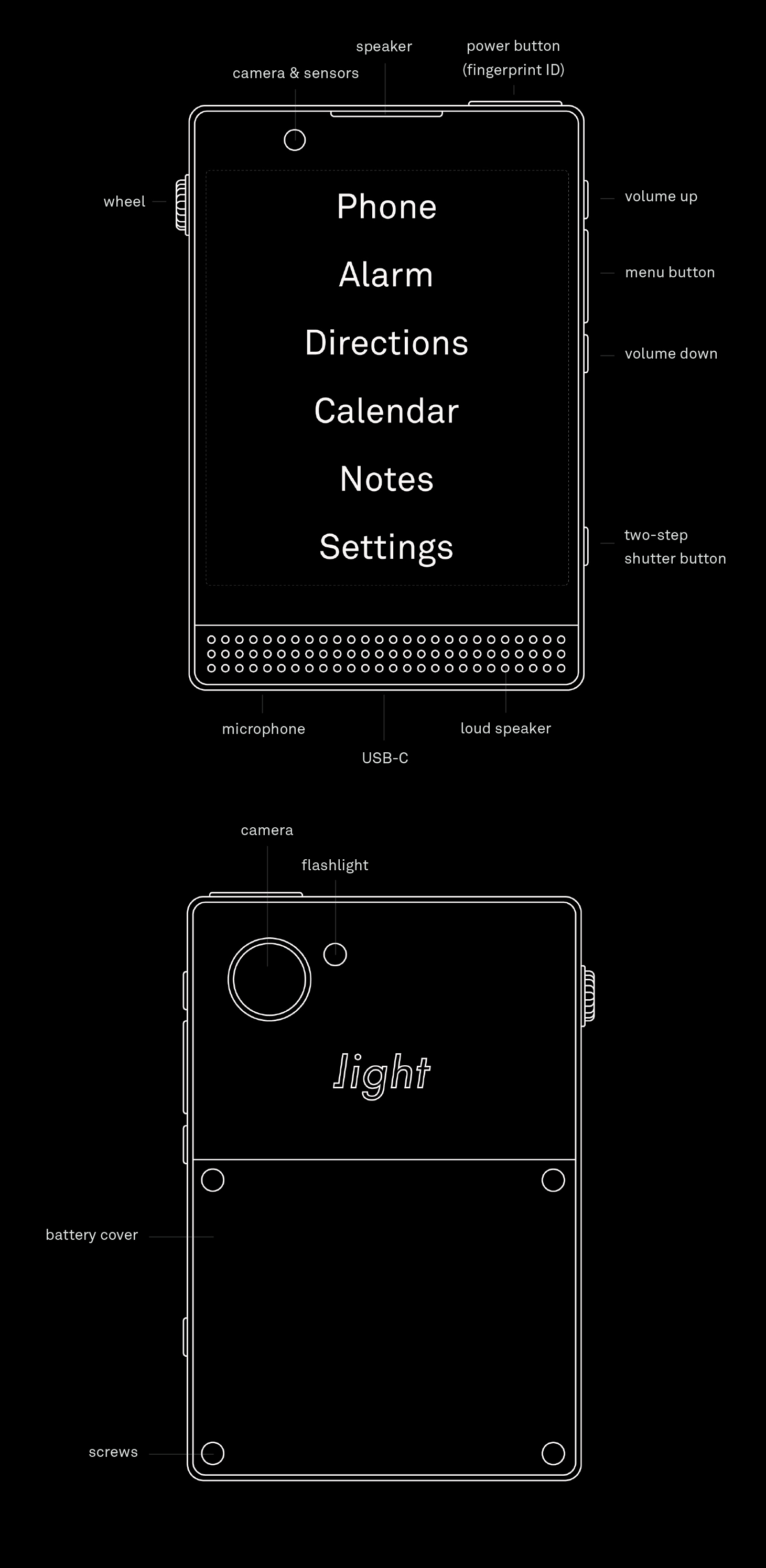
The Light Phone III is the clearest example of minimalism becoming a premium product rather than a budget compromise. It looks more like a small contemporary smartphone than a nostalgic flip phone, but LightOS removes the structural ingredients that make smartphones endlessly expandable: no open app store, no web browser, no social feeds and no email.
The important part in 2026 is that LightOS has become more practical. Light’s current tool list includes directions, music, podcasts, calendar, notes, hotspot, weather, an authenticator and, on Light Phone III, a rideshare tool. The September 2026 update introduced rideshare directly into LightOS, while earlier updates added an authenticator and weather. That closes two of the biggest gaps that used to make a minimalist phone impractical as a primary device.
What remains absent is equally important. There is still no WhatsApp, browser, email or banking-app ecosystem. Light says it may explore services such as WhatsApp or Signal only where deeper platform collaboration makes sense. If your social life runs through WhatsApp, or your bank insists on its own app, Light’s philosophy becomes a hard constraint rather than a soft preference.
From a design perspective, that is exactly why it works. The Light Phone does not ask you to exercise better judgment inside an infinite environment. It removes the infinite environment.
Mudita Kompakt
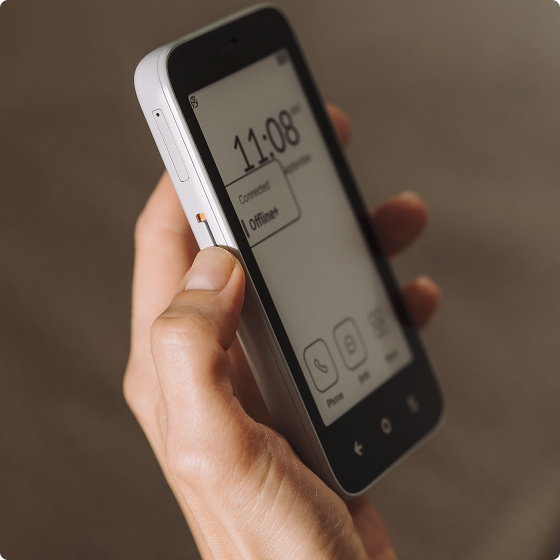
Mudita Kompakt takes a different route. Its 4.3-inch E Ink display makes the device visually quieter, and Mudita’s Offline+ mode can cut the GSM modem and microphones at the hardware level while disabling the camera, Wi-Fi and Bluetooth through software. It also includes offline maps, a camera, music, notes and other essentials.
The clever compromise is that MuditaOS K is based on AOSP. There is no app store, but Mudita explicitly documents that technically capable users can sideload Android APKs. That means a user who absolutely needs a particular utility may have an escape hatch.
It also means the phone is not magically compatible with everything Android. Apps may render badly on E Ink, depend on Google Play Services, refuse to run on a de-Googled environment or simply make no sense on a low-refresh monochrome display. “Can install” and “works reliably” are very different claims.
Kompakt is therefore one of the most interesting phones for people who want friction with selective exceptions. It is less doctrinaire than Light, but more intentionally constrained than a normal Android phone.
Punkt MP02
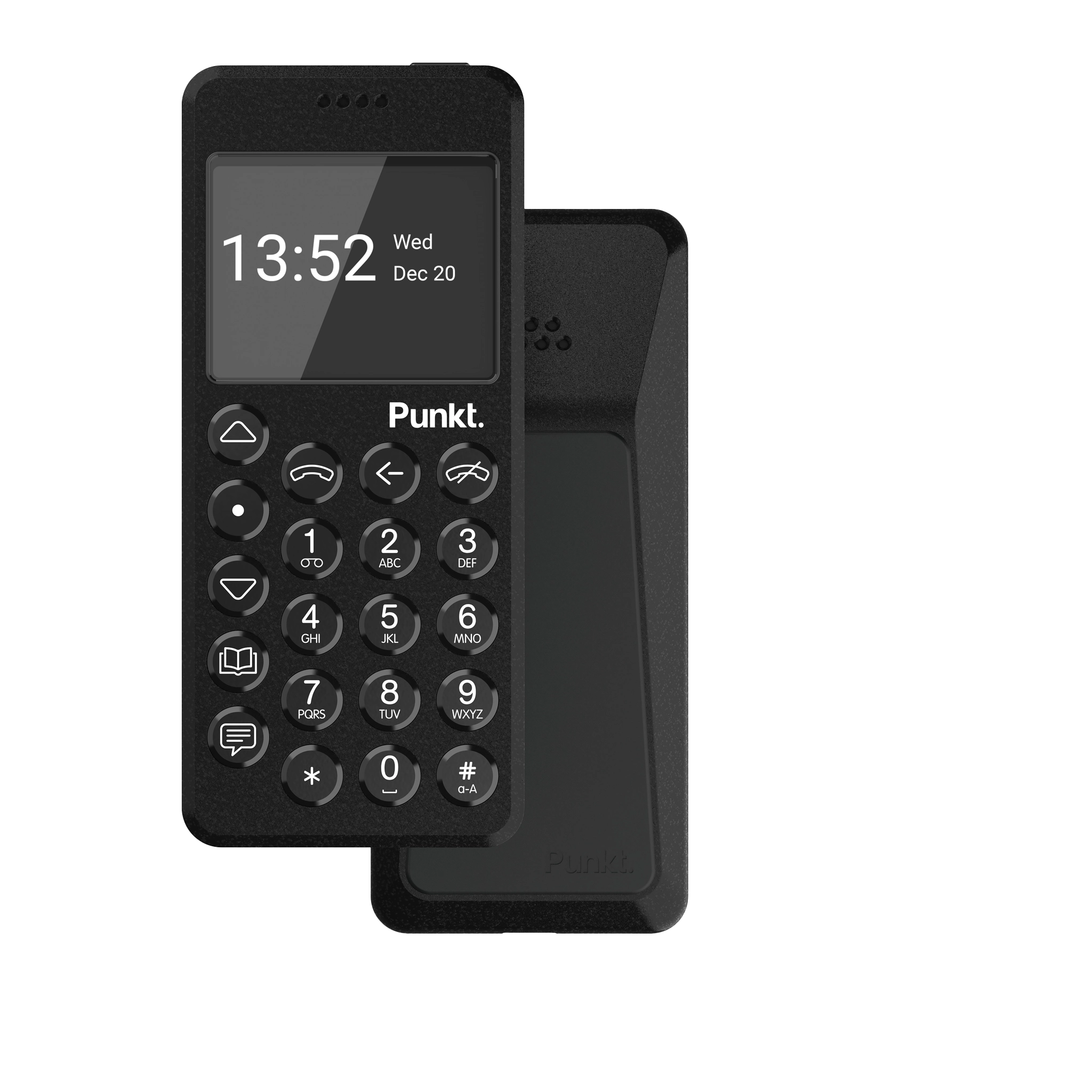
The Punkt MP02 remains the design purist’s dumb phone. Designed by Jasper Morrison, it is a compact keypad device built around calls, SMS, tethering and Pigeon, Punkt’s Signal-compatible encrypted messaging layer. Punkt continued updating Pigeon in 2026, including a June maintenance release rebased on newer Signal code.
But the MP02 also illustrates an important difference between minimalism and security longevity. Punkt’s own specifications say no further Android/vendor security updates are planned for the underlying platform, even while Pigeon continues to receive updates. Punkt’s current store is again accepting MP02 orders from CHF 299 as of this writing.
There is no maps app, no camera, no WhatsApp and no banking ecosystem. The device can share a 4G connection to another device, which reveals Punkt’s deeper philosophy: the internet exists, but the phone should not be the place where you live inside it.
If that sounds liberating, the MP02 is unusually coherent. If it sounds inconvenient, believe yourself before buying it.
Sunbeam F1 Pro Aspen
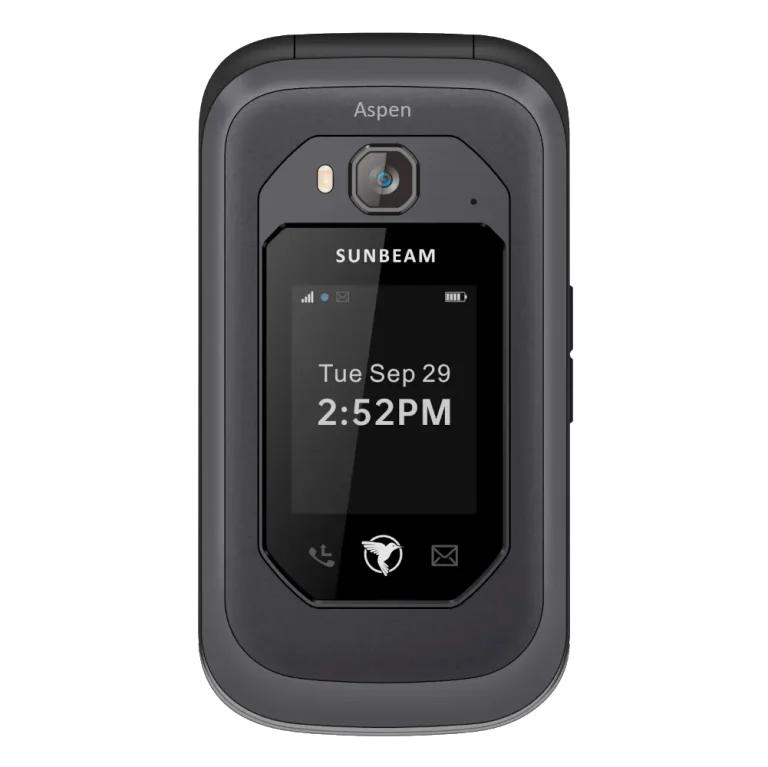
Sunbeam Wireless occupies a practical middle ground, especially in North America. The F1 Pro Aspen is a rugged flip phone with Waze, weather, music, camera, an authenticator and Wi-Fi hotspot, but no browser, app store or social media.
That combination matters. Navigation and hotspot are two of the reasons people return to smartphones after an idealistic week with a basic flip phone. Sunbeam keeps both while preserving the tactile clamshell form factor and limited software surface.
Availability and geography are the catches. As of October 1, 2026, Sunbeam marks the Aspen itself out of stock on its official store. Sunbeam also says the Aspen is intended for North and South America and lacks the LTE bands required across much of Europe, Africa and Asia. That kind of inventory and carrier friction is common in this category and is one reason a 2026 buying guide has to distinguish products worth understanding from products you can actually use where you live.
Calm Technology Makes Friction Useful
Product design has spent two decades treating friction as something to remove. Faster checkout. Fewer taps. Automatic login. Infinite feeds. One-click purchase. Personalized recommendations. Every extra second between desire and action became a usability defect.
Dumb phones invert that logic. They make some actions slower because slowness can be protective. That sounds like bad UX only if we assume the purpose of every interface is to maximize completion, frequency and return.
A keypad makes long-form browsing annoying. E Ink makes video unrewarding. A closed app ecosystem turns impulse installation into a dead end. A flip phone creates a physical state change between “available” and “put away.” A tiny screen makes the web technically possible but emotionally uninteresting.
This connects directly to what Amber Case told DesignWhine about calm technology: good tools should dissolve through use and let attention remain on the goal rather than the interface. It also complicates our older idea of invisible UX. Sometimes the interface should not disappear because it is seamless. Sometimes it should disappear because the product refuses to keep asking for attention.
A 2025 randomized controlled trial published in PNAS Nexus blocked mobile internet on participants’ smartphones for two weeks while preserving calls and texts. The intervention improved sustained attention, subjective well-being and mental-health measures, although the researchers also noted that longer-term evidence is still needed. The interesting design lesson is that the intervention did not require replacing the phone. It removed one capability: permanent mobile internet.
That should make designers uncomfortable in a useful way. The feature we spent fifteen years making ubiquitous may itself be the thing some users now want a product to defend them from.
The Compromises: Keep The Infrastructure
For many adults, the problem is not apps in general. It is the handful of products engineered for compulsive return. These phones keep modern infrastructure such as WhatsApp, banking, ride-hailing and maps while making the rest of smartphone life harder to fall into.
Wisephone II
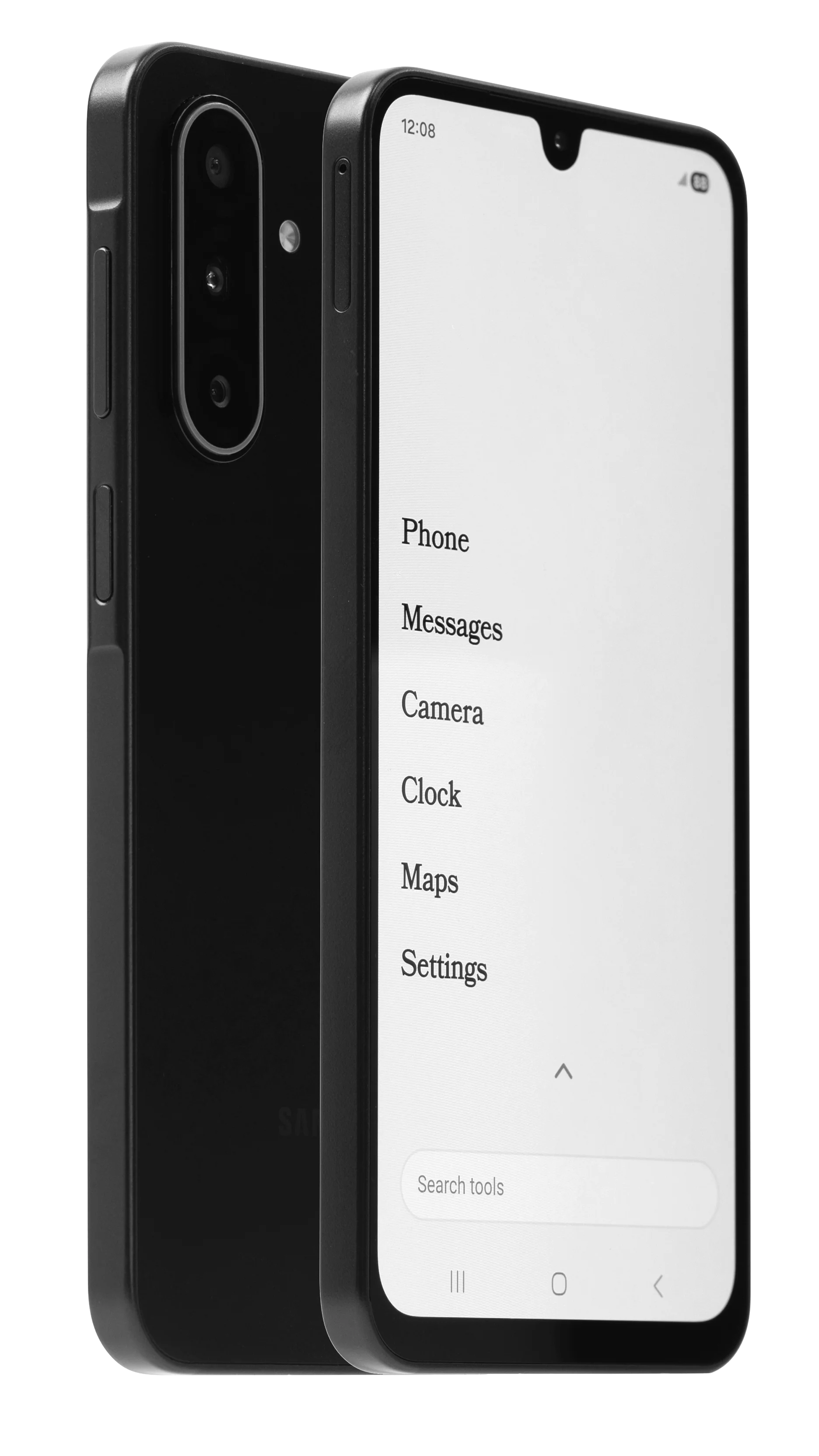
Wisephone II is a useful reminder that many people do not actually want a dumb phone. They want a smartphone without the parts that behave like a casino.
Techless starts with modern Samsung hardware and runs WiseOS, a locked-down Android experience with no browser, no email, no open app store, no social media and no games. Its curated Tool Drawer can provide practical apps such as WhatsApp, Signal, Uber, Waze, Spotify, Google Maps, password managers and payment tools. Wisephone also includes a two-factor authentication tool, one of the most important pieces of infrastructure missing from many minimalist phones.
The trade-off is economic as much as technical. The phone is listed at $399 plus a $39 activation fee, and WiseOS requires an ongoing subscription. Techless currently lists standalone WiseOS at $14.99 a month or $164.88 a year.
This is a fascinating inversion of the smartphone business model. A mainstream smartphone gives you an enormous software ecosystem and then monetizes your engagement indirectly. Wisephone charges you directly to keep most of that ecosystem away.
Balance Phone
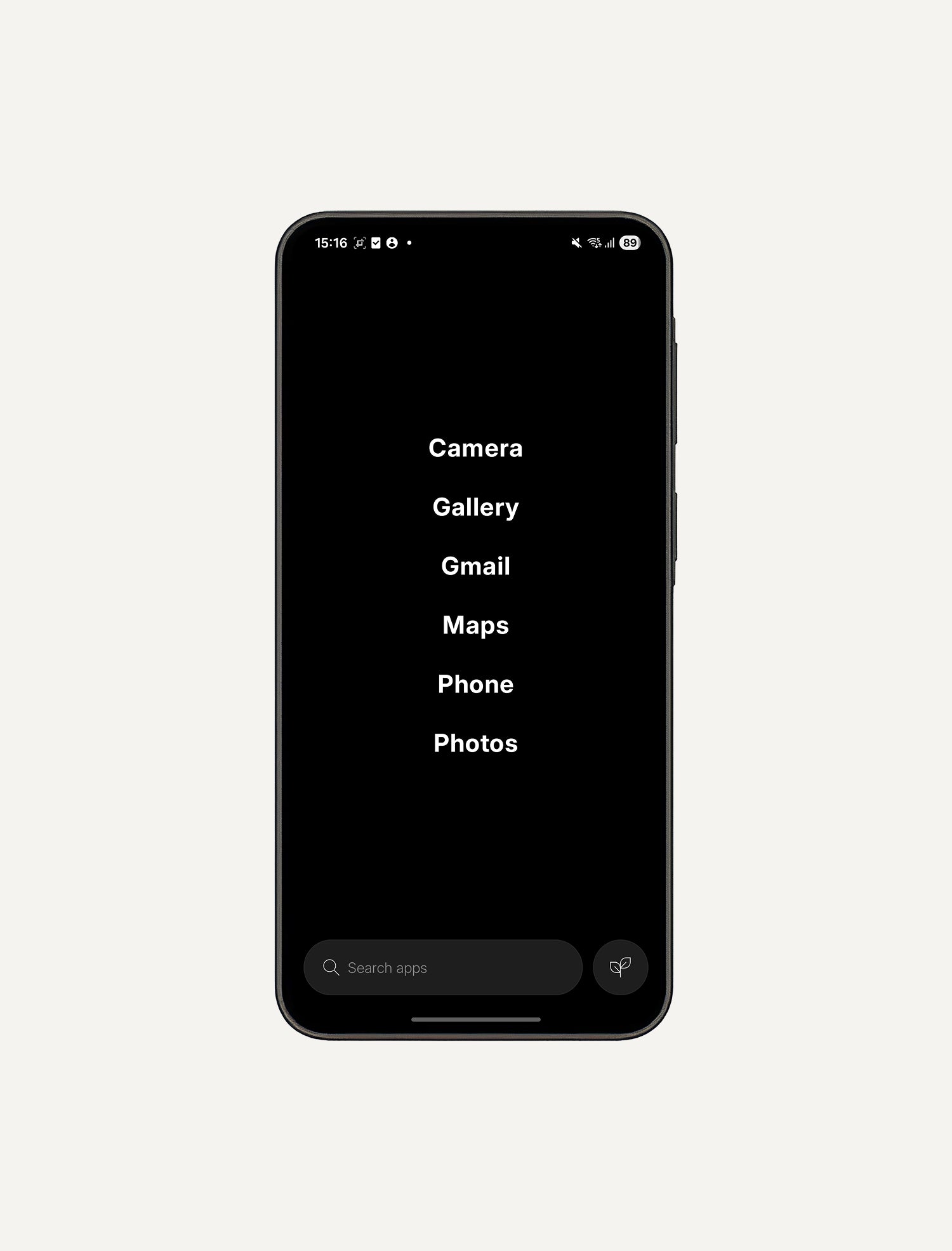
The current Balance Phone pairs Samsung Galaxy A37 hardware with Balance OS, blocking categories such as social media, games, gambling, adult content and streaming at the system level while preserving calls, messaging, maps, camera and other utilities. The current Balance Phone is listed at €449, and Balance also sells its software separately for compatible Samsung devices at €79 a year.
It is not a dumb phone in the traditional sense. That is the point. A person who needs WhatsApp, modern payments, banking, ride-hailing and a good camera may get far more benefit from structural software restriction on reliable mainstream hardware than from an exotic phone that requires rebuilding their life around missing apps.
The risk is that the device still looks and feels like a smartphone. For some people, that familiarity is desirable. For others, the physical ritual of opening a flip phone or pressing a keypad is part of what breaks the habit.
Dumber Mini
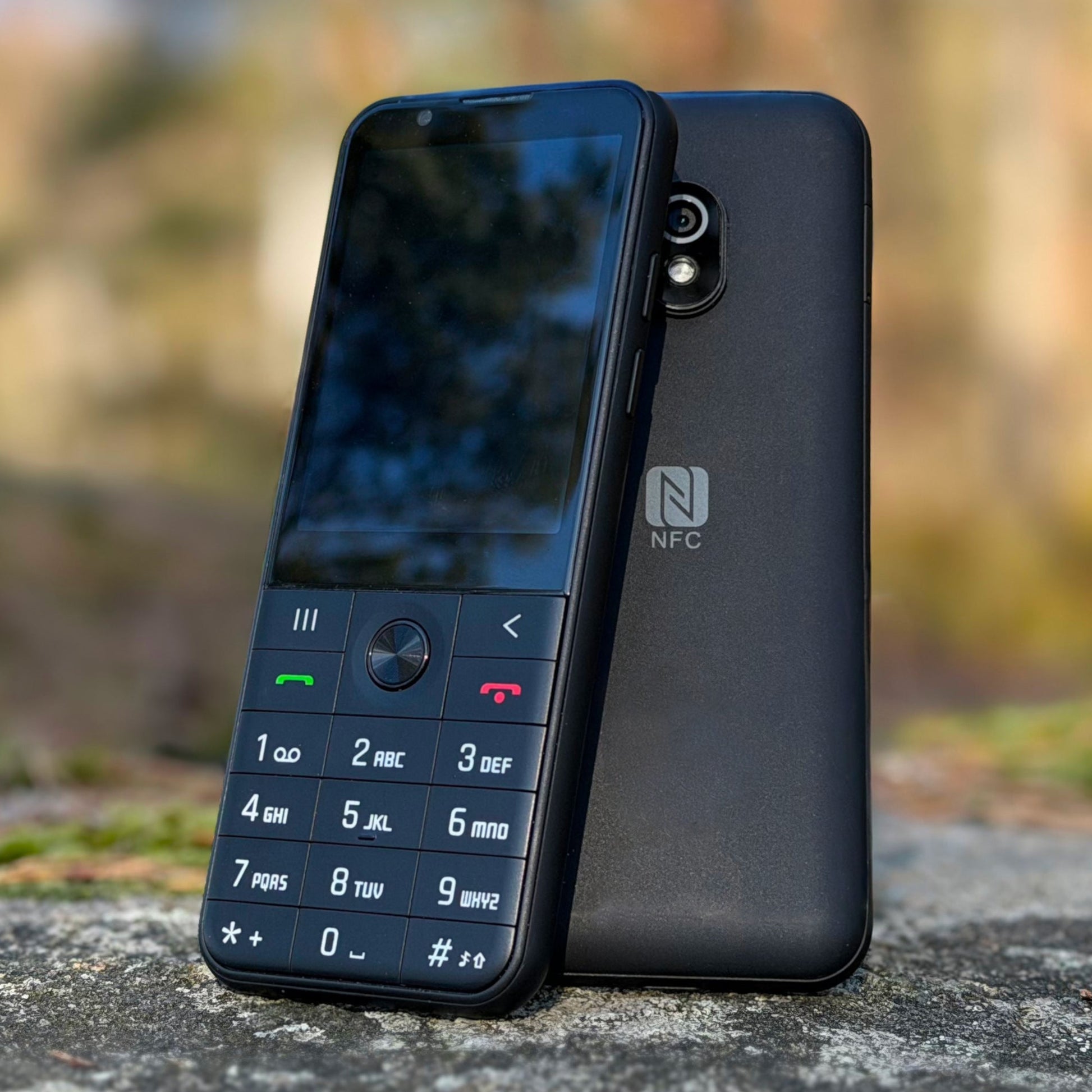
The Dumber Mini may be the most revealing device in this entire market because it tries to solve the contradiction directly: people want physical buttons and a tiny screen, but they also need WhatsApp, Google Maps, banking, transit, digital IDs, Uber and Spotify.
The result is a 2.8-inch touchscreen plus keypad running Dumber OS, an open-source AOSP 14-based system with app access, an app blocker and support for modern utilities. It costs £159 for current preorders.
There is a significant caveat. Dumber OS publicly acknowledged in September that the first batch had more hardware defects than expected, including black-screen problems, and current preorder estimates extend into January 2027. That transparency is commendable, but it also means this is not the conservative choice for someone who needs a boring, proven phone tomorrow.
As a product idea, however, Dumber Mini gets one thing exactly right: the future of digital minimalism may not be fewer capabilities. It may be capabilities presented through hardware that makes compulsive consumption unpleasant.
The Smartphone Became Infrastructure
For years, the smartphone industry competed by absorbing more of life into one object. Cameras, maps, taxis, tickets, payments, music, messaging, work authentication and social life collapsed into a single rectangle.
Dumb phones reveal the cost of that success. Once one device owns everything, it becomes extraordinarily difficult to remove the parts designed to capture attention without also removing the parts required to function in society.
This is why Wisephone, Balance and Dumber Mini are not weak versions of the minimalist idea. They are responses to a different design problem. Their users are not asking for less technology in the abstract. They are asking for selective capability: keep the bank, map, authenticator and taxi; make the infinite feed harder to reach.
The harder smartphones become to leave, the clearer it becomes that attention and infrastructure have been bundled into the same product.
Which Dumb Phone Fits Your Life?
By this point the pattern is clearer: there is no single ladder from “smart” to “dumb.” There are different compromises. This is the practical map we hinted at near the beginning.
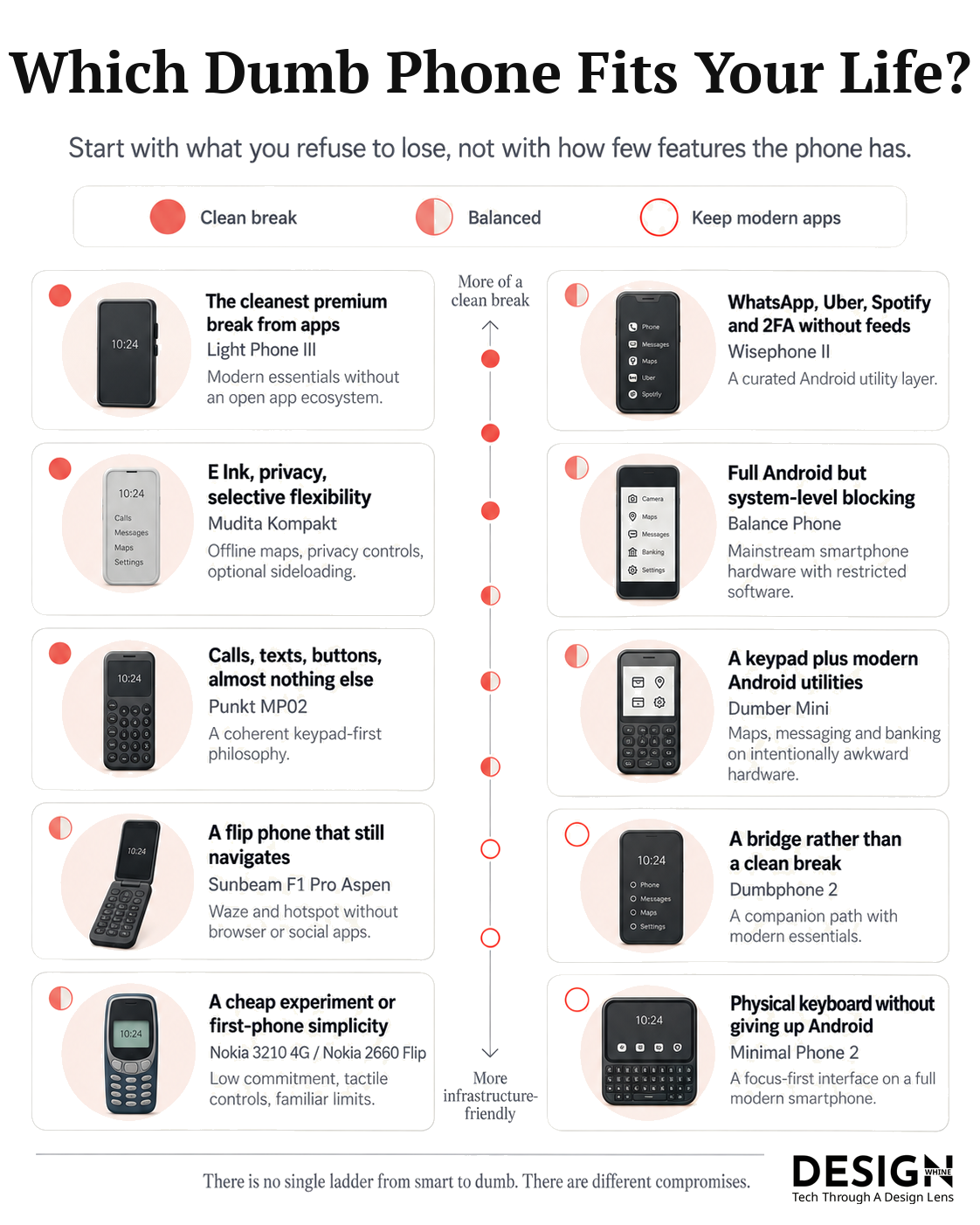
In plain English, Light Phone III, Mudita Kompakt and Punkt MP02 suit people seeking the strongest break from smartphone behavior. Wisephone II, Balance Phone and Dumber Mini preserve more modern infrastructure. Sunbeam and the Nokia feature phones make sense when tactile simplicity or a low-cost experiment matters more than app compatibility, while Dumbphone 2 and Minimal Phone 2 sit closer to the “keep modern apps, change the relationship” end of the spectrum.
The Cheap Test: Feature Phones
Before spending premium-smartphone money on intentional hardware, there is a cheaper experiment: live with a conventional 4G feature phone. The experience is less polished, but it quickly reveals which smartphone conveniences are habits and which are genuine dependencies.
Nokia 3210 4G
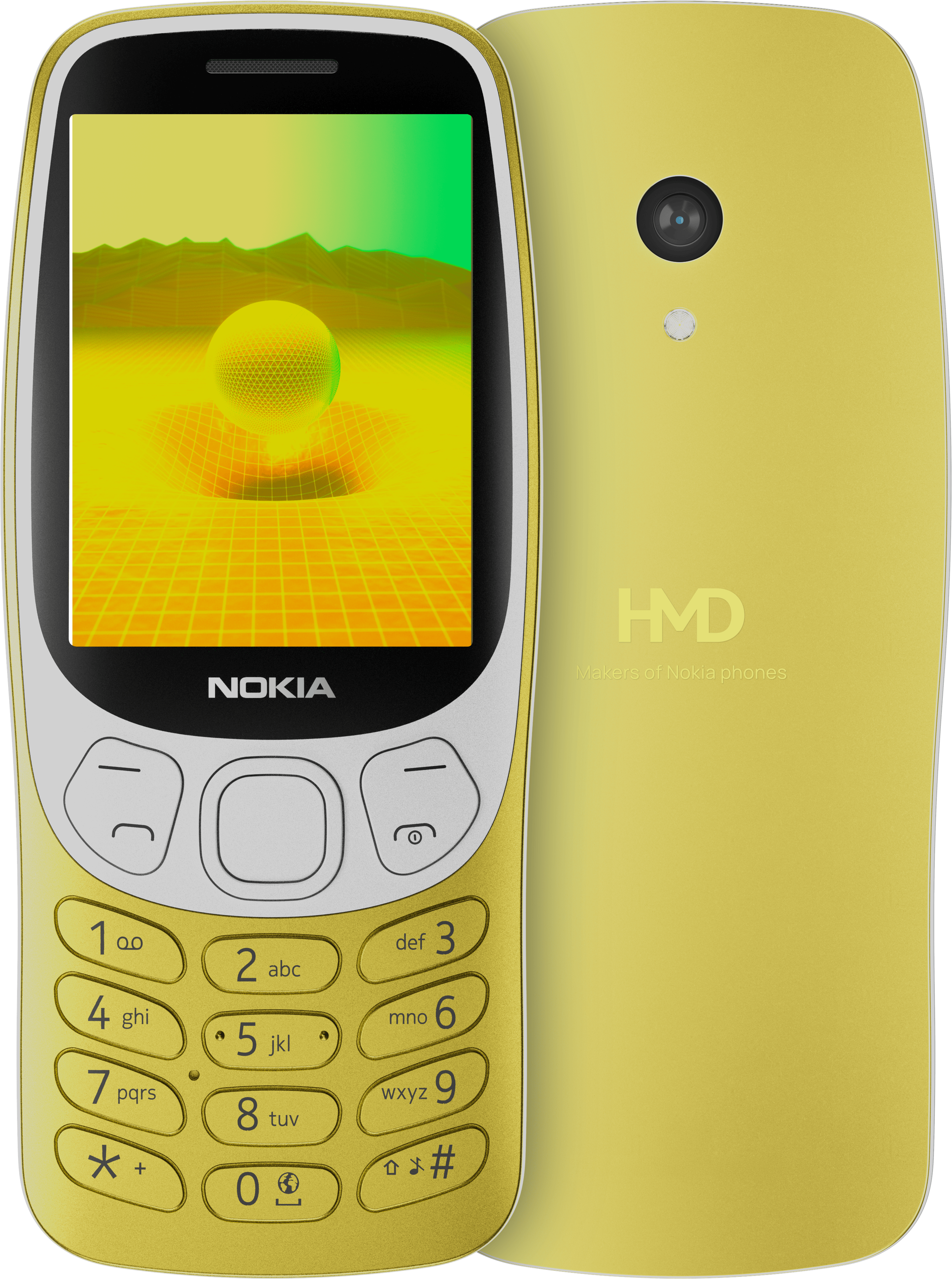
The Nokia 3210 4G is useful precisely because it is not trying to be a boutique philosophy product. HMD has revived the 3210 as a 4G feature phone with a 2.4-inch display, physical keypad, removable battery, USB-C, Bluetooth, FM radio, MP3 playback and a 2MP camera.
In some regions, HMD also offers cloud-hosted services on the phone. That creates a peculiar middle ground: the device can access pieces of the online world without becoming a general-purpose smartphone.
For anyone simply curious about digital minimalism, this category makes financial sense. You do not need to spend premium-smartphone money to discover whether you actually enjoy texting with T9, carrying no banking app and navigating without the normal Google Maps experience.
Nokia 2660 Flip
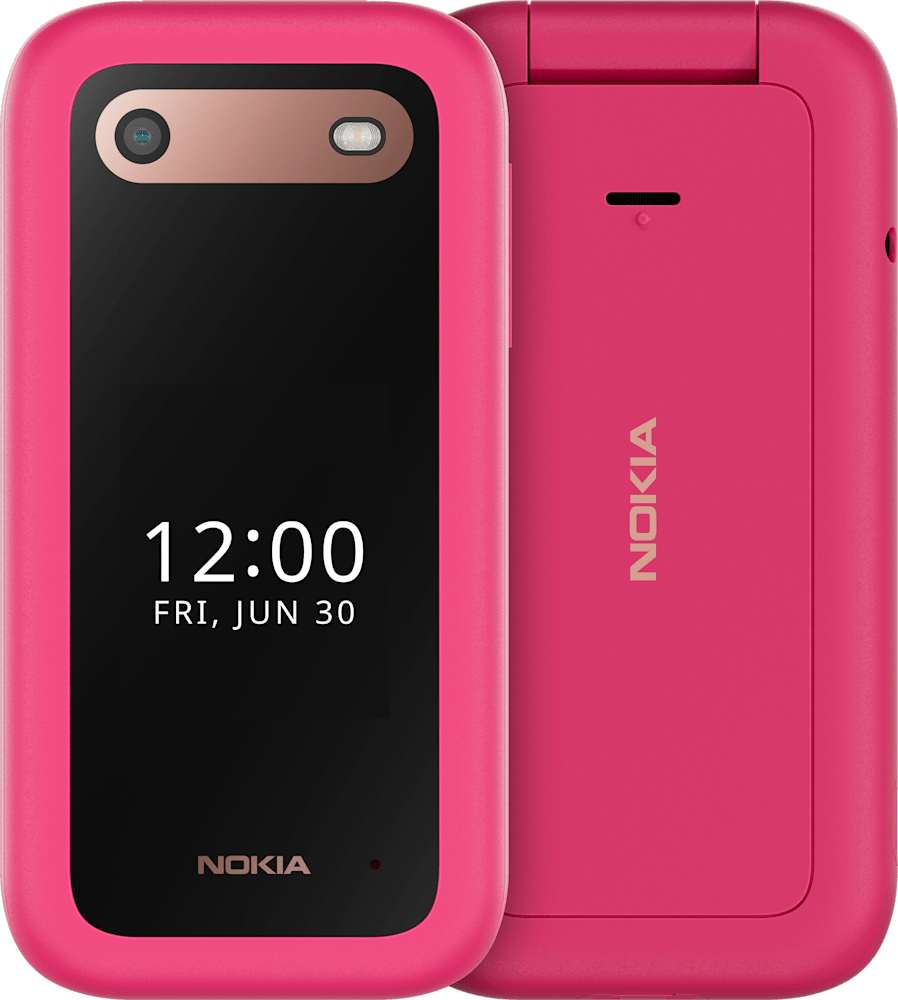
The Nokia 2660 Flip is even more explicit about simplicity: large buttons, a 2.8-inch main display, an external screen, 4G VoLTE, FM radio, a removable battery and a dedicated emergency button. HMD markets it for digital detox, older users and first-phone scenarios.
Regional availability is the catch. HMD still lists the device for sale in markets including India, while its UK site marks it discontinued. This is a recurring rule of the dumb-phone market: the same model name can be a current product in one country and effectively legacy stock in another.
That is why network bands and local carrier support matter more here than they do when buying an iPhone or Galaxy.
Why Paying More Makes Sense
The category creates an obvious economic joke: why should a phone that does less cost more?
Because capability is cheap at smartphone scale. Restraint is not.
Apple, Samsung and Google spread hardware engineering, certification, software development and supply-chain costs across enormous volumes. A small minimalist-phone company has to certify radios, build an operating system, maintain carrier compatibility, manufacture relatively tiny batches and support customers who often expect the reliability of a mass-market flagship.
What you are buying from Light, Mudita, Punkt or Sunbeam is not the absence of features. You are buying a deliberately maintained boundary around the product.
Wisephone makes that boundary explicit by turning it into a subscription. Whether that feels reasonable depends on what you believe the product is: hardware you own, or an ongoing service that protects you from the rest of Android.
The Second-Phone Strategy
There is a false binary in most dumb-phone coverage: either keep your smartphone exactly as it is or replace it completely.
For many people, the more sustainable answer is a second-phone strategy. Keep the smartphone at home, in a bag, or powered off for the situations where modern infrastructure genuinely requires it. Carry the dumb phone for evenings, weekends, social events, walks, focused work or travel where calls and basic navigation are enough.
That is less ideologically satisfying than “I quit smartphones.” It is probably more compatible with actual life.
Dumb.co is effectively productizing this compromise. Light supports hotspot use. Punkt treats a tethered laptop as the place where the internet belongs. These are not failures of minimalism. They are acknowledgments that context is a better boundary than purity.
Software Can Be Enough
Before buying new hardware, it is worth testing whether your existing smartphone can be made boring enough.
Use grayscale. Delete social apps. Disable nearly every notification. Remove widgets. Turn off mobile data for entertainment apps. Put the browser behind friction. Use a minimalist launcher. Ask someone else to set the Screen Time or Digital Wellbeing passcode if you routinely override your own limits.
Research suggests that structural restrictions can matter. A 2025 study in Computers in Human Behavior Reports found that a minimalist-phone interface reduced habitual smartphone behavior and overall screen time in a small experimental sample, while a separate randomized trial on screen-time reduction found mental-health benefits from reducing smartphone use. These studies do not prove that everybody needs a dumb phone. They suggest that changing the environment can be more effective than repeatedly asking yourself to resist the environment.
That also explains why a hardware change can still work when a launcher does not. A phone you can reconfigure in thirty seconds is a weak commitment device. A keypad phone with no app store is a strong one.
Privacy Is A Different Problem
Minimalist phones are often discussed as if fewer apps automatically mean greater privacy. Sometimes that is true. It is not a rule.
Mudita makes privacy an explicit hardware and software goal. Punkt emphasizes encrypted communication. Light removes advertising-driven platforms from the device. But a tiny Android phone with access to Google Play can still run the same trackers as a large Android phone. A restricted Samsung may reduce compulsive use while still depending on mainstream cloud services. A carrier flip may have a basic browser, cloud shortcuts and its own telemetry.
Attention, privacy, security and simplicity overlap, but they are four different design problems. Buy for the one you actually have.
The Watchlist: What Comes Next
Three of the most interesting ideas in this market are not equivalent to a proven phone you can buy and use today. They still matter because they show where minimalist hardware is heading: companion devices, full Android with stronger behavioral boundaries, and tactile form factors returning without abandoning 5G.
Dumbphone 2
Dumb.co’s Dumbphone 2 attacks the transition problem instead of trying to build the perfect object. It is a low-cost flip phone paired with a service plan and designed to work as either a companion to a smartphone or a more permanent primary device.
Its current product description includes calls, texts, WhatsApp, Google Maps, Uber, 2FA, camera, weather and other utilities. Dumb.co says the device can sync selected functions and messages from a smartphone, which makes it less of a cold-turkey detox and more of a bridge away from smartphone dependence.
That approach is probably more realistic for a large group of buyers than the absolutism of a no-app device. It also introduces a different dependency: the low hardware price is tied to service. The phone itself is inexpensive, but the relationship is not simply “buy once and leave.”
Minimal Phone 2
Minimal Phone 2 is one of the most ambitious focus-first phones announced for late 2026. It combines a compact 4-inch OLED display with a physical QWERTY keyboard, full Android app compatibility, a 50MP rear camera, 5G, NFC, fingerprint security and software controls designed to make distraction harder.
The crucial detail is that it is not a locked-down dumb phone. Minimal says the device ships with Google Play Services and can run any Android app. Its minimalism comes from interface design, physical typing, optional grayscale, launch delays, app limits and the ability to choose stricter configurations. An official de-Googled ROM is also planned for users who want it.
Preorders start at $599 and the company says shipping is planned for December 2026. Until production devices reach buyers at scale, treat it as a promising upcoming option rather than a proven recommendation.
Light Flip
Light’s next device may tell us even more about where the category is going. The Light Flip takes LightOS and puts it into a fully tactile clamshell with a 2.8-inch non-touch OLED display, T9 keypad, 5G, USB-C, headphone jack and removable battery.
The unlocked preorder price is currently $349. The first two batches are sold out and current reservations are for May 2027 delivery, so it does not belong among phones you can buy and use today. It does belong in this guide because it captures the cultural direction perfectly: users are no longer merely asking for less software. They are asking for a phone that looks and feels unlike a smartphone.
What We Would Avoid
There are many interesting devices around the edges of this category, but not all of them deserve to be primary recommendations in 2026.
- Qin F21 Pro and similar import Android keypads: clever and popular with enthusiasts, but carrier bands, software variants and support can be messy. Some US-configured sellers even warn buyers not to factory reset particular devices. Dumber Mini exists partly because this idea needs a cleaner product layer.
- TCL Flip 4 5G: impressive 5G flip hardware with email and a browser, but it is carrier-oriented and currently sold out on TCL’s own US store. It can make sense if your carrier sells it directly.
- CAT S22 Flip: a rugged Android flip that became a cult minimalist device, but it is older Android hardware and increasingly a used/remaining-stock proposition rather than a modern platform bet.
- HMD Barbie Phone: genuinely fun and intentionally limited, but its main differentiator is cultural design rather than a superior minimalist workflow. Buy it because you want the object, not because it solves a unique dependency problem.
The wider lesson is simple: do not confuse a small screen with intentional software. A full Android phone can still be a smartphone addiction machine at 2.8 inches. It is merely a less comfortable one.
The Bigger Design Lesson
The most interesting minimalist phones are no longer merely phones with fewer features. They are experiments in selective capability. Light says useful tools can exist without infinite feeds. Mudita says connectivity can coexist with hardware-level disconnection. Wisephone says an app ecosystem can be curated. Dumber Mini says physical friction can make full Android less seductive. Punkt says the internet can live on another device entirely.
This is also the mirror image of what DesignWhine has explored in addictive UX. If engagement mechanics can become a product liability, restraint can become a product feature. The provocative part is that people are now willing to pay for that restraint.
That is why the dumb phone is not really a return to the past. It is a critique of the present phone, expressed as hardware. The category is asking a question mainstream product design rarely asks: not how much more a device can do, but how much it can refuse to do while still helping someone live a modern life.
The future of the dumb phone is not less technology. It is technology with a boundary.
Dumb Phone Frequently Asked Questions
These are the questions that matter most before switching to a dumb phone or minimalist phone in 2026.
What is the best dumb phone in 2026?
There is no single best dumb phone for everyone. Light Phone III is one of the strongest premium choices for people who want a tightly controlled device with maps, rideshare and 2FA but no browser or app store. Mudita Kompakt suits users who prefer E Ink and stronger privacy controls. Wisephone II or Balance Phone make more sense if WhatsApp, modern maps, banking and curated apps are non-negotiable.
Which dumb phones have WhatsApp?
Wisephone II supports WhatsApp through its curated Tool Drawer. Balance Phone supports practical Android apps including WhatsApp. Dumber Mini supports WhatsApp and other Android utilities. Dumbphone 2 also lists WhatsApp support. Light Phone III and Punkt MP02 do not currently offer WhatsApp. Mudita Kompakt can technically sideload Android apps, but compatibility is not guaranteed.
Which dumb phones have maps?
Light Phone III has a dedicated Directions tool. Mudita Kompakt includes offline maps. Wisephone II supports Google Maps and other approved navigation apps. Sunbeam F1 Pro Aspen includes Waze. Dumber Mini and Balance Phone can use modern Android mapping apps. Punkt MP02 has GPS hardware but no consumer maps app.
Can a dumb phone handle two-factor authentication?
Some can. Light Phone III added an Authenticator tool in 2026, and Wisephone II includes two-factor authentication support. Full or restricted Android devices can usually run compatible authenticator apps. Traditional feature phones generally rely on SMS codes, which may not satisfy employers or services that require app-based authentication.
Can you use banking apps on a dumb phone?
Usually not on true feature phones or closed minimalist phones. Wisephone II, Balance Phone, Dumber Mini and Minimal Phone 2 are more suitable if banking apps are essential. Even Android-based minimalist devices can fail with banking apps when Google services, device certification or security requirements are missing, so verify your bank before switching.
Are dumb phones good for kids?
They can be, but the right choice depends on what the child needs. A Nokia 2660 Flip offers calls, texts, large controls and an emergency button with very little else. Restricted smartphones such as Wisephone or Balance preserve maps and selected messaging while blocking social feeds. Parents should also check school communication apps, location-sharing needs and emergency requirements before choosing a device.
Do dumb phones work on 5G?
Some do. Light Phone III, Wisephone II and modern restricted Android devices support 5G. Many classic feature phones remain 4G-only, which is sufficient for calling, messaging and basic data on compatible networks. Carrier certification and supported frequency bands matter more than the 4G or 5G label, especially with imported devices.
Is a minimalist phone better than using Screen Time or a minimalist launcher?
Not necessarily. Software restrictions are cheaper and preserve all of your smartphone’s infrastructure. Dedicated minimalist hardware creates stronger friction because the missing apps cannot simply be re-enabled. If you routinely override your own limits, hardware may work better as a commitment device. If you only need fewer notifications and less visual stimulation, software may be enough.



If you switched to a dumb phone tomorrow, what would break first in your life: WhatsApp, maps, banking, work authentication, payments, or something else?