
If you are a senior product designer rebuilding your portfolio in 2026, this guide gives you a concrete structure for what to show, what to cut, how many case studies you need, how to prove seniority, where AI belongs, how to handle work under NDA, and how to make a hiring manager understand your value before they have time to admire your mockups.
The old portfolio formula was built for a slower design market: polished screens, a tidy double-diamond process, a research section, some wireframes, a final UI and a triumphant “what I learned.” That format is not useless. It is simply no longer enough. AI has made polished artifacts easier to produce, product roles are bleeding into one another, and senior designers are increasingly being hired for judgment, ownership, systems thinking and their ability to move a problem from ambiguity into something real.
That changes the job of the portfolio. A senior portfolio is no longer a record of your design process. It is evidence that you can be trusted with consequential product decisions.
Table of Contents[Open/Close]
- 1.What Changed in 2026
- 2.What Hiring Teams Now Scan For
- 3.The Seniority Evidence Stack
- 4.Choose Three Case Studies
- 5.Build Each Case Study Around Decisions
- 6.Show AI Without Looking Dependent
- 7.Handle NDAs and Missing Metrics
- 8.Use the 15-Minute Portfolio Test
- 9.What to Delete
- 10.Your Portfolio Is Not the Interview
- 11.Senior Product Design Portfolio FAQ
What Changed in 2026
The strongest signal is not that design hiring has disappeared. Figma’s 2026 hiring research found that 82% of hiring managers said their need for designers had stayed stable or increased. But the mix has shifted upward: 56% reported increasing demand for senior designers, versus 25% for junior talent. Figma’s hiring managers also placed visual polish, collaboration, systems thinking and product strategy among the skills they value most. (Source: Figma, 2026 design hiring research.)
Live senior-product-design roles tell the same story. Figma asks designers to move between strategy, storytelling and execution. Future wants end-to-end ownership, product thinking, systems design, user feedback, metrics and AI fluency. HighLevel explicitly asks for a portfolio demonstrating product judgment, systems thinking, customer empathy, execution and measurable impact. InStride asks for complex workflow design, systems thinking and measurable outcomes. AlphaSense wants designers who can simplify ambiguous, data-rich problems and actively use AI across research, ideation and prototyping. (Figma; Future; HighLevel; InStride Health; AlphaSense.)
Notice what is missing from that list: “can produce a perfect Discover → Define → Ideate → Prototype → Test diagram.” Employers still care that you can research, design and validate. They just care more about what you did with that information.
Your portfolio is no longer proving that you know the design process. It is proving that you know when to use it, when to skip it, and what decision came out the other side.
This is especially important because AI is raising the craft floor. Figma’s State of the Designer 2026 found that 89% of designers said AI helps them work faster and 91% said AI tools improve their designs. When competent output becomes easier to make, competent output stops being a useful proxy for seniority. (Source: Figma, State of the Designer 2026.)
What Hiring Teams Now Scan For
A senior portfolio has to survive two different reads. The first is a scan. The second is an interrogation.
During the scan, a reviewer is trying to answer a small number of questions quickly: What kind of designer is this? What level of problem have they owned? What products or domains have they worked in? Can they ship? Do they have taste? Is there evidence of impact? Is there enough here to justify spending more time?
During the interrogation, the questions become harder: What did this person actually own? What was difficult? Which decision changed because of them? Where did they push back? What trade-off did they make? What happened after launch? Can they distinguish their contribution from the team’s? Could I trust them with an ambiguous problem without prescribing the solution?
The portfolio therefore needs two layers. Your homepage and project cards should make the scan effortless. Your case studies should make the interrogation rewarding.
| Portfolio Layer | What It Must Prove | What to Show |
|---|---|---|
| Homepage | Positioning | Level, product/domain focus, 3 strong projects, concise outcome signals |
| Project card | Relevance | Problem, role, scope, outcome |
| Case study | Judgment | Constraints, decisions, trade-offs, evidence, impact |
| Artifacts | Craft | Flows, prototypes, UI, systems, shipped product |
| Reflection | Maturity | Failed bet, course correction, what you would change now |
The Seniority Evidence Stack
Instead of asking whether a case study “looks senior,” audit it against seven forms of evidence. We call this the Seniority Evidence Stack.
- Scope: Was the problem consequential enough to require senior judgment?
- Ambiguity: Did you receive a clear brief, or did you help define the problem?
- Decision quality: Can the reader see the choices you made and why?
- Influence: Did you change product direction, align stakeholders or shape priorities?
- Systems thinking: Did you consider connected flows, states, platforms, edge cases or reusable patterns rather than one isolated screen?
- Outcome: What changed for users or the business because the work shipped?
- Learning: What was wrong, uncertain or unsuccessful, and what did you do next?
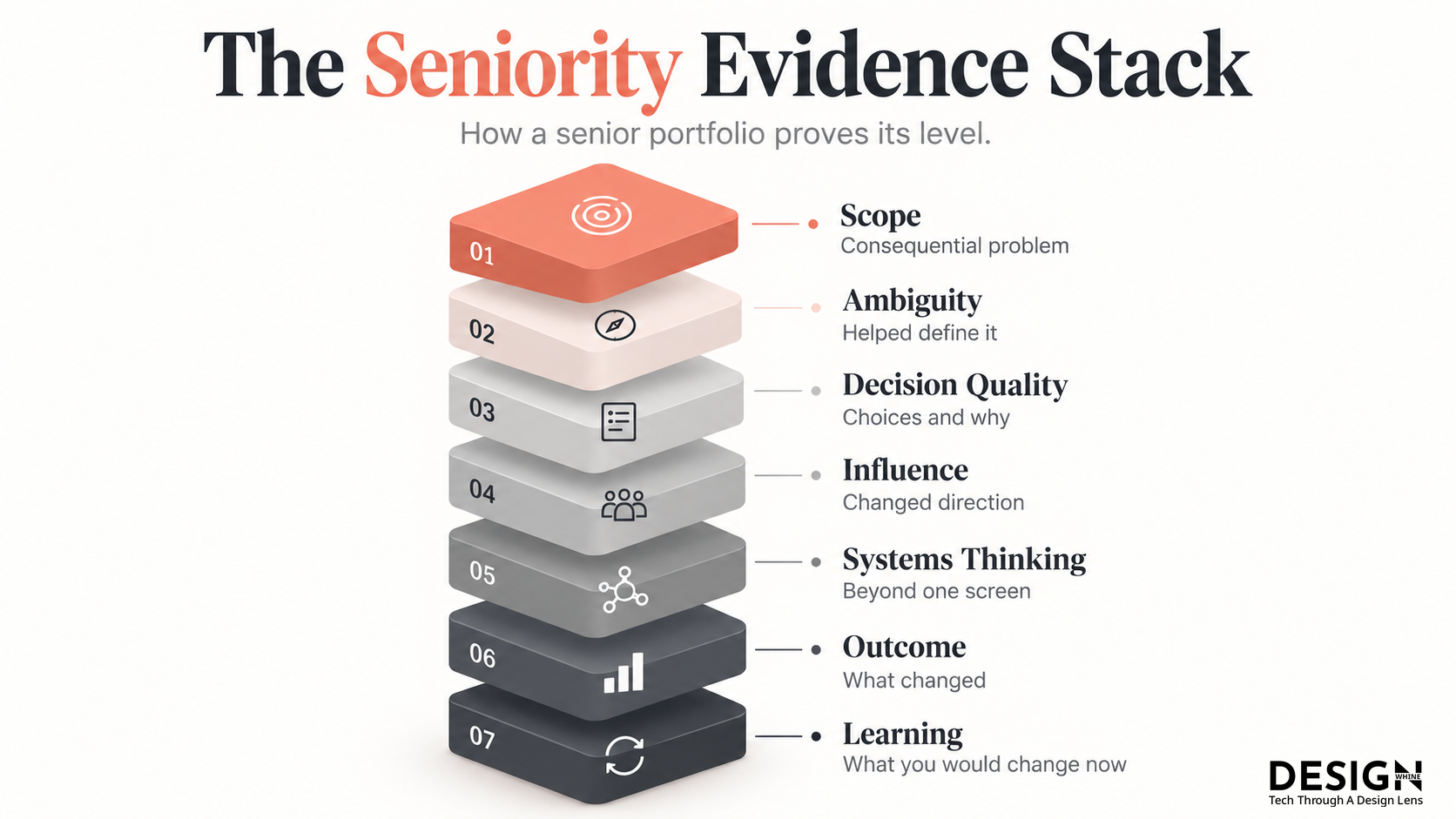
A polished project that scores well only on craft is not senior evidence. A visually imperfect enterprise project can be extremely strong if it shows scope, ambiguity, influence, systems thinking and a measurable outcome.
This is the same career shift we explored in The UX Career Ladder Is Becoming a Trap: progression is becoming less about accumulating a larger title and more about demonstrating what kind of decisions an organization can safely hand you.
Seniority is not the complexity of your Figma file. It is the complexity of the decision you can be trusted to make.
Choose Three Case Studies
For most senior designers, three strong case studies are enough. The goal is not to show everything you have done. It is to construct a believable picture of your range.
A useful portfolio mix is:
- Case Study 1: The flagship. A complex, shipped product problem with strong ownership and a clear outcome.
- Case Study 2: The contrast. A different kind of challenge that proves range: systems, growth, enterprise complexity, 0→1, mobile, AI, research-heavy work or platform design.
- Case Study 3: The future signal. Work that points toward the roles you want next, particularly AI-enabled product work, deeper prototyping or design-to-code if that is where you are heading.
Do not choose three projects because they are your prettiest. Choose them because together they answer the hiring question: what can this person own?
If your career is moving toward implementation, the third case study can naturally connect to the skills in our guide on becoming a design engineer when you are already a product designer. If your advantage is AI fluency, use the framework in The Senior Product Designer’s AI Workflow Map for 2026 to show where AI genuinely extended your reach rather than merely speeding up output.
Build Each Case Study Around Decisions
This is where most portfolios should be rebuilt. Stop using the design process as the table of contents. Use the decision story.
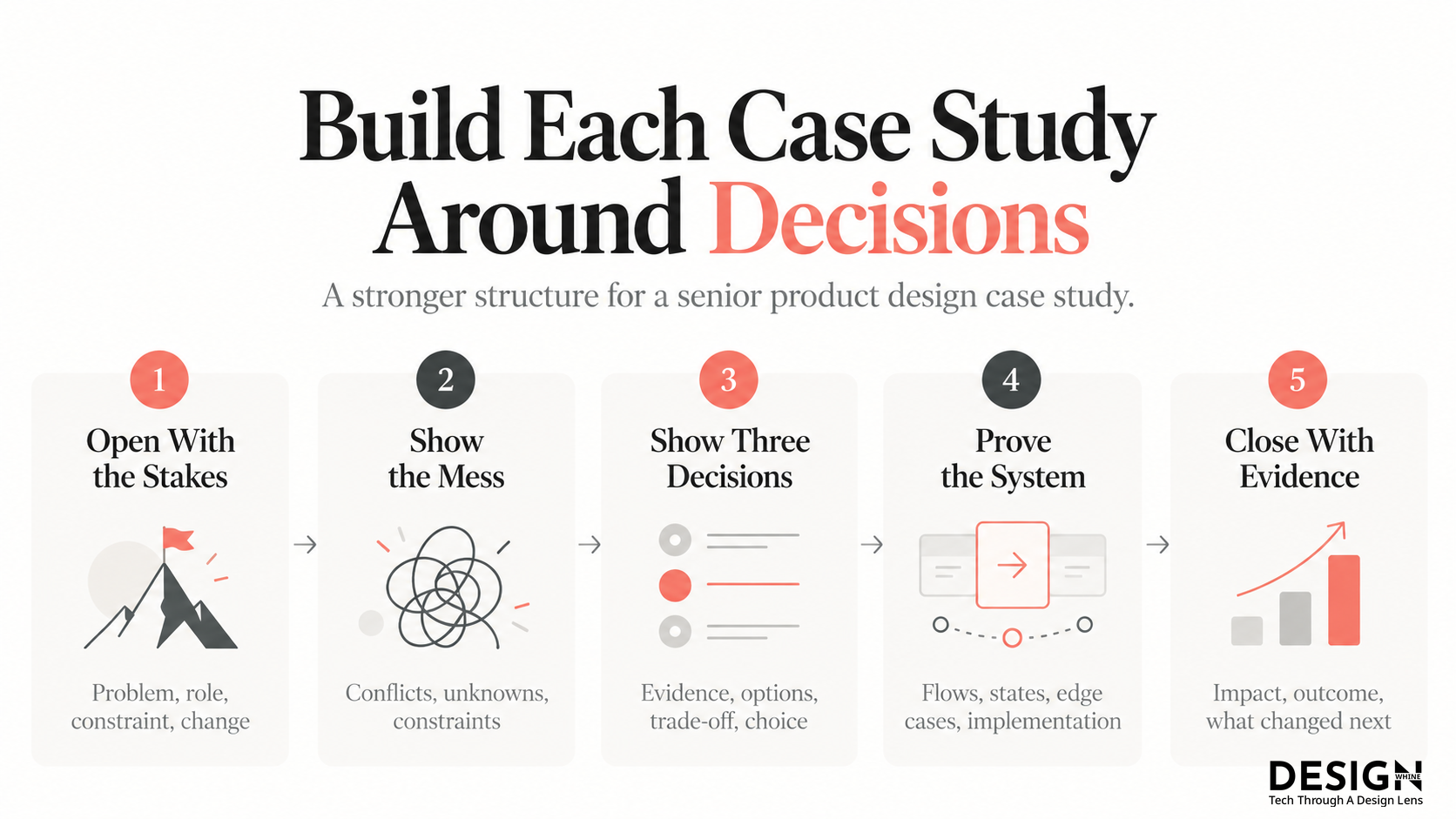
1. Open With the Stakes
Give the reader the entire project in roughly 100 words: what the product was, what was broken or uncertain, your role, the scale, the constraint and what changed.
Weak: “We were asked to improve onboarding, so I followed a user-centred design process.”
Stronger: “Activation had stalled because enterprise admins could not understand which setup steps belonged to them and which belonged to IT. I led the redesign across research, product definition and interaction design with one PM and four engineers. We reduced the setup flow from 11 loosely connected tasks to four role-based stages and increased successful first-week configuration from X to Y.”
2. Show the Mess
Senior work is rarely linear. Show why the obvious solution did not work. Surface the contradictory user needs, technical debt, stakeholder conflict, bad assumption, missing data or organizational constraint that made the project difficult.
This is often more persuasive than showing five pages of workshop photos because it tells the reviewer you can operate when the method does not tell you what to do next.
3. Show Three Decisions
Pick the three decisions that most changed the project. For each one, use the same four-part structure:
- Evidence: What did you know?
- Options: What could you have done?
- Trade-off: What did each option cost?
- Decision: What did you choose, and what happened?
This is the section hiring teams can discuss internally. “This designer decided X because Y, despite Z” is far more memorable than “this designer created a journey map.”
4. Prove the System
Show the experience beyond the hero screen. Include awkward states, permission differences, empty states, responsive behavior, design-system decisions, failure states, accessibility, content logic or implementation constraints where they mattered. Current senior roles explicitly ask for end-to-end flows, systems thinking, edge cases, design-system adoption and implementation quality because that is where shipped products stop behaving like portfolio shots.
5. Close With Evidence
Use the strongest evidence you genuinely have: conversion, retention, activation, completion rate, support volume, adoption, revenue, time saved, defect reduction, research signal, rollout scale or a concrete organizational outcome. If no metric exists, say what observable behavior changed. Never invent precision to make the project look more senior.
Then add one short section titled something like What I Would Change Now. Seniority is easier to believe when the story contains a mistake, compromise or later insight. A portfolio where every decision was correct on the first attempt feels less experienced, not more.
The most senior sentence in a case study is often not “we increased conversion.” It is “we were wrong about this, and here is what changed next.”
Show AI Without Looking Dependent
AI fluency is now a hiring signal, but “I use AI” is rapidly becoming meaningless. Figma’s hiring research found that the need for AI-tool proficiency has increased across regions, while current senior roles increasingly mention AI-assisted workflows directly. The useful question is therefore not whether you used AI. It is what new capability the tool gave you and what judgment remained yours.
Show AI in your portfolio when it changed one of these things:
- Speed: You moved from idea to realistic prototype quickly enough to test something that previously would not have been built.
- Range: You explored more plausible directions before committing.
- Depth: You interrogated a larger evidence set, more states or more implementation possibilities.
- Reach: You crossed into code, data or another discipline and reduced a handoff.
- Quality: You used AI to inspect, challenge or refine work, then applied human judgment to the result.
Do not devote a case-study section to your prompt library unless prompting itself was central to the product problem. A senior designer’s AI story should sound like leverage, not dependence.
The larger shift is the one we described in When Product Teams Ship Faster, Thinking Becomes the Scarce Resource. The ability to produce is expanding. Your portfolio has to make the quality of your choices visible.
Handle NDAs and Missing Metrics
Senior designers often have their strongest work trapped behind confidentiality. Do not let that become an excuse for an empty portfolio.
For NDA work, abstract the story without pretending it is public. Remove client names, sensitive numbers, proprietary UI and strategic details. Keep the problem class, your role, constraints, decision logic and non-sensitive outcome. If visuals cannot be shown, recreate simplified diagrams that explain the interaction structure rather than reproducing the product.
If you cannot share exact metrics, use ranges, directional outcomes or qualitative evidence only when permitted: “double-digit reduction in support contacts,” “rolled out across all enterprise accounts,” “adopted by three internal teams,” or “eliminated a manual review step.” State clearly when numbers are withheld.
A credible incomplete story is stronger than a suspiciously complete one.
Use the 15-Minute Portfolio Test
Before publishing, give your portfolio to another senior designer, product manager or engineering lead and ask them to spend no more than 15 minutes with it. Do not explain anything first.
Then ask them these eight questions:
- What kind of product designer do you think I am?
- What level do you think I operate at?
- Which project would you ask me about in an interview?
- What is the hardest product decision you saw me make?
- What did I personally own?
- What impact do you remember?
- Where did AI make me more capable?
- What are you still unsure I can do?
The eighth answer is usually the most valuable. Your next edit should not be “make the site prettier.” It should be “add the missing evidence.”
What to Delete
A senior portfolio often improves more through subtraction than addition.
- Delete generic explanations of Double Diamond, Design Thinking or Agile.
- Delete every workshop artifact that does not change the story.
- Delete giant walls of affinity notes unless the analysis itself was exceptional.
- Delete fake personas created to decorate the process.
- Delete mockups that repeat the same interaction without adding evidence.
- Delete “users loved it” unless you can explain what was measured.
- Delete tool inventories that read like keyword stuffing.
- Delete projects that are beautiful but make your current level look smaller.
- Delete fictional redesigns if you already have real shipped work.
- Delete anything that makes the reader work to discover what you actually did.
Keep craft. Figma’s 2026 research found that 58% of hiring managers still place visual polish among the five most important skills for designers. But craft should support the evidence of judgment, not camouflage its absence. (Source: Figma.)
Your Portfolio Is Not the Interview
The portfolio has one job: make a hiring team curious enough to test the claims in it.
That means you should build every case study with the interview in mind. If you show a strategic decision, expect to defend it. If you claim impact, know how it was measured. If you say you drove alignment, be ready to explain who disagreed. If you show an AI-assisted workflow, be prepared to demonstrate what you understood deeply enough to catch when the model was wrong.
For senior candidates, the portfolio and interview should reinforce the same identity. If your site presents you as a systems-minded B2B product designer but the interview is a tour of pretty mobile screens, the positioning collapses.
And if you are trying to escape the feeling that every design career now leads to the same narrow ladder, that is precisely why portfolio positioning matters. As we argued in Leaving UX Design in 2026, designers are increasingly redefining their careers around the problems they want to own rather than a single inherited job title.
The best senior portfolio does not say “look at everything I can make.” It says “this is the kind of problem you can trust me to own.”
Senior Product Design Portfolio FAQ
What should a senior product design portfolio include?
A senior portfolio should include clear positioning, roughly three strong case studies, evidence of end-to-end ownership, product decisions and trade-offs, systems thinking, strong craft, measurable or observable outcomes, collaboration and influence, and honest reflection on what did not work.
How many case studies should a senior product designer show?
Three strong case studies are enough for most senior portfolios. Choose projects that collectively demonstrate depth, range and relevance to the roles you want next rather than showing every project you have completed.
Should I show AI tools in my product design portfolio?
Yes, when AI materially changed your speed, range, depth, technical reach or quality. Explain what the tool enabled and what judgment remained yours. Avoid turning the case study into a list of prompts or AI products.
What if I cannot show work because of an NDA?
Abstract the case study. Remove confidential names, visuals and numbers while preserving the problem class, your role, the constraints, the decisions you made and any non-sensitive outcome you are allowed to discuss.
Do senior product design portfolios still need polished UI?
Yes. Craft remains a hiring signal, but polished UI alone is not evidence of seniority. The portfolio should show how strong execution connects to product judgment, systems thinking, user needs and measurable outcomes.




Design leaders and hiring managers: what is the one thing a senior product design portfolio must prove before you will move a candidate forward?