
For years, the UX career ladder came with a reassuring promise. Learn the craft. Become a senior designer. Lead bigger problems. Gain influence. Eventually, move into staff, lead, management or design leadership.
The higher you climbed, the better the career was supposed to get.
That assumption is starting to look less secure. The uncomfortable question facing experienced designers in 2026 is not simply whether they can get promoted. It is whether the next promotion gives them more of the work they actually want.
That distinction matters. In our recent piece on why designers are considering leaving UX, the deeper story was not that UX had suddenly stopped existing. It was that the old career bargain had begun to fray. The UX career ladder may be where that bargain becomes most visible.
The problem with the UX career ladder is not that designers cannot climb it. It is that the view from the next rung increasingly looks like less of the work they wanted.
The Ladder Was Built for an Older UX
The conventional ladder assumes that professional growth and organizational elevation are roughly the same thing. A junior designer becomes more capable, earns a senior title, takes on broader scope, then eventually moves toward leadership. Responsibility expands. Compensation usually rises. The designer becomes more important to the organization.
But importance and satisfaction are not the same variable.
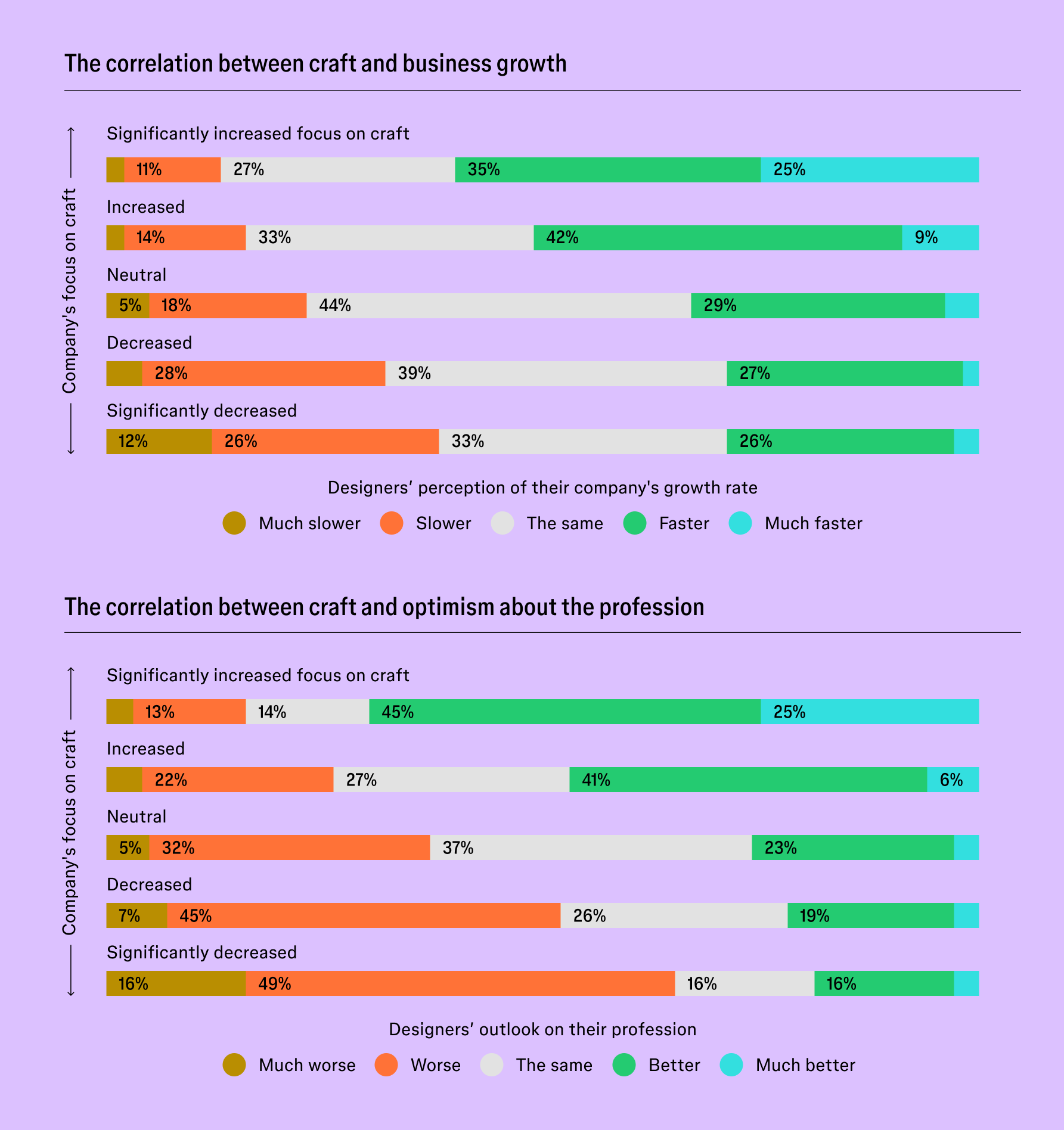
Figma’s State of the Designer 2026, based on 906 digital designers across multiple regions, gives this tension unusually clear numbers. Creative freedom was the most important contributor to happiness at work. Forty-eight percent placed it in their top three job attributes. Work-life balance followed at 47%. Impact of work and compensation each reached 37%.
Opportunities for growth came in at 28%.
That does not mean designers have stopped caring about growth. It suggests something subtler: growth is valuable when it produces a better working life. A bigger title is not automatically a better working life.
Promotion Often Means Leaving the Work
Design is hardly the only profession with this problem. The classic management transition asks a strong individual contributor to stop succeeding primarily through their own output and start succeeding through other people, systems, priorities and decisions.
In UX, however, that transition has become especially strange because the craft itself is changing at the same time. Senior designers are expected to understand research, product strategy, business context, design systems, analytics, accessibility, AI workflows and increasingly some amount of code. The rise of the design engineer has made that boundary even more porous.
Then the ladder asks many of those same people to prove their maturity by spending less time inside the work and more time around it.
The calendar changes first. More planning. More one-to-ones. More reviews. More hiring. More performance conversations. More cross-functional negotiation. More budget discussions. More escalation. More decks explaining what design is doing and why it matters.
None of this is fake work. Good design leadership can transform a product organization. But it is a different job from being excellent at product design, and treating it as the natural next level quietly turns management into a tax on mastery.
The rise of the design engineer has made that boundary even more porous.
The Autonomy Paradox
This is where the ladder becomes a trap rather than merely a choice.
Designers often pursue seniority partly because they want more autonomy. Yet higher organizational responsibility can produce the opposite experience. You may have more authority on paper while becoming more constrained by roadmaps, staffing, executive priorities, dependencies, delivery pressure and the need to align a larger number of people.
Figma’s research found that 87% of designers say decision-making power helps them do their best work. Ninety-one percent say clear goals and expectations help, and 90% say collaboration is essential to producing good work. Those findings are not contradictory. They describe the environment designers are looking for: freedom inside clarity, rather than freedom from everyone else.
The broader workplace evidence points in the same direction. Gallup’s 2025 American Job Quality Study found that 71% of U.S. employees reported at least some freedom to decide how they carry out their work, and notes the established relationship between autonomy, job satisfaction, well-being and burnout risk.
For experienced designers, the career question is therefore not simply how much responsibility they can accumulate. It is whether responsibility increases their agency or consumes it.
Seniority is supposed to buy agency. Too often, it buys a larger surface area of things you are accountable for but do not control.
AI Makes Seniority Stranger
AI is accelerating this tension because the artifacts that once signaled design expertise are becoming cheaper to produce.
Wireframes, interface directions, prototypes, variants, copy and increasingly working front-end code can appear far earlier in the process. As we argued in The Gates of Design Have Fallen, access to production is no longer the scarce resource it once was.
Judgment becomes more important precisely because making becomes easier. But judgment is awkward to fit into a ladder designed around increasingly visible scope. The best senior designer may be the person who prevents an unnecessary feature, simplifies an interaction before it becomes a roadmap, notices the weak assumption in a prototype or understands why a seemingly minor design decision will create a system-level problem six months later.
Those are high-value contributions. They are also harder to package as evidence of upward motion than a larger team, a bigger initiative or a more impressive title.
AI therefore creates a strange possibility: experienced designers may become more valuable as practitioners at exactly the moment the traditional ladder encourages them to leave practice.
The Portfolio Never Stops
There is another reason seniority no longer feels as protective as it once did. The profession repeatedly asks experienced designers to re-prove themselves.
A decade of work does not necessarily remove the need for the case study. Senior candidates are still expected to reconstruct process narratives, quantify outcomes, explain constraints, demonstrate craft, show strategic thinking and prove exactly which decisions belonged to them inside highly collaborative products.
The irony is obvious. The more senior the designer, the more collective the work often becomes. The hiring artifact still asks for a clean individual story.
The hiring picture is less bleak than the mood of the field suggests. In Figma’s 2026 survey of hiring managers, 82% reported that their need for designers had either held steady or increased; more than 45% highlighted collaboration, systems thinking and product strategy among critical skills.
That is not a dead profession. It is a profession whose definition of senior value is getting wider while its proof mechanisms remain surprisingly old.
Management Cannot Be the Prize
The answer is not to romanticize individual contribution or treat management as a mistake. Some designers genuinely want to build teams, coach people, shape organizations and make their impact through others. They should have a serious leadership path.
The problem begins when that path is treated as the default definition of ambition.
A healthy design organization needs multiple forms of seniority. Deep craft. Systems stewardship. Research leadership. Product strategy. Design engineering. Team management. Organizational leadership. Some of those paths should involve people management. Others should not.
That is also why the operating model matters. Our guide to building an AI-native UX team without destroying design practice argues for clearer ownership of judgment, research, critique and accountability as role boundaries blur. A modern ladder should do the same thing for careers: make room for increasing influence without forcing everyone toward the same destination.
A Better Career Is Not Always Upward
The old ladder is appealing because it makes success legible. Titles tell a clean story. Senior. Lead. Manager. Director. VP.
Real careers are becoming messier than that. An experienced designer might move closer to code. Another might return from management to an individual contributor role. Another might specialize in design systems or AI evaluation. Another might deliberately choose a smaller company where the title is less impressive but the work is more direct. Another might keep the same title for years while their influence expands dramatically.
None of those paths is a failure to progress.
The deeper shift is that senior designers are becoming less willing to accept status as a substitute for a good working life. Creative freedom, meaningful impact, autonomy, compensation, balance and craft are not soft alternatives to ambition. They are increasingly the things ambition is for.
The most mature career decision may be refusing a version of success that removes the reasons you wanted the career in the first place.
The Next Rung Has to Earn Its Place
The UX career ladder is not disappearing. It is losing its monopoly on what progress looks like.
That is probably healthy. A profession built around understanding human needs should be capable of designing careers around them too.
The important question for a senior designer is no longer simply, “What is the next level?” It is, “What becomes better if I take it?”
If the answer is more agency, more meaningful scope, better compensation, greater craft, stronger influence or a life that works better, climb.
If the answer is mostly a title and a calendar full of work you never wanted, the ladder has stopped being a ladder. It has become a trap.



For experienced designers: what would make the next level genuinely better for you, more scope, more autonomy, more craft, better pay, or something else?