


For years, the AI climate debate has obsessed over the electricity consumed by data centers. A new peer-reviewed study suggests the bigger question may be what AI helps the rest of the economy produce.
For all the anxiety over how much electricity ChatGPT consumes, some of the most consequential AI emissions may never show up on a data center electricity bill.
They might instead come out of an oil well.
That distinction matters because the environmental debate around AI has spent the past few years becoming remarkably good at counting things we can see: GPUs, watts, cooling water, model-training runs and, occasionally, the supposed carbon footprint of a single prompt.
DesignWhine encountered the absurdity of this numbers game last August, when estimates for the emissions generated by an AI query varied by more than 175 times. The disagreement was not merely about measurement. Researchers were drawing completely different boundaries around what an AI carbon footprint actually was.
We ended that piece wondering whether the obsession with getting the number right was distracting us from a more important question: what happens when AI leaves the data center and starts changing the systems around it?
A year later, there is now a rather uncomfortable answer. It is a question DesignWhine has been circling for the past year, first through AI’s messy carbon accounting, then through the idea of enabled emissions.
A new peer-reviewed study published in npj Climate Action, a Nature Portfolio journal, estimates that AI-driven productivity gains across the energy economy could increase global CO₂ emissions by roughly 0.5 to 1.8 gigatonnes annually under scenarios in which the technology is adopted in parallel across fossil fuels and renewables.
The reason is not the electricity required to run AI.
It is what AI makes easier to extract.
The Carbon That Never Reaches An AI Company’s Ledger
This particular blind spot is not entirely new to DesignWhine.
In October 2025, we spoke at length with Holly Alpine, a former Microsoft employee who, alongside Will Alpine, had begun campaigning around a term they called enabled emissions.
Their argument was simple enough to be unsettling.
Suppose an AI system helps an oil company identify reserves more accurately, reduce drilling costs or extract more oil from an existing field. The technology company might account for the electricity consumed by the AI system. The oil company might account for its operational emissions.
But what about the additional oil that became economical to extract because the technology made the operation more productive?
In October 2025, Holly told DesignWhine that AI, cloud computing and IoT tools were being sold into fossil-fuel operations specifically because they could make production “cheaper, faster, and more profitable.”
The carbon released when that additional fuel is eventually burned sits awkwardly outside the conventional accounting boundary.
That, Holly argued, was the missing category.
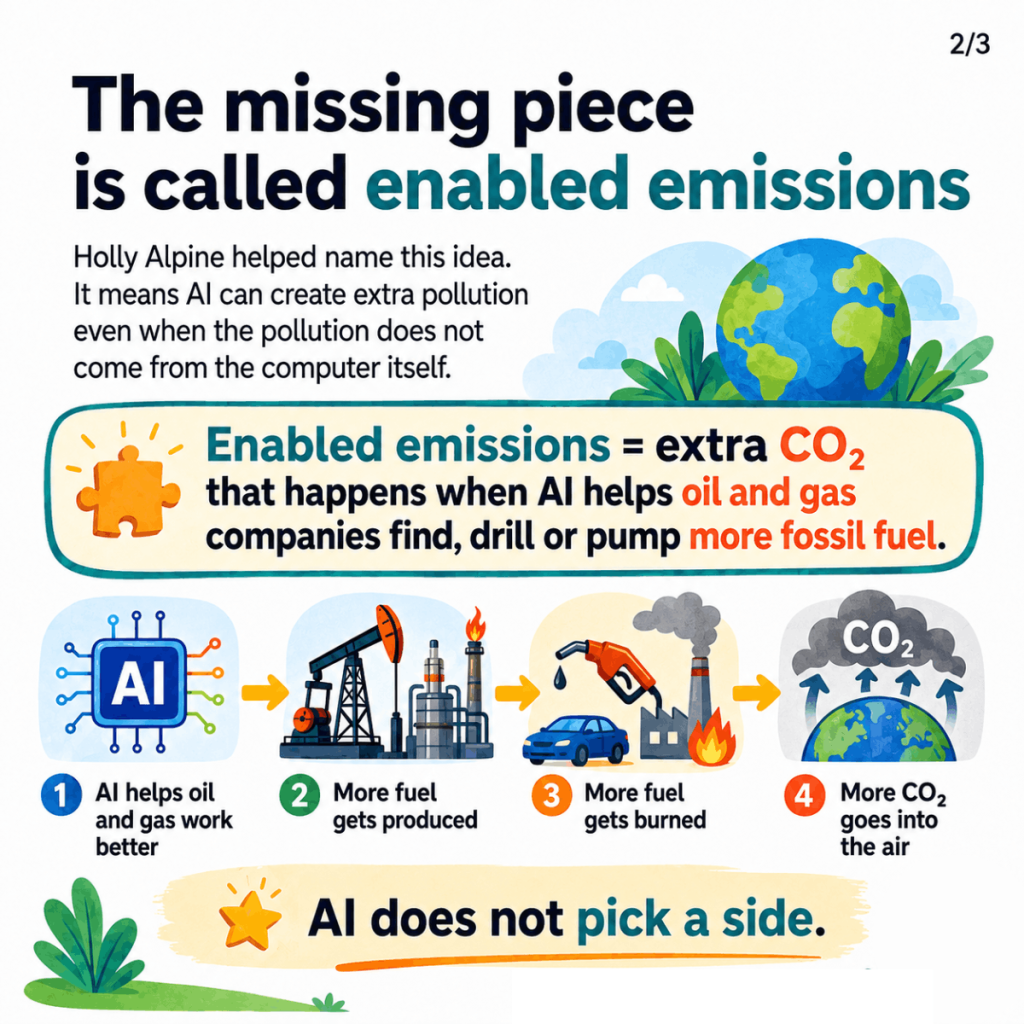
At the time, enabled emissions were primarily an accountability argument. Holly told DesignWhine that AI, cloud computing and IoT tools were being sold into fossil-fuel operations specifically because they could make production “cheaper, faster, and more profitable.”
The new paper, authored by Will Alpine, Nathan Geldner, Holly Alpine and Purdue University researcher Maksym G. Chepeliev, attempts to take the next step: what happens if you actually model those effects across the global economy?
AI Does Not Pick A Side
One of the most useful ideas in the paper, authored by Will Alpine and Holly Alpine of the Enabled Emissions Campaign, Nathan Geldner, and Maksym G. Chepeliev of Purdue University, is its description of AI as a “bidirectional productivity amplifier.” The Enabled Emissions Campaign was created to address what its founders see as a major accountability gap: the climate consequences of advanced technologies used to expand fossil-fuel production.
AI can make a wind farm better at forecasting generation. It can improve grid management. It can optimize industrial energy use.
It can also make an oil field easier to explore, a reservoir more productive and a marginal fossil-fuel project more economically viable.
The technology itself does not choose between the two. 💬 (1)
The researchers therefore model productivity improvements across competing energy pathways rather than treating AI primarily as an additional source of electricity demand. Under parallel adoption, their model produces a net increase of 0.5 to 1.8 gigatonnes of CO₂ per year, or about 1.2 to 4.8 percent of 2024 global energy-related CO₂ emissions.
The researchers find that renewable-energy productivity gains have to outpace fossil-fuel productivity gains by roughly four to five times just to reach emissions breakeven
More striking is what it takes for the equation to move in the other direction.
The researchers find that renewable-energy productivity gains have to outpace fossil-fuel productivity gains by roughly four to five times just to reach emissions breakeven. Across 64 modeled combinations, emissions reductions occurred only where fossil-sector productivity gains were zero.
That is an extraordinary imbalance, but it makes more sense once you stop thinking of AI purely as a cleaner or dirtier piece of software.
Improving renewable generation helps produce more low-carbon energy. Improving fossil-fuel extraction can alter the economics of the resource itself. Lower production costs expand what is commercially viable to extract, which can affect supply, prices and consumption elsewhere in the economy.
The paper finds that upstream extraction, rather than fossil-fuel power generation, is the principal driver of the imbalance.
In other words, an AI system that makes a power plant marginally more efficient is not necessarily the problem. An AI system that makes previously uneconomical oil economical may be.
AI Emissions May Be Much Bigger Than The Data Center
This is where the scale of AI emissions beyond the data center becomes difficult to ignore.
The International Energy Agency’s 2025 Energy and AI report estimated emissions from electricity used by data centers at around 180 million tonnes of CO₂, with that figure rising toward 300 million tonnes by 2035 in its base case.
The new paper estimates enabled emissions from fossil-fuel productivity gains alone at 0.6 to 2.4 gigatonnes annually, equivalent to roughly 3.3 to 13.3 times the IEA’s current data-center figure.
The researchers are careful not to simply add the two together. They are different categories of impact. Datacenter emissions measure the operational footprint of the infrastructure. Enabled emissions measure economic consequences arising from how the technology is used.
The new paper estimates enabled emissions from fossil-fuel productivity gains alone at 0.6 to 2.4 gigatonnes annually, equivalent to roughly 3.3 to 13.3 times the IEA’s current data-center figure
But perhaps that is exactly the point.
We have spent an extraordinary amount of energy asking how much electricity an AI model consumes because that is relatively easy to conceptualize. There is a server somewhere. Electricity goes in. Carbon comes out somewhere upstream. We can argue about the decimal places.
It is much harder to measure the emissions created when technology changes what becomes economically possible.
And yet those may be considerably larger.
A Model Should Not Be Mistaken For A Meter
The headline numbers need one important qualification.
The study is not claiming that AI is currently adding precisely 0.5 to 1.8 gigatonnes of CO₂ to the atmosphere every year.
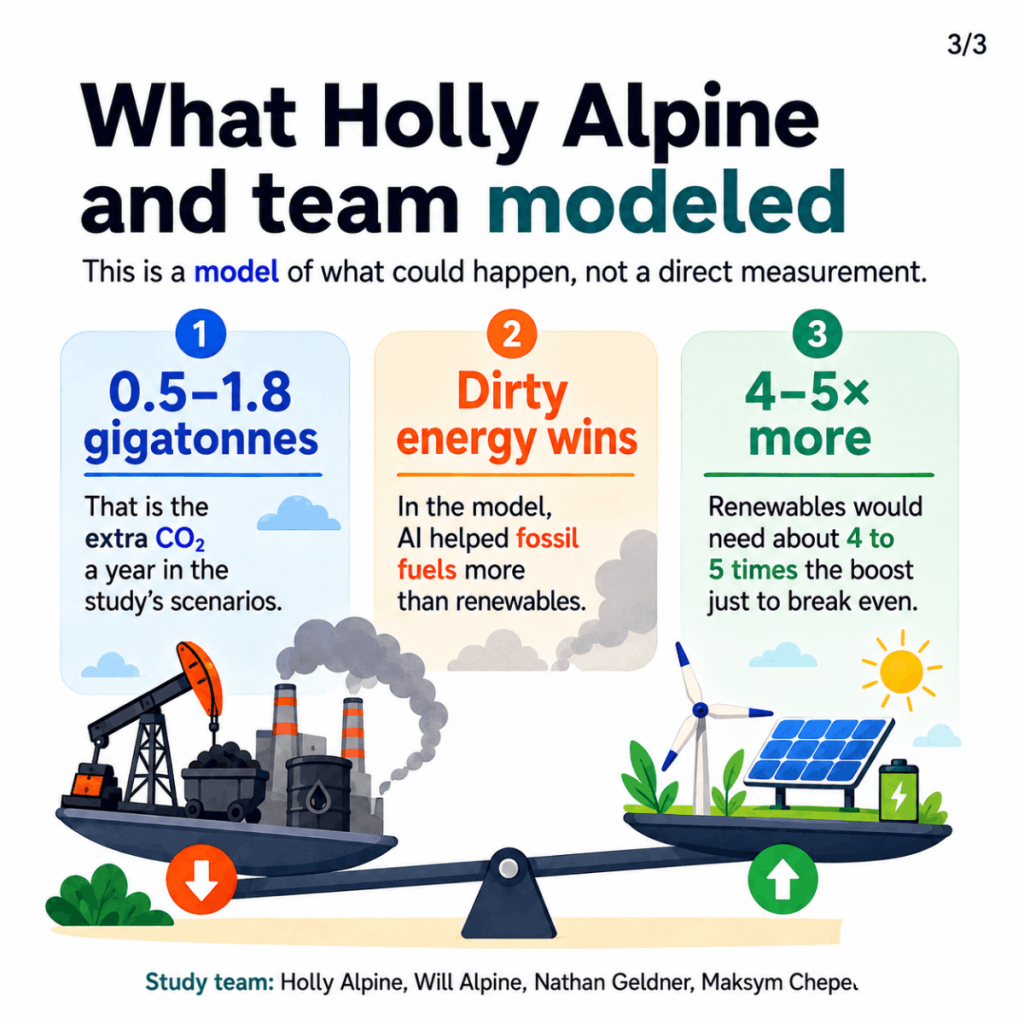
It uses a global computable general equilibrium model to simulate how AI-driven productivity changes could move through competing parts of the economy. The authors explicitly describe the results as indicating direction and approximate scale under current economic conditions, rather than providing a time-specific forecast.
There are other limitations. The model is built on an economic database with a 2017 base year, adjusted to better approximate the 2024 electricity mix. It does not capture every political, infrastructural or technological feedback that could alter what happens in the real world.
The study uses a global computable general equilibrium model to simulate how AI-driven productivity changes could move through competing parts of the economy
Interestingly, some of the assumptions lean in the opposite direction to what critics might expect. Renewable productivity improvements were modeled using the upper bounds of documented technical potential, while much of the fossil-fuel calibration draws on gains already reported or projected by operators and industry analysts.
The number, then, should not become another entry in the very carbon-footprint numbers game we questioned last year.
The more important contribution is the boundary it redraws.
The AI Climate Question Just Became Much Larger
There is a neat, if slightly depressing, progression to this story.
In August 2025, DesignWhine asked why estimates of an AI query’s carbon footprint could disagree by almost two orders of magnitude and concluded that the climate conversation needed to move beyond per-query arithmetic. (Read that piece)
Two months later, Holly Alpine gave us a name for one of the things sitting outside those calculations: enabled emissions. (Read our interview with Holly) Her contention was that technology companies could not celebrate the emissions AI might help avoid while treating the emissions it helped make economically possible as somebody else’s problem.
The real climate question may not be how much CO₂ a ChatGPT query produces, but what happens when AI becomes good enough to make entire industries more productive
Now there is peer-reviewed research attempting to place both sides inside the same economic model.
The study does not prove that AI emissions are inherently destined to rise. In fact, one of the paper’s more interesting conclusions is almost the opposite: AI has no inherent climate direction at all.
It makes systems more productive.
The problem is that the system receiving this enormous productivity boost is still deeply anchored in fossil fuels. The paper concludes that without policy steering, AI’s modeled effects reinforce those incumbent carbon-intensive pathways rather than displacing them.
Perhaps, then, the defining climate question for AI was never going to be how many grams of CO₂ came from asking ChatGPT a question.
It was going to be what happened after AI became good enough to optimize everything else.








Our view: responsibility probably cannot sit with the fossil-fuel company alone. If an AI provider knowingly helps make extraction cheaper, faster or more viable, some accountability should follow the technology too. The harder question is how far that responsibility should extend.