

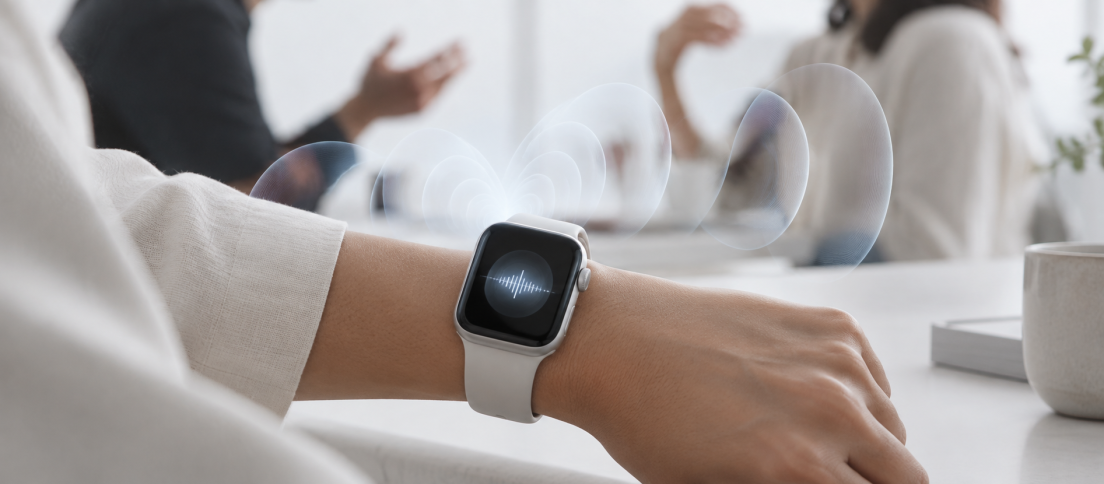
Apple has turned one of the oldest anxieties about smart devices into a product feature. With Apple Watch Series 12, the company is introducing a new set of Audio Intelligence capabilities that can listen for important sounds, recover the previous 15 seconds of speech and generate summaries of conversations.
The headline needs an important caveat. Apple is not saying the Watch secretly records everything around it. The company says these features do not create or store audio recordings, that raw audio is processed inside a hardware-isolated Secure Exclave on the S11 chip and immediately deleted, and that Siri Recap and Live Rewind are opt-in. Users can choose when and where Siri Recap takes notes.
But the product-design shift is still significant. An Apple Watch can now be configured to continuously make sense of the acoustic world around its wearer. The interface is no longer waiting only for an explicit command. It is listening first so that it can become useful later.
Privacy can protect the owner of a device. Consent has to account for everyone standing around it.
What the Watch Actually Hears
Apple is bundling several very different ideas under Audio Intelligence. Sound Recognition listens for sirens, alarms, doorbells or a crying baby and is explicitly designed to help Deaf and hard-of-hearing users. Automatic Shazam identifies music. Live Rewind lets the wearer double-press the Digital Crown to surface what was said in the previous 15 seconds as text. Siri Recap goes further, creating a title, summary and key points from conversations that can later be reviewed in the Siri app.

These are not all ethically equivalent. Sound Recognition is a persuasive example of ambient computing solving a real accessibility problem. Live Rewind and Siri Recap, however, extend the same sensing architecture into ordinary social conversation. Apple says Siri Recap can be set to operate only at work, never at night or according to other user-defined contexts. TechCrunch reported that users can also choose to keep the feature always on.
That puts Apple into territory already being explored by AI wearables and memory products, but at an entirely different scale. A niche AI pendant can remain a niche social experiment. Apple Watch is already a familiar object at dinner tables, offices, classrooms, clinics and family gatherings. The most consequential design change may therefore be cultural rather than technical.
Apple Has Thought About Privacy
Apple’s protections are substantial. Its Audio Intelligence privacy documentation says raw audio is inaccessible to the operating system, apps, the user and Apple itself. Siri Recap creates high-level notes rather than a verbatim transcript, does not attribute individual speakers and is designed to omit categories of sensitive information. Saved Live Rewind snippets and Siri Recap summaries are end-to-end encrypted when synced through iCloud.
This is the kind of privacy architecture we recently argued matters in Perplexity’s local-first AI agent: privacy is strongest when it becomes part of the product architecture rather than a settings-page promise. Apple is doing exactly that here.

But Privacy Is Not Consent
This is where the UX problem becomes more interesting. Apple’s protections largely answer the question, what happens to the wearer’s data? Social consent asks something else: does everyone whose speech contributes to the feature understand what the device is doing?
Apple clearly recognizes the problem. Live Rewind plays an audible chime even when the Watch is on silent and displays a full-screen animation and microphone indicator. Those signals are intended to alert people nearby that the feature has been activated.
Yet Live Rewind has an unusual temporal problem. Its purpose is to recover the previous 15 seconds. The social signal therefore appears when the wearer invokes the feature, after the relevant speech has already occurred and been held temporarily for processing. Technically, that audio was not stored as a conventional recording. Socially, the distinction may be less intuitive to the person who just spoke.

Siri Recap presents an even subtler design challenge. In its public documentation, Apple describes wearer-facing controls for deciding where and when Recap takes notes, while its explicit audible and visible bystander signals are described for Live Rewind. That difference matters because Siri Recap is the feature closest to passive meeting memory rather than a momentary recovery gesture.
The next privacy indicator may need to work more like a social contract than a microphone icon.
The Bystander Is Now a User
Product designers have traditionally treated the device owner as the primary user. Ambient AI breaks that assumption. A wearable microphone, camera or sensor creates a second class of participants: people who never bought the product, never accepted its terms and may not even know which features exist.
We ran into the same problem while examining Meta’s smart-glasses privacy problem. Once computing perceives the environment around its owner, bystanders become part of the interaction whether the product team acknowledges them or not. Indicators, sounds, gestures, physical orientation and social conventions become UX components.
Apple’s approach is considerably more conservative than simply storing a continuous audio archive. It should get credit for that. But strong cryptography does not make an ambient interface socially legible. A person across the table cannot see a Secure Exclave. They can only interpret the object on your wrist and whatever signals it gives them.
This Is Bigger Than Apple Watch
TechCrunch described the new Watch features as part of a broader normalization of technology that is always listening, alongside products built around persistent AI memory. That framing is useful because Apple is not merely competing with other smartwatches. It is making ambient AI feel ordinary by embedding it in one of the most socially accepted wearables in the world.
The shift also sits alongside Apple’s other attempt this week to redefine established interaction models. In our analysis of the new iPhone Duo, the interesting story was not the fold itself but how software responded to a changing physical state. Audio Intelligence asks a similar question in a less visible medium: how should an interface behave when the environment itself becomes an input?
That distinction also matters to our broader argument in Liquid Design and the Myth of Apple’s Great UX. Apple’s engineering can be excellent while the experience still leaves a human problem unresolved. Here, the open question is not whether Apple can process ambient audio securely, but whether the people around the device can understand and negotiate what that processing means.
Apple Watch Series 12 does not settle that question. It does something more consequential: it moves it from experimental AI hardware into mainstream product design. Soon, the challenge will not simply be whether our devices can listen privately. It will be whether the people around those devices can understand, trust and meaningfully negotiate the listening at all.








Apple has gone much further on privacy here than most ambient-AI products: no stored raw audio, hardware-isolated processing, end-to-end encryption and visible/audible signaling for Live Rewind. The harder design question is social rather than technical. If someone else’s words become input to your device, what should meaningful consent actually look like?