

Qualtrics has the peculiar problem of being famous for something smaller than what it actually is. Ask what Qualtrics does and the answer will probably involve surveys. That is accurate in roughly the same way that calling Photoshop a photo cropper is accurate.
The survey builder remains central, but modern Qualtrics extends considerably further. Its research platform brings quantitative surveys, qualitative research, audience recruitment, statistical analysis, text analytics, dashboards and AI-assisted workflows into a much broader research environment. Qualtrics can also bring human panels, first-party audiences and synthetic respondents into that ecosystem.
That breadth is its greatest advantage. It is also why recommending Qualtrics requires more qualification than recommending a conventional survey tool.
DesignWhine's Verdict
Overall
-
Capability
-
Ease of Use
-
Quality & Reliability
-
Value for Money
Summary
Qualtrics remains one of the most capable research platforms available, especially for organisations running sophisticated quantitative research at scale, with its survey logic, analysis tools, audience options and expanding qualitative features making simpler competitors feel limited by comparison.
However, capability and suitability are not the same, and while Qualtrics delivers significant depth it also demands money, learning and organisational commitment that smaller teams doing occasional research may struggle to justify.
Pros
Exceptional survey logic and methodological flexibility
Deep quantitative analysis and reporting capabilities
Strong support for complex and recurring research programmes
Human, first-party and synthetic audience options
Expanding qualitative and AI-assisted research capabilities
Cons
Advanced workflows become considerably more complex than basic survey creation
Expensive for teams with modest research requirements
Breadth can make routine studies feel over-engineered
Full value depends heavily on research maturity and sustained usage
Qualtrics Is Built For Research That Gets Complicated
A basic survey can be made almost anywhere now. The interesting part of Qualtrics begins when the survey stops being basic.
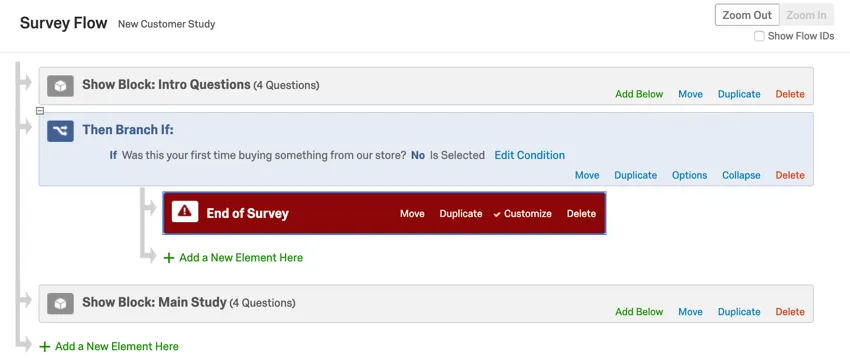
Researchers can construct sophisticated respondent journeys using display, branch and skip logic, organise questions into blocks, randomise experiences and carry embedded data through a study. Survey Flow gives researchers another layer of control over how respondents move through an experiment or questionnaire.
That flexibility matters because real research rarely remains as tidy as its first draft. A study might need respondents assigned to different conditions, sections displayed according to previous answers, quotas imposed on segments or data carried invisibly between stages. Qualtrics is unusually comfortable once those requirements begin piling up.
The platform goes much further than collection. Stats iQ brings statistical analysis into the environment, while Crosstabs, Text iQ and specialist methodologies such as Conjoint and MaxDiff extend what researchers can do without immediately exporting their data elsewhere.
This is the foundation of Qualtrics’ reputation. It does not merely help researchers ask questions. It lets them control the conditions under which those questions are asked and what happens when the answers come back.
Qualtrics is at its best when research has become infrastructure rather than an occasional task.
Tell us where you draw the line."]Qualtrics is at its best when research has become infrastructure rather than an occasional task.[/comment_nudge]
The Basics Are Accessible, The Depth Is Not
It would be unfair to describe Qualtrics as a product that requires weeks of training before someone can send a survey. Creating questions, arranging blocks and launching straightforward studies is reasonably approachable. The learning curve becomes more visible when a team begins using the machinery that makes Qualtrics worth considering in the first place.
Survey Flow, embedded data, advanced logic, quotas, distributions, dashboards, statistical tools and administration introduce layers of decisions that lighter products simply do not expose.
That distinction matters. Some of Qualtrics’ complexity is not bad design so much as the inevitable consequence of allowing researchers to construct complicated studies. Removing those controls would make Qualtrics easier while also making it less Qualtrics.
Still, complexity has a cost even when it is justified. Routine jobs can feel over-engineered, and the breadth of the platform can make apparently simple tasks involve more navigation and configuration than expected. Teams buying Qualtrics primarily to run occasional questionnaires may discover that they have purchased an aircraft carrier for journeys that mostly require a ferry.
Products such as Typeform or SurveyMonkey make considerably more sense when speed and simplicity dominate. Qualtrics becomes compelling when research needs repeatability, methodological control and organisational scale.
Qualtrics Is Finding Sensible Uses For AI
Qualtrics has accumulated the inevitable language of AI, but some of its applications are more useful than decorative.
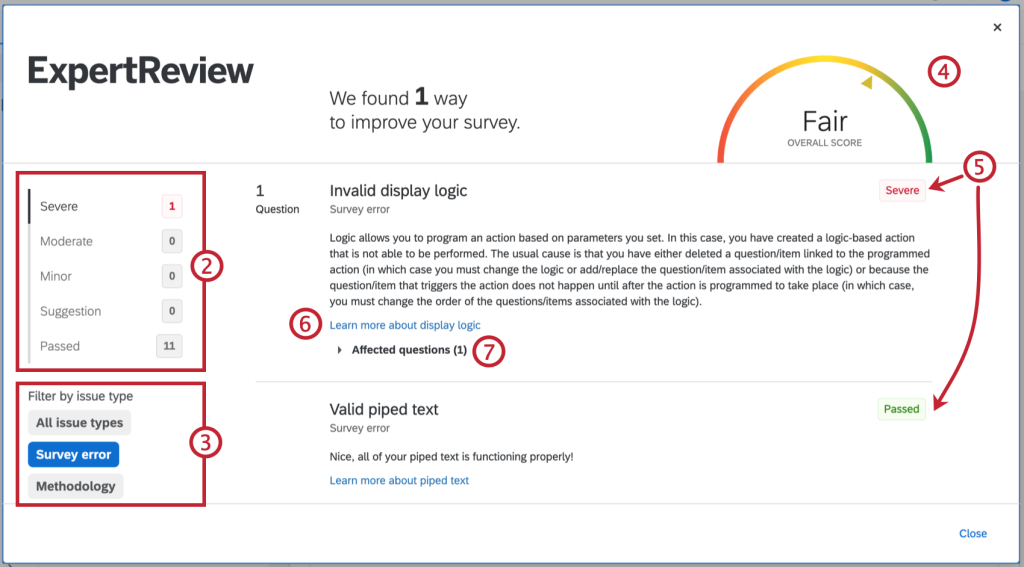
ExpertReview checks surveys before fieldwork and flags potential quality problems. Qualtrics also uses AI around response quality, text analysis, summaries and increasingly qualitative research.
That is a sensible place for automation. Research teams do not necessarily need software to pretend to become the researcher. They need it to reduce the mechanical work surrounding research while making methodological mistakes easier to spot.
Qualtrics is also moving further into qualitative research, supporting interviews, video and audio feedback, diary studies and open-ended research. That expansion makes strategic sense. Researchers increasingly work across quantitative and qualitative evidence rather than treating them as separate professions conducted in separate software.
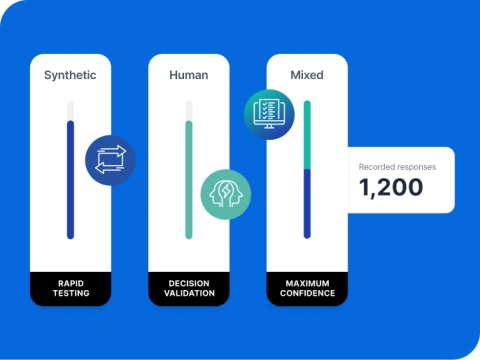
More provocative is Qualtrics’ embrace of synthetic audiences. Its current research offering allows teams to work with synthetic, human and mixed audiences. Used for rapid exploration or early hypothesis generation, synthetic respondents can have legitimate value. Used as a substitute for observing actual people in consequential research, their confidence can become more impressive than their evidence.
Qualtrics deserves credit for putting the researcher, rather than the technology, in charge of that distinction.
Qualtrics deserves credit for putting the researcher, rather than the technology, in charge of that distinction.
The Real Advantage Appears After The Responses Arrive
A surprisingly large number of research products are excellent at obtaining information and much less interesting once somebody has to understand it.
Qualtrics has spent years trying to close that gap. Its Data & Analysis workspace supports filtering, cleaning, classification and analysis, while Stats iQ, text analysis and reporting tools allow researchers to stay inside the platform deeper into the research process.
This becomes particularly valuable in larger organisations. The difference between a survey application and research infrastructure is not simply the number of question types available. It is whether studies can become part of a repeatable system for gathering, analysing and distributing evidence.
Qualtrics increasingly resembles the latter.
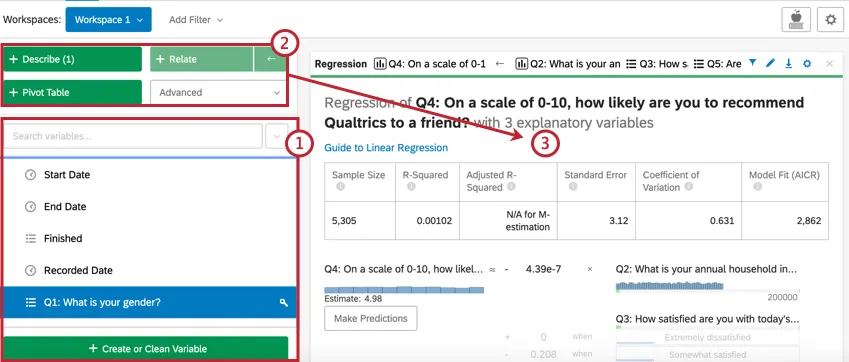
The catch is that this value only appears when an organisation uses enough of the system. Powerful reporting, sophisticated analysis and elaborate workflows are not inherently valuable if a team rarely needs them.
The real Qualtrics question is not whether it can do the job, but whether your organisation needs this much machinery to do it.
Qualtrics Pricing Makes That Question Unavoidable
Qualtrics is not priced like casual survey software. If that is the buying decision you are making, our Qualtrics vs SurveyMonkey comparison makes the difference in scope much clearer.
Its current self-service Surveys package is listed at $420 per month when billed annually, or $5,040 per year, with 1,000 responses shared across users. A more limited free account is also available, while larger parts of the Qualtrics portfolio use packaging and usage structures aimed at organisations rather than individuals.
That pricing changes how the product should be judged.
If a research team needs sophisticated survey design, audience management, statistical analysis, governance and multiple research methods inside one environment, Qualtrics can consolidate a remarkable amount of capability. If most users require only a fraction of those functions, the same platform begins looking less like an investment and more like overhead. Our best market research tools guide places that trade-off alongside narrower research platforms.
This is where some of the frustration surrounding Qualtrics becomes understandable. The product’s ambition keeps expanding, while many customers still arrive with relatively ordinary research problems. More capability does not automatically mean more value.