

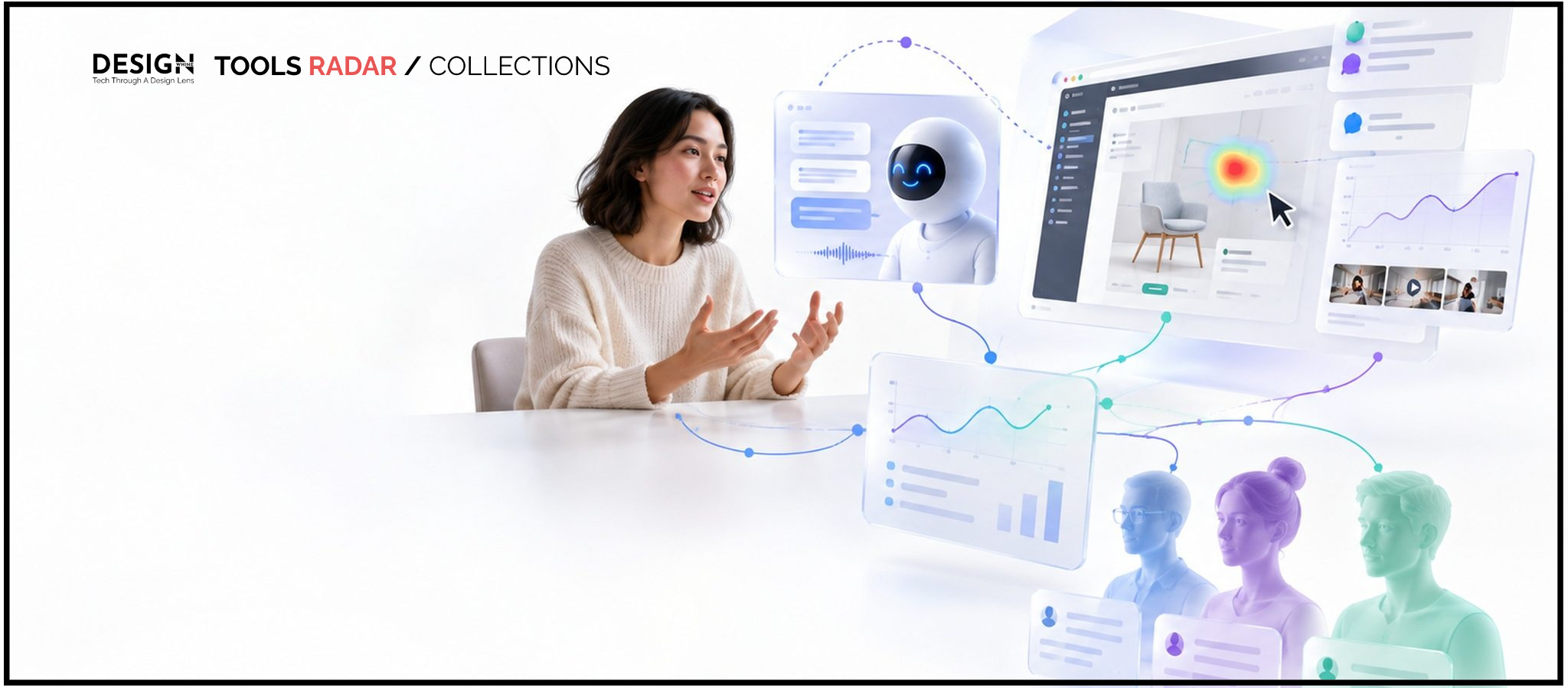
“AI user research tool” has become an almost uselessly broad label. One product uses AI to moderate an interview with a real participant. Another analyses recordings. Another generates synthetic people who never existed. A fourth adds an AI summary to an otherwise conventional usability-testing workflow. Putting them in a single category can make the market look simpler while making the buying decision harder.
The better question is not which tool has the most AI. It is which part of the research process you are willing to delegate. Research planning, participant conversations, usability testing, synthesis and simulated research carry different risks. A team that wants faster analysis needs a different product from one that wants an AI interviewer, and both need a different product from a team experimenting with synthetic users.
This collection sits alongside DesignWhine’s broader best user research tools guide. Here, we have deliberately narrowed the lens to platforms where AI materially changes the research workflow rather than merely appearing as an assistant button.
How We Chose the Tools
We prioritised four questions. Does the AI perform a meaningful research task? Can a researcher inspect the evidence behind the output? Does the tool preserve an appropriate role for real participants where real behaviour matters? And is the product useful enough outside its AI story to justify becoming part of a research stack?
That last point matters because the market is filling with products that are impressive demonstrations but weak research systems. Nielsen Norman Group’s recent AI-for-UX study guide argues that AI is especially useful in planning and analysis, while also distinguishing those applications from AI-generated data. Its earlier testing of synthetic users found that simulated participants can help generate hypotheses but should not replace research with real people.
That distinction shapes this list. AI-moderated interviews with humans are not the same methodology as synthetic interviews. AI-assisted usability testing is not the same as a research repository. We rank the products as tools, but the more useful way to read the collection is by the research job each one is best equipped to handle.
Maze
Research
Best for product teams that want AI to accelerate a broad, real-participant research workflow rather than replace the participant. Maze is strongest when rapid prototype and usability studies need to sit close to everyday product work.
Maze is a product-research platform for prototype testing, live website studies, surveys, information-architecture testing, interviews, and participant recruitment. It increasingly combines traditional research workflows with AI-assisted study creation, moderation, and analysis.
Who will find this useful: UX researchers, product teams, designers
UserTesting
Research
Best for enterprise teams that still want human research at the centre but need scale around recruitment, sessions and synthesis. UserTesting remains a heavyweight option when evidence quality matters more than lightweight setup.
UserTesting is an enterprise research platform for moderated and unmoderated studies, usability testing, participant recruitment, video feedback, and analysis. Its current platform also incorporates AI-assisted study creation and synthesis.
Who will find this useful: UX researchers, product teams, CX teams
Userology
Research
Best emerging option for AI-moderated usability research. Userology is particularly interesting when the goal is to combine adaptive interviewing with observed interaction rather than turn qualitative research into a static chatbot survey.
Userology is an AI-moderated research platform built around adaptive interviews and usability studies. Its agent can conduct sessions, respond to participant behavior, and help turn qualitative conversations into research outputs.
Who will find this useful: UX researchers, product teams, insights teams

Strella
Research
Best for teams exploring scalable AI-moderated customer interviews. Strella is a stronger fit for continuous discovery and concept conversations than for teams primarily seeking conventional unmoderated task testing.
Strella is an AI-powered customer research platform for running interviews and synthesizing qualitative findings. It supports use cases including exploratory research, concept testing, and usability research.
Who will find this useful: UX researchers, insights teams, product teams
Perspective AI
Research
Best for conversational customer research that needs adaptive follow-up at higher volume. Perspective AI fits teams trying to turn recurring qualitative conversations into an operating rhythm rather than isolated interview projects.
Perspective AI is a conversational research platform for adaptive AI-powered customer conversations and structured feedback. It supports research, product, customer-experience, and other teams that need scalable qualitative input.
Who will find this useful: Researchers, product teams, CX teams
TheySaid
Research
Best for product teams wanting several lightweight research formats in one AI-native workflow. TheySaid is useful when interviews, surveys and user tests need to coexist without a heavyweight enterprise research stack.
TheySaid is an AI user-research platform for user tests, interviews, surveys, and polls. It uses AI to help create studies, moderate feedback sessions, and analyze responses.
Who will find this useful: Product teams, UX researchers, customer insights teams
UserCall
Research
Best for voice-led AI interviews and qualitative workflows. UserCall is worth considering when spoken responses and adaptive interviewing matter more than broad usability-testing infrastructure.
UserCall combines AI-moderated voice interviews with qualitative analysis of transcripts and open-ended feedback. Researchers can define interview logic, test concepts or prototypes, and analyze evidence within the same workflow.
Who will find this useful: UX researchers, market researchers, product teams
Articos
Research
Best for fast synthetic exploration before human validation. Articos can generate useful directional material quickly, but its strongest role is helping teams form and challenge hypotheses rather than certifying what real users believe.
Articos is an AI-native research platform that uses synthetic personas to run interviews, message tests, and other validation studies without recruiting participants. It is positioned for fast, repeatable research across product, marketing, and strategy questions.
Who will find this useful: UX researchers, product teams, marketers
Delve AI
Research
Best for teams combining persona and digital-twin thinking with synthetic research workflows. Delve AI is most interesting as a rapid exploratory layer around market and product questions, not as a substitute for observed user behaviour.
Delve AI is an AI-powered market research platform that generates data-informed personas, digital twins, and synthetic users for surveys, interviews, focus groups, concept testing, and other exploratory research.
Who will find this useful: UX researchers, market researchers, product teams, marketers
Synthetic Users
Research
Best for teams specifically experimenting with synthetic interviews and generated participant feedback. Synthetic Users makes the method unusually accessible, which also makes methodological discipline especially important.
Synthetic Users is an AI research platform that simulates interviews and feedback from generated user profiles. It is aimed at teams that want rapid directional insight before or alongside traditional human research.
Who will find this useful: Researchers, insights teams, agencies
Its earlier testing of synthetic users found that simulated participants can help generate hypotheses but should not replace research with real people.
Start with the Research Job
If your priority is testing real interfaces with real participants, begin with the platforms whose AI accelerates established usability workflows rather than replacing the participant. Maze and UserTesting sit closest to that end of the spectrum. They are not interesting because AI exists inside them; they are interesting because research teams can use AI around workflows that already produce observable behavioural evidence.
If the bottleneck is the interview itself, look at tools built around AI moderation with real respondents. Userology, Strella, Perspective AI and UserCall approach that problem differently, but the common proposition is powerful: asynchronous or scalable qualitative conversations that can probe rather than behave like static surveys. The appeal is obvious for teams that cannot schedule dozens of live interviews every month.
TheySaid occupies a useful middle ground because it combines conversational research with more familiar surveys and user-testing patterns. That can be attractive for product teams that do not want separate software for every lightweight discovery method.
Synthetic Research Needs a Different Standard
Articos, Delve AI and Synthetic Users belong to a more controversial branch of this market. They can produce extremely fast directional material because the “participants” themselves can be generated or simulated. That speed is useful, but it changes what the evidence is.
DesignWhine explored this tension directly in Synthetic Users vs Real Users. Our conclusion was not that synthetic research is worthless. It is that teams should treat it as a different epistemic object. It can expose assumptions, pressure-test a discussion guide, broaden a hypothesis set and help teams think before recruitment. It cannot tell you that a real population behaved in a particular way simply because a generated persona produced a plausible answer.
That is also the central tension in our Articos review. The speed is genuinely compelling. The danger arrives when polished output looks enough like conventional research that the organisation forgets how it was produced.
The danger arrives when polished output looks enough like conventional research that the organisation forgets how it was produced.
AI Can Scale Bad Research Too
The strongest 2026 research tools are not necessarily the ones doing the most on the researcher’s behalf. They are the ones that make delegation inspectable. Researchers should be able to trace an AI-generated finding back to a participant moment, understand how a study was configured, inspect the moderation logic and challenge the synthesis.
This becomes more important as the software moves upstream. Nielsen Norman Group has warned that methodological problems become more consequential when tools begin planning and analysing research rather than simply hosting it. A bad question written by a human affects one study. A bad research pattern embedded in automation can be repeated across dozens of studies with impressive efficiency.
Our interview with researcher Brendan Jarvis reached a similar conclusion from a different direction. In The Interview Survives, the question was not whether AI will enter research. It already has. The question is which parts of human understanding become more valuable when routine work becomes cheaper.
How to Choose in 2026
Choose an AI research tool by identifying the slowest defensible part of your current process. If analysis is the bottleneck, automate analysis. If scheduling is the bottleneck, explore AI moderation. If early ideation is the bottleneck, synthetic research can be useful as a pre-research sandbox. If the bottleneck is that nobody is talking to users at all, buying a more automated platform may solve the wrong problem.
The most mature research stack will probably be hybrid. Real people remain essential wherever behaviour, context, emotion and lived experience are the evidence. AI can make those studies cheaper to plan, easier to run and dramatically faster to analyse. Synthetic participants can add another exploratory layer, but they should not quietly inherit the authority of human research.
That is the dividing line we would use to evaluate every new AI research product entering this category: not whether it can generate an answer, but whether it helps a team know what kind of answer it actually has.
Give your tool more visibility
Upgrade in the Tools Radar. You will be redirected to PayPal checkout on submission.
$300 Founder Rate
The Founder Rate is available to startups with fewer than 15 team members and that are 4 years old or younger. No application or proof upload.
Email us for the Founder Rate →This tool already has a DesignWhine review, so the Featured placement is the relevant upgrade.
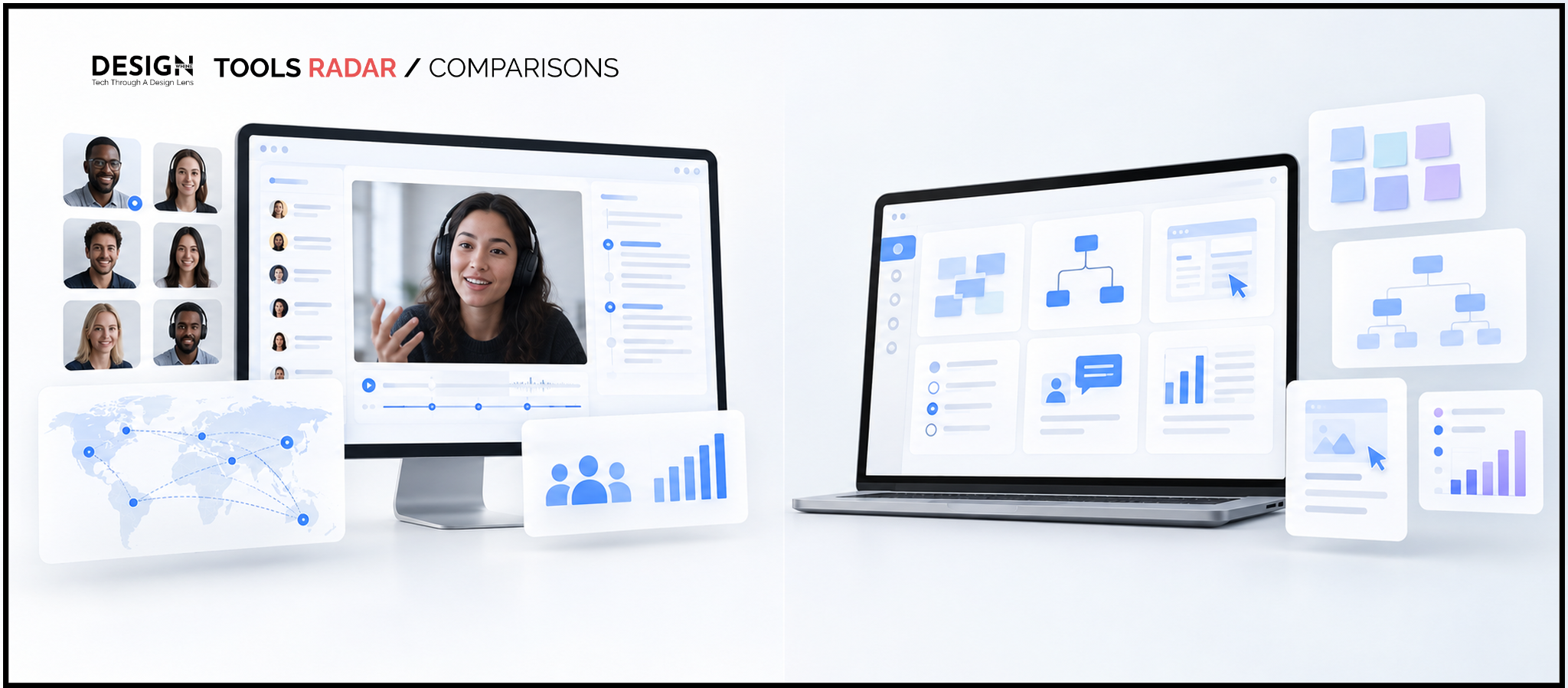

The most important distinction in AI research may be simple: is AI helping you study people, talking to people for you, or pretending to be the people? Those are very different forms of evidence.