


Spend enough time around UX in 2026 and a strange question keeps returning in different forms.
Not “How do I break into UX?” Not even “Will AI replace designers?” A darker, more personal one: what if I do not want to do this anymore?
That question matters because UX was not supposed to become this kind of career. For much of the 2010s and the pandemic-era boom, it was sold as one of technology’s dream jobs: creative, strategic, well paid, increasingly remote, and accessible to people who did not come through traditional engineering paths. It promised craft with influence, empathy with business value, and a credible route into modern product work.
DesignWhine has seen that aspiration story before. In Degrees of Separation, we surveyed roughly 1,000 UX professionals across 17 countries to ask whether self-taught designers received equal opportunity. That story reflected the older anxiety around UX: could you get in? The emerging anxiety is different. Increasingly, the question is whether people who made it in still want to stay.
This is not evidence of a measurable mass exodus. Public conversation is not a census, and people who are unhappy are often louder than people who are content. But repeated conversation is still a signal. Over the last six months, we sampled public discussions across UX communities where practitioners were actively talking about leaving the field, changing careers, or no longer recognizing the work they had signed up to do.
The interesting story is not that UX is dead. The available labour data does not support that simplistic claim. The more interesting story is that the career bargain around UX has changed. The work is harder to enter, more politically demanding, increasingly compressed across disciplines and, for many practitioners, farther from the craft that attracted them in the first place.
UX may not be dying. The career bargain around UX is.
Why UX Designers Are Leaving
The reasons are not mysterious. They are also not all the same.
Across 23 sampled public discussions from UX communities between March and September 2026, the strongest recurring themes were the job market and layoffs, burnout and workload, AI-driven role compression, organizational politics and lack of influence, loss of craft, and unclear career growth. Multiple themes could appear in the same discussion, so this should be read as directional analysis rather than a representative survey.
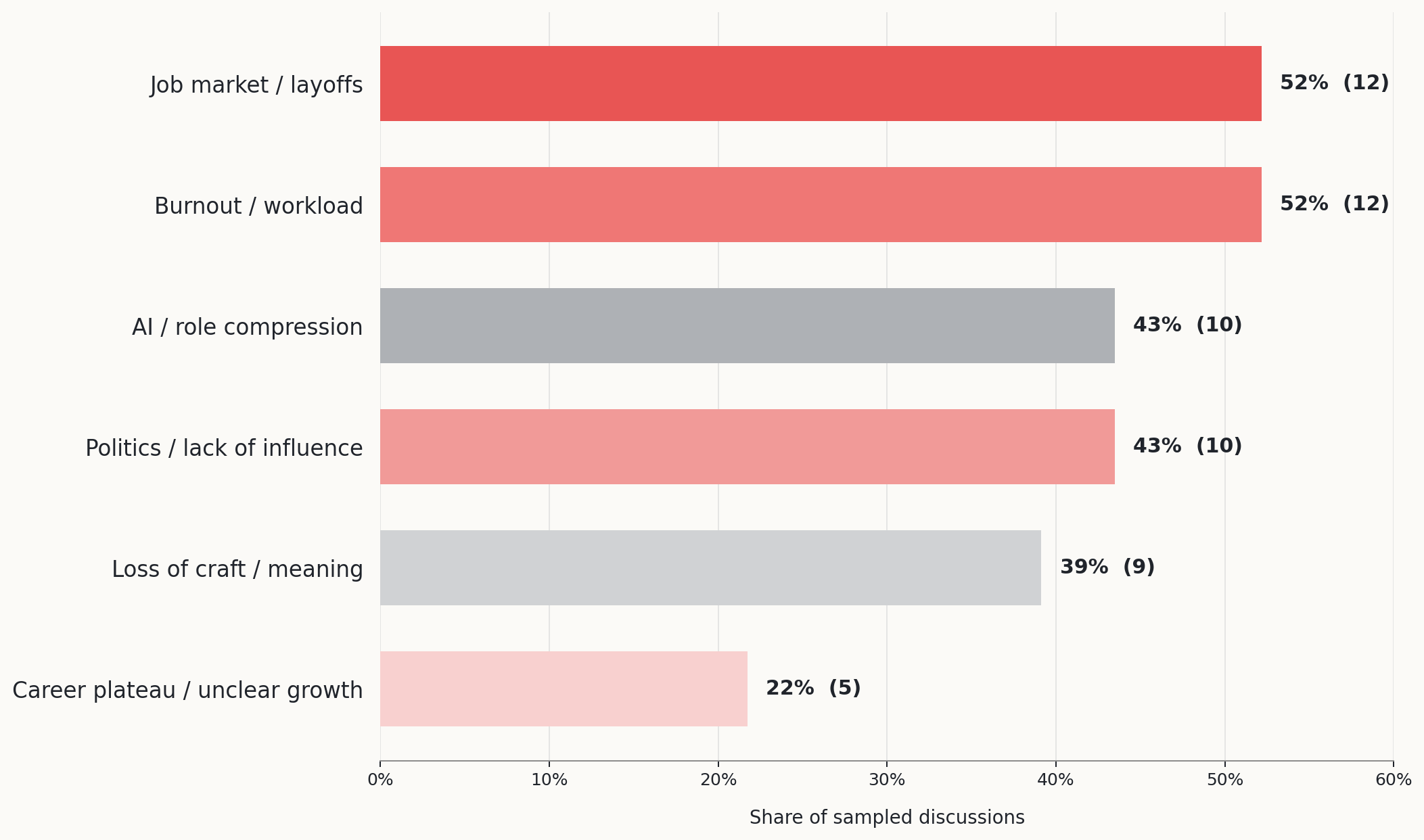
What is striking is not just that these frustrations exist. It is how tightly they reinforce one another.
A frustrating UX job is easier to tolerate when the market is healthy and another role feels close. When hiring slows, layoffs rise and interview loops stretch for months, people stop treating a bad role as a temporary inconvenience and start questioning the category itself. The job-market problem becomes an identity problem.
Burnout works the same way. In UX, it is often described as a workload issue, but the more corrosive version is structural. Designers can be busy without feeling useful, responsible without having authority, and accountable for user outcomes without having enough influence over the decisions that create those outcomes.
Rosenfeld Media’s 2025 State of UX/Design Organizational Health found that insufficient staffing and lack of time to focus on the work correlate strongly with burnout. It also highlighted weak career pathing and limited development support inside design organizations. That is a useful counterweight to the idea that designers are simply becoming less resilient. In many cases, the structure of the role itself is becoming harder to love.
The Dream Career Became a Political One
UX has always involved politics. Design competes with roadmaps, engineering constraints, business models, deadlines and executive preferences. The problem is the ratio.
Across the conversations we reviewed, one complaint kept recurring in different language: experienced designers spend more time aligning, persuading, defending and translating, while spending less time doing the work that made the profession attractive in the first place.
Senior designers often discover that career progression takes them farther from visible craft. Their leverage increasingly comes from systems thinking, facilitation, stakeholder management and judgment. Those are legitimate design skills. They are also not necessarily why someone fell in love with design.
The result is an odd form of professional success: you become experienced enough to spend less time doing the thing that made you want the career.
AI Is Making the Boundaries Disappear
AI did not create weak design influence, role confusion or career fatigue. Those problems were already here. What AI has done is accelerate the collapse of old role boundaries and make the profession’s identity problem harder to ignore.
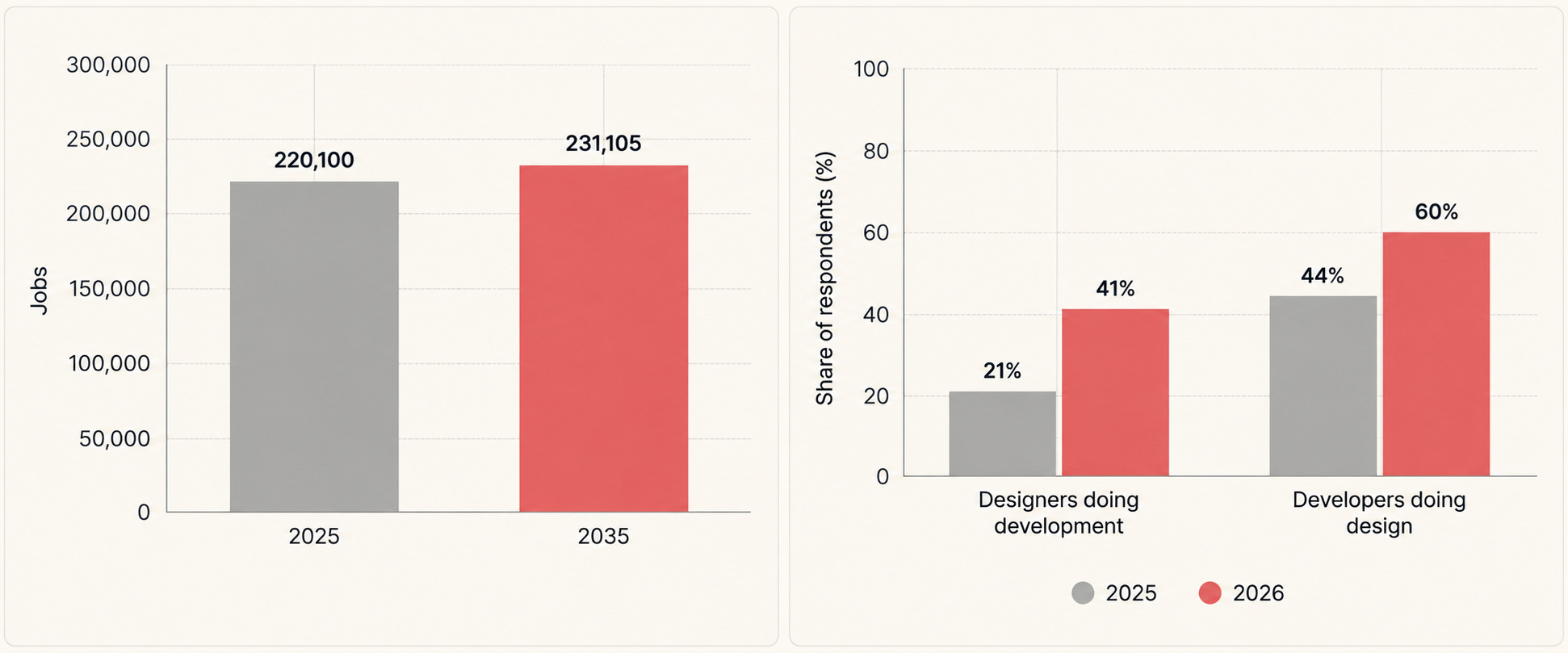
Figma’s 2026 AI Report, based on 8,403 survey responses and 639 qualitative interviews over three years, found that 41% of respondents now say AI meaningfully changes how their teams work together, up from 7% two years earlier. The share of designers participating in development doubled from 21% to 41% in a year, while developers doing design work rose from 44% to 60%.
That shift is visible in the rise of the design engineer and in the broader collapse of handoff culture. Designers are coding more. Developers are designing more. Product managers can generate credible interface directions. AI can turn rough ideas into working artifacts before the traditional design process has finished explaining itself.
As we argued in The Gates of Design Have Fallen, the monopoly on producing design artifacts has weakened. That does not make design judgment less valuable. It makes it harder to prove through the old signals.
A profession can survive on paper while becoming less lovable to the people inside it.
Is UX Design Dead? The Data Says No
The simplest version of the “UX is dead” story does not survive contact with the labour data. The U.S. Bureau of Labor Statistics does not classify UX designer as a standalone occupation, so its numbers are an imperfect proxy. But its web developers and digital designers category employed about 220,100 people in 2025 and is projected to grow 5% through 2035, faster than the average for all occupations. BLS expects about 13,600 openings each year over that decade. (U.S. Bureau of Labor Statistics)
Within that category, web and digital interface designers alone held about 132,700 jobs in 2025. Their median annual wage was $104,000. Whatever is happening to UX, this does not resemble a profession disappearing overnight.
But employment growth and career satisfaction are different questions. A field can have jobs and still become less attractive. It can grow while individual roles become broader, harder to enter, more politically demanding and less recognizable to the people who joined five or ten years earlier.
Where UX Designers Go After Leaving
This is where the story becomes more interesting than another obituary for UX.
Across the public conversations we sampled, designers did not imagine one clean exit route. We found 67 destination mentions spanning independent business, creative practice, trades, teaching, helping professions, marketing, finance, product, strategy, engineering, healthcare and other professional paths.
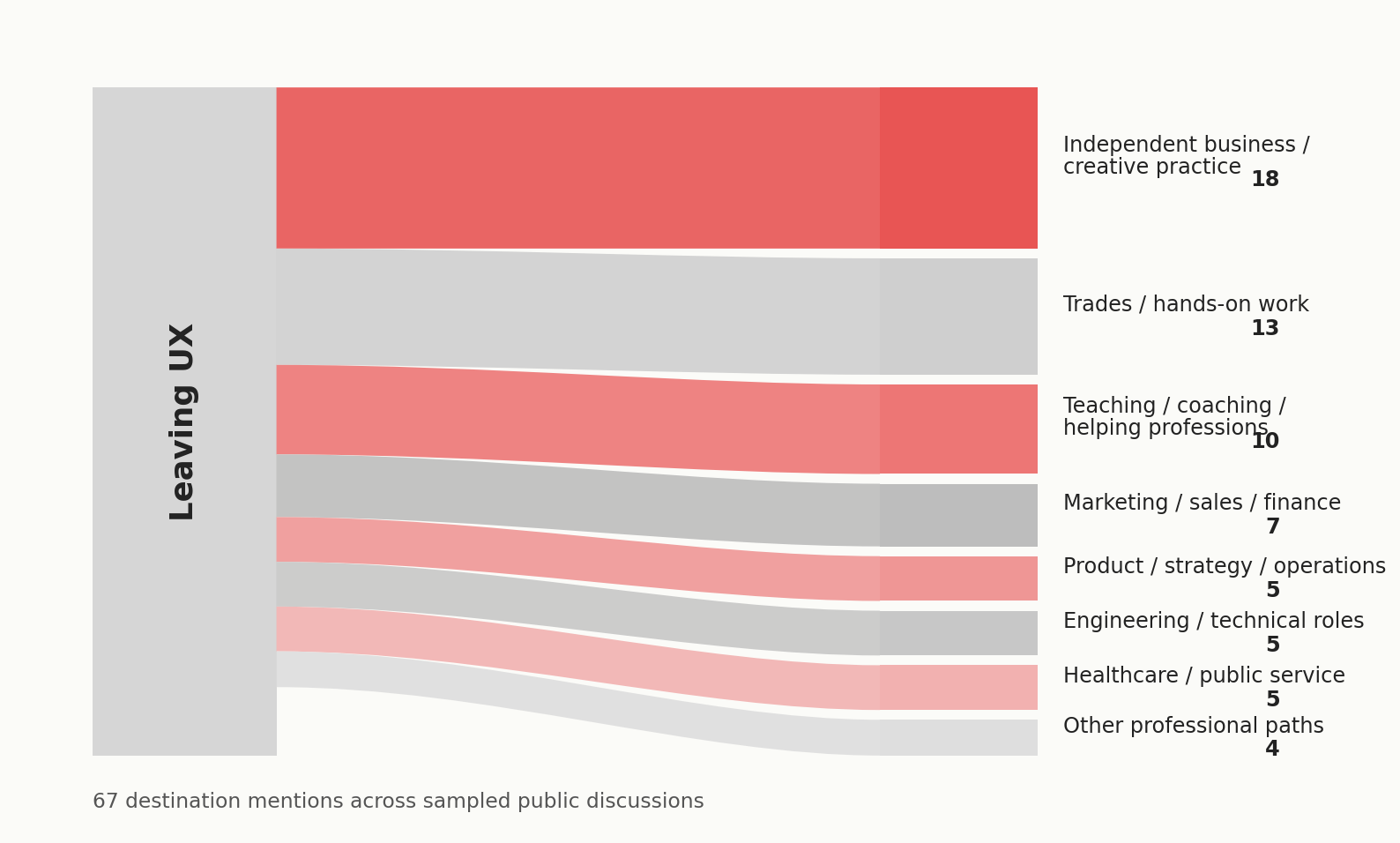
The largest destination in our sample was not another conventional technology role. It was independent business or creative practice. That is revealing. Some designers do not appear to be trying to escape design at all. They are trying to escape the structure in which design currently happens.
The second-largest group of mentions pointed toward trades and hands-on work. That sounds like a radical pivot until you consider what many frustrated designers say they are missing: tangible progress, visible authorship and the satisfaction of making something whose outcome is not mediated through five layers of approval.
Teaching, coaching and helping professions also appeared frequently. So did marketing, sales and finance. Product strategy, operations and engineering remained natural adjacent paths, but they were not the only ones. The pattern suggests that the UX skill stack travels farther than the UX title does.
Research, synthesis, facilitation, systems thinking, storytelling and product judgment are portable capabilities. A designer leaving UX is not necessarily abandoning those skills. They may simply be looking for a context where the skills feel more consequential.
Leaving UX Is Not the Same as Leaving Design
This distinction matters because AI is making titles less useful as maps of what people actually do. If designers increasingly write code, engineers shape interactions, product managers prototype, and small teams collapse old role boundaries, leaving a UX title does not necessarily mean abandoning design practice.
Our guide to building an AI-native UX team reaches the same conclusion from the organizational side. The durable question is not which artifacts belong exclusively to designers. It is which decisions require human judgment, accountability and understanding of the user.
That may be where UX is heading. Less protection around the title. Less certainty around the workflow. More pressure to connect design judgment directly to products, systems and business decisions.
The risk to UX is not only that AI changes the work. It is that talented people stop believing the work is worth defending.
The Question Is No Longer ‘Is UX Dead?’
That question has always been a little lazy. It flattens a complicated professional shift into a headline-friendly obituary.
A more useful question is what kind of UX career is still worth wanting.
A role defined mainly by producing screens is becoming harder to defend as a specialist identity. A role built around judgment, systems thinking, user understanding, decision-making and proximity to outcomes may become more demanding, but also more durable.
That answer will not satisfy everyone. Some designers want a clearer ladder. Some want less politics. Some want to make things again. Some want to get closer to code. Some want to get closer to business. Some want an entirely different life. None of those decisions requires an obituary for the field.
But the recurrence of this conversation should still make the industry uncomfortable. UX can survive as a capability while becoming less convincing as a dream.
The old story was about getting into UX. The emerging one is about whether people still want to stay.





If you’ve seriously considered leaving UX, what changed the equation for you: the job market, burnout, lack of influence, AI, loss of craft, or simply wanting different work?
The article’s distinction between “Will AI replace designers?” and the darker question of whether designers still want the career is especially sharp. Framing the exodus as a consequence of UX becoming unlike the dream job promised during the 2010s and pandemic boom makes the discussion feel much more grounded than another AI-versus-design debate.
The shift from UX being sold as a “dream job” to designers quietly asking whether they should leave is a striking measure of how much the field has changed. I’m especially curious about the paths the article identifies beyond traditional product teams, rather than treating departure as a simple failure of resilience.
The distinction between “Will AI replace designers?” and the darker question of whether designers still want the job feels especially sharp. Framing the shift as a consequence of the gap between UX’s pandemic-era promise and today’s reality makes the career exits—and the paths people are moving toward—feel much more understandable.
The contrast between UX being sold as a “dream job” during the 2010s and the darker question designers are asking now feels especially telling. The move toward product strategy, research, or adjacent roles seems less like abandoning design and more like reclaiming agency over the work.