

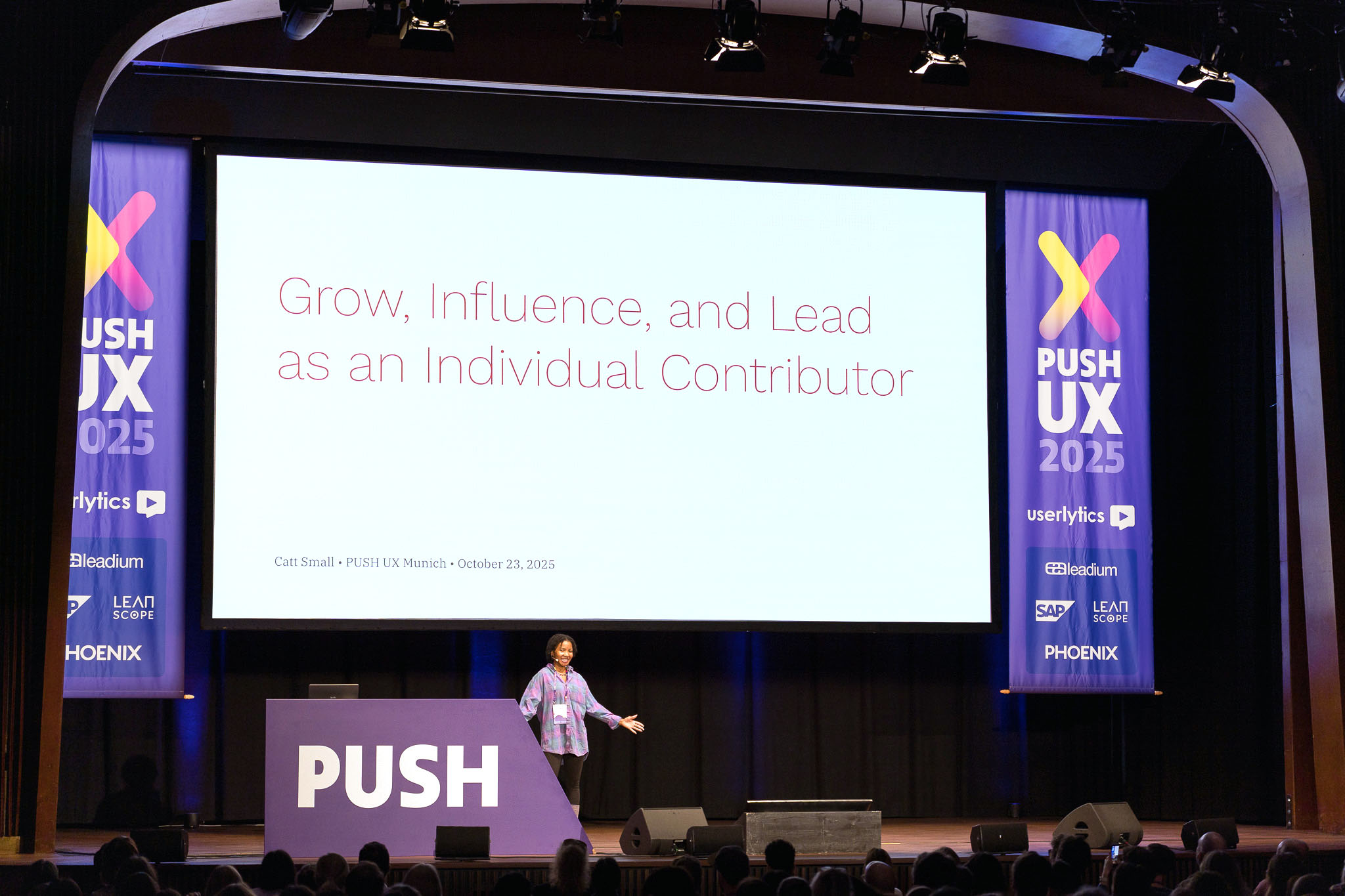
At PUSH UX in Munich in 2025, Catt Small stood beneath a screen carrying a deceptively simple proposition: grow, influence and lead as an individual contributor. It was the kind of presentation title that would have sounded contradictory in an earlier era of design leadership, when moving up generally meant moving away from the work and into managing the people who did it.
Small has spent years challenging that assumption. A Staff Product Designer and the author of The Staff Designer: Grow, Influence, and Lead as an Individual Contributor, she has worked across product organizations including Etsy and Asana. Her talks on senior individual-contributor leadership confront a problem many design ladders still struggle to describe: what does leadership look like when nobody reports to you?
In a new interview with DesignWhine, Small puts a sharper edge on that question. As AI makes design production faster, it becomes easier to mistake prolific output for strategic value. The work that distinguishes a Staff Designer may be precisely the work a dashboard, a portfolio or an AI-generated prototype cannot reveal.
A Promotion That Changes the Problem
A promotion from Senior to Staff is sometimes imagined as a reward for being the best person in Figma. Small’s distinction is more uncomfortable. Senior designers can own a defined journey and deliver exceptional solutions. Staff designers are expected to walk into situations where the problem, the direction and even the boundaries between teams remain unsettled. Asked what really changes when a designer moves from Senior to Staff, Small makes the distinction explicit:
“An excellent senior designer is able to be assigned a track of work that focuses on an end-to-end customer journey and deliver high-quality thinking. They meet the quality bar for thinking and execution. A staff designer is able to take on ambiguous problems, define a direction for a major product area or problem space, and in many cases set new standards for experience quality. Staff designers can see how their work connects to others’ and proactively reach out to create solutions that make systems more cohesive. They also do much more politicking than senior designers because they are heavily contributing to strategy. It’s a whole other altitude of thinking!”
Her mention of ‘politicking’ is especially revealing. Design culture likes to talk about influence as if it were a natural consequence of good craft. In a real organization, it involves competing priorities, budget owners, technical constraints and people who may not agree that design has a mandate to set direction. Calling that work politics does not make it cynical. It makes it visible.
“They also do much more politicking than senior designers because they are heavily contributing to strategy.”
AI Makes Bad Decisions Cheaper
AI has made it possible to move from an idea to a plausible interface with startling speed. But the ability to produce a solution is not evidence that the problem deserves solving. The danger for product teams is not only that AI might make mistakes. It is that a team can act on a weak idea before anyone has seriously examined the cost of getting it wrong. When we put the question of AI-era judgment to Small, she went straight to the cost of losing user trust:
“Yes! Teams can now build most solutions, but the human work remains in identifying what is most valuable and useful. Staff designers do exactly this kind of work. User trust is not an unlimited resource. If you build the wrong thing too many times, people will get frustrated and go somewhere else.”
That warning about trust is the hinge of Small’s argument. A team can prototype five ideas in the time it once took to prototype one; customers do not have five times as much patience for unwanted features, confusing changes or speculative automation. The limiting resource shifts from production capacity to the judgment needed to decide what is worth putting in front of people.
“User trust is not an unlimited resource.”
DesignWhine has explored the same tension in why familiar UX evaluation methods can fail AI products. Faster execution raises the stakes of asking better questions before shipping. For a Staff Designer, slowing the wrong decision can be a more valuable contribution than accelerating the right-looking mock-up.
The Work Nobody Can Screenshot
A curious problem follows when the most experienced designer stops personally producing every final artifact. How should that person’s contribution be judged? A portfolio is good at displaying an object. It is much worse at displaying the conversation that prevented a costly mistake or the shared understanding that helped another team succeed. We asked Small how Staff designers can make that often-invisible contribution visible to leadership. Her answer is refreshingly practical:
“I find that senior ICs often struggle to have their impact recognized when they are not actually putting in effort to socialize it. Help leadership understand how the artifacts you crafted led to the decisions other people made. What are you doing to move conversations forward? What are you learning? This is what you must make sure others can see. Your manager is probably way too busy to proactively pay attention. Even sending them a short summary of bullet points at the end of the week can help them better recognize your efforts.”
Small is not suggesting that designers become full-time publicists for their own careers. She is describing a translation problem. Strategy becomes credible to leadership when someone can connect the invisible work to a changed decision, a clearer direction or an outcome another team could deliver. The weekly summary she recommends is almost mundane, which is why it is useful.
But there is a responsibility on the other side of that equation. If design leaders say they value strategic influence while only rewarding individually shipped outputs, they have built a career ladder that contradicts their own job descriptions. That is part of the wider dilemma we examined in The UX Career Ladder Is Becoming a Trap.

Real Influence Survives the Meeting
Small’s most memorable measure of influence is also her least bureaucratic. Forget the number of stakeholders in the room or how enthusiastically they praised the presentation. The meaningful test is what happens when the designer has left and other people must decide what to do next. Asked how to recognize real influence, Small offered a test that reaches beyond the meeting room:
“General influence is extremely important when you work through other people, but more specifically I would say that sharing your ideas often enough that they begin to get shared when you’re not in the room is the major signal you’re looking for. When your ideas take on a life of their own and people are reaching out to you because someone else mentioned your idea, that means you’ve got the best kind of influence a hands-on designer can have.”
An idea repeated in a roadmap meeting by a product manager, adopted by an engineering lead or brought back by someone who never heard the original pitch has crossed a threshold. It is no longer merely advice from the design team. It has become part of how the organization understands the problem.
“When your ideas take on a life of their own”
That influence grows through clarity, relationships and repetition, a theme Small also explored in a 2026 conversation with UserTesting. Her answer to DesignWhine offers an even tougher test: does the thinking travel without you?
The AI-Native Job Description
Our final question invited Small to rewrite the Staff Designer job description for an AI-native company. It would have been easy to produce a long checklist of prompting, coding, agent workflows and model evaluation. She chose one addition instead.
“I would add “knows when to prototype in code and when a user flow diagram would suffice” and keep everything else.”
That answer rejects a common confusion in the AI era: that fluency is measured by how many new tools a designer uses. The judgment is knowing which tool produces the right kind of evidence for the question at hand. A coded prototype may expose a real interaction problem. A simple flow diagram may settle the decision faster. Choosing between them is the skill.
A Different Definition of Design Leadership
The story of seniority in design has too often been told through scale: more screens, larger projects, bigger teams, greater visibility. Small offers a less photogenic and more useful account. A Staff Designer creates the conditions for others to make better decisions, often without owning the artifacts those decisions produce.
That is an uncomfortable proposition for an industry built on portfolios and for organizations that still demand visible proof of every contribution. But it may also be a way forward. As we examined in Leaving UX Design in 2026, experienced designers are already questioning the bargain between their growing responsibilities and the careers available to them. Small’s answers suggest that the alternative to management is not simply doing more design work. It is changing the quality of decisions a product organization is capable of making.
The most important design work in an AI-native company may end long before a polished interface appears. It begins when someone sees the wrong problem being solved and convinces the room to change course. And, at its best, that conviction survives even when that person is no longer in the room.





What is the clearest evidence of Staff-level impact you’ve seen: a shipped product, a decision that changed, or an idea that kept spreading?