

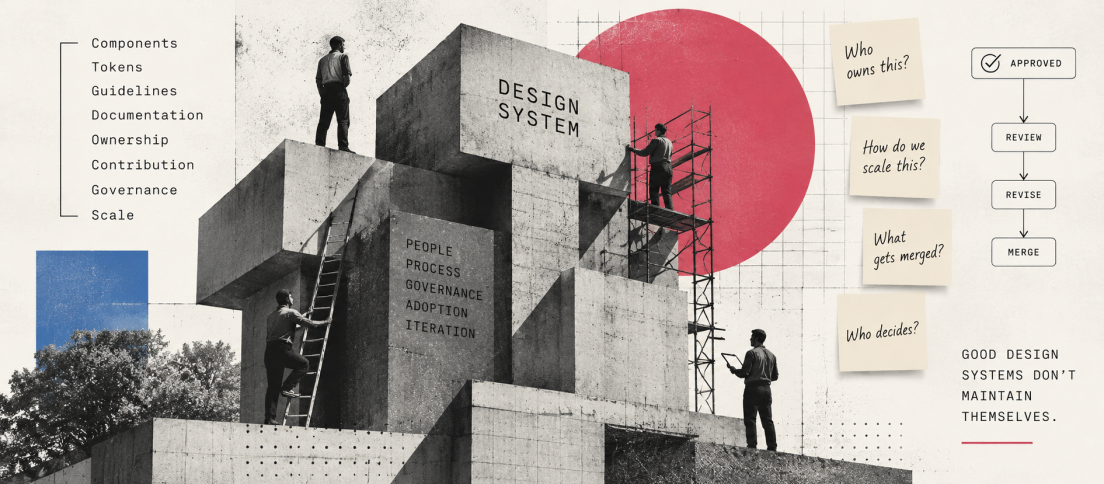
The glamorous part of a design system is the launch. The Figma library is tidy. The documentation site is new. The component catalogue feels coherent. Leadership can finally point to something concrete and say the organization has a system.
Then real product work resumes.
A team needs a variant that does not exist. Engineering fixes a component without updating design. A new product surface requires a pattern nobody anticipated. Someone opens a request, nobody owns the decision, and three weeks later the product team ships a local workaround because the roadmap cannot wait.
This is where design systems stop being a library problem and become a governance problem.
The moment a design system becomes useful, someone has to decide how it is allowed to change.
Our DesignWhine Guide to Design Systems argues that a design system is product infrastructure and institutional memory, not merely a component library. Governance is the operating model that keeps that infrastructure alive. It decides who can change the system, what evidence a new pattern needs, how contributions are reviewed, how breaking changes are released, when components are deprecated and what happens when product teams disagree with the system itself.
None of that sounds as exciting as launching a new component set. That is exactly why it is where so many systems begin to fail.
Governance Starts After Launch
Most teams think about governance too late. They build foundations, tokens and components first, then add a contribution form once requests begin arriving. By then, the system has already established an informal operating model: whoever has access to the library, enough seniority, or the loudest product deadline effectively governs it.
A healthier system makes those decisions explicit before pressure exposes them. Who owns a component after it ships? Which changes can a product team make locally? What requires system-level review? How long can a request remain unresolved before a team is justified in creating an exception? What happens when the coded component and Figma component disagree?
This is why design-system governance looks suspiciously like product management. There is a backlog. There are users. There are competing requests, limited capacity, release risks and decisions about what not to build. The system team is not simply maintaining assets. It is managing a product used by other product teams.
That distinction matters because the governance problem is rarely solved by adding more reviewers. It is solved by making the decision model visible.
Ownership Cannot Be Symbolic
One of the most common governance failures is assigning ownership without authority or capacity. A designer becomes the “design system owner” but still carries a full product workload. An engineering lead is asked to maintain the component library between roadmap commitments. A committee is formed, but nobody can actually approve a change without escalating it elsewhere.
That is not ownership. It is accountability without control.
Real ownership means somebody can prioritize the work, say no to requests, approve exceptions, schedule migrations and decide when system integrity matters more than a local deadline. In a small company that might be one design-engineering pair. In a larger organization it may be a dedicated core team with representatives from product groups. The shape matters less than the mandate.
A design system owner who cannot prioritize, reject or retire work is not an owner. They are a librarian with a queue.
Our interview with Diana Wolosin about building and maintaining design systems at Indeed captures the reality well. Mature systems are constantly negotiating between innovation and stability. New Figma capabilities, token models or product requirements may justify change, but migration cost and technical debt still have to be absorbed by real teams.
Contribution Is Not Permission
Open contribution sounds democratic and healthy. Unstructured contribution produces entropy.
The better public systems make a useful distinction: anyone can propose, but not every proposal belongs in the system.
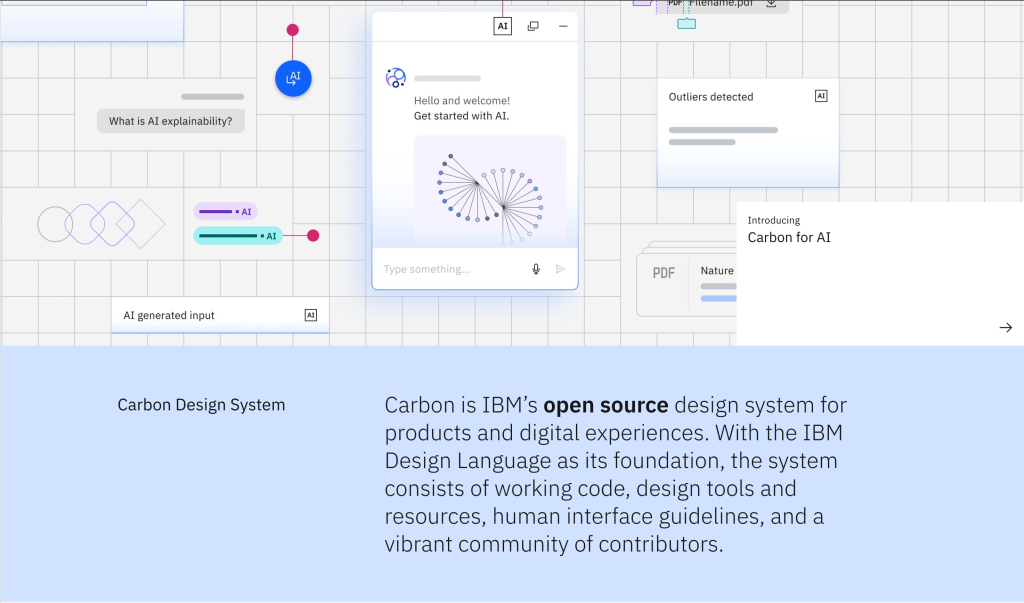
The GOV.UK Design System, for example, asks contributors to demonstrate that a proposed component or pattern is both useful across multiple services and genuinely distinct from what already exists. Before publication, it is reviewed for usability, consistency, versatility and accessibility. Carbon similarly accepts community work, but routes contributions through issue triage, feedback, review and maintainers rather than treating the library as a communal dumping ground. Atlassian is even more conservative: its public contribution guidance says small fixes and enhancements are easier to accept, while larger changes require system-wide coordination across code, design and guidance. These different operating models are also why all three feature in our guide to the design systems worth studying in 2026. (Sources: GOV.UK Design System; IBM Carbon; Atlassian Design System.)
The principle is simple: contribution should widen the intelligence feeding the system without weakening the standards protecting it.
| Contribution Type | Typical Governance | Why |
|---|---|---|
| Documentation correction | Light review | Low blast radius |
| Bug fix | Maintainer review + testing | Can affect production behaviour |
| New component variant | Usage evidence + design/code review | Expands the system API |
| New component or pattern | Research evidence + broader review | Creates a long-term maintenance commitment |
| Breaking change | Explicit owner + migration plan + release communication | Pushes cost onto every consuming team |
This is also the point where many internal systems become unpopular. Product teams experience governance as friction because a request that feels obviously necessary locally may be rejected at system level. But the system team has to price in a cost the requesting team does not: every new component or variant becomes something that must be documented, coded, tested, migrated and supported for years.
The System Needs a Lifecycle
Libraries become difficult to govern when every asset appears equally permanent.
A more useful model gives components and patterns a lifecycle. A proposal is not a stable component. An experimental component should not silently become the default because one team shipped it. A deprecated pattern should not remain visually indistinguishable from something the organization wants teams to adopt.
GOV.UK has been actively introducing component lifecycle statuses, including trial states that make uncertainty visible to consuming teams. Its research found that users valued knowing which components were still being worked on and wanted guidance for using trial components safely. (Source: GOV.UK Design System.)
Internal systems need the same honesty. “Available” is not enough information. Teams need to know whether something is experimental, recommended, stable, under migration or headed for retirement.
Without lifecycle governance, systems only grow. Every historical decision remains present, every exception becomes precedent, and the component library starts resembling an archaeological site.
Centralized or Federated?
There is no universally correct governance structure. There are only trade-offs.
A centralized model gives a core team tight control over consistency, release quality and architecture. It works well when the organization can fund a real systems team. Its failure mode is distance: the core team becomes a gatekeeper that cannot keep up with the product teams it serves.
A federated model distributes contribution across product teams while preserving maintainers who decide what enters the core. This increases domain knowledge and capacity, but only if contribution paths are clear. Otherwise “federated” becomes a polite word for nobody owning the whole thing.
Fully distributed governance sounds attractive in organizations that prize autonomy, but it is difficult to sustain once shared components have a large blast radius. Someone still has to resolve conflicts, coordinate migrations and protect compatibility.
For most organizations, the practical answer is a strong core with porous edges: a small group owns standards and releases, while product teams contribute evidence, designs, code, research and proposals.
Speed Is a Governance Metric
Governance is usually measured by quality: consistency, accessibility, code parity and adoption. It should also be measured by response time.
If a product team waits six weeks for an answer to a component request, the system has effectively made the decision for them. They will ship something local. The workaround may later be criticized as non-compliance, but the governance process created the incentive.
This is one of the dynamics behind the failure modes in Why Design Systems Fail. Teams often stop using a system because the sanctioned path becomes slower than the workaround. Once that happens repeatedly, the system loses legitimacy.
A healthy team should know at least a few operational numbers: request age, time to first response, time from approved proposal to release, number of local exceptions, adoption of new versions and the percentage of production components still aligned with the design library.
None of these metrics proves that the system is good. Together they reveal whether governance is functioning quickly enough to remain relevant.
AI Makes Governance More Important
AI complicates this further because agents can now generate local UI faster than a governance process can review it.
That creates a new kind of design-system debt. A developer asks an agent for a missing pattern, the agent produces something plausible, the code ships, and the organization has accidentally created another unofficial component. Repeat that across dozens of teams and AI becomes an entropy machine.
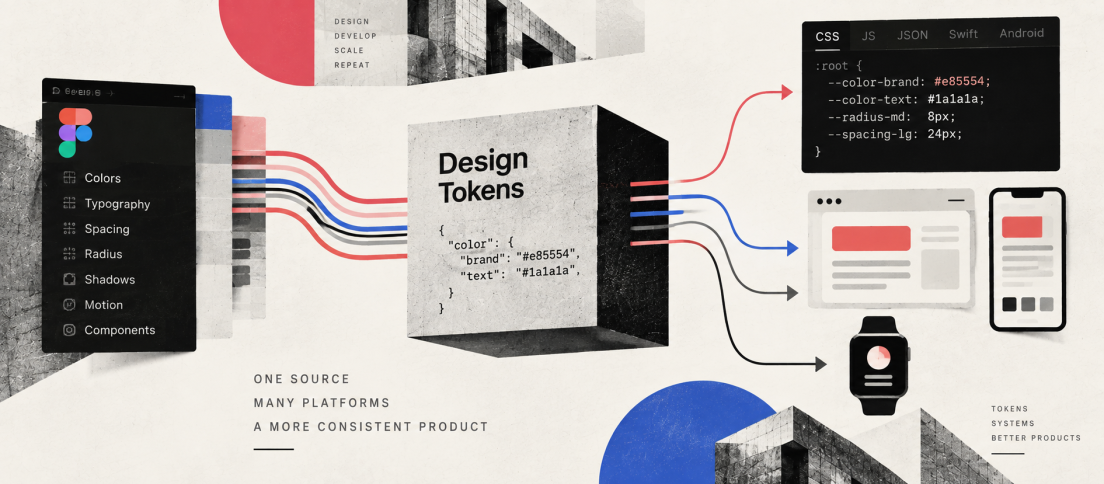
Our guide to making a design system AI-ready argues that machine-readable context must include governance, not just tokens and components. An agent should know which components are canonical, what it may extend, when it must ask for a new pattern and which directories or packages are off-limits.
AI makes it cheaper to bypass a design system. That means governance has to become easier to follow, not merely harder to break.
This is governance becoming executable. Rules that once lived in review meetings increasingly need to exist in documentation, component APIs, code ownership, tests and agent instructions.
A Governance Model That Works
You do not need a governance council to begin. You need explicit answers to a small set of questions.
- Who owns the core? Name the people who can make final system decisions.
- How can teams contribute? Define separate paths for bugs, enhancements, variants and entirely new patterns.
- What evidence is required? A new system pattern should solve a recurring need, not one screen.
- What is the response expectation? Set a service level so product teams know when they will hear back.
- How are releases communicated? Make breaking changes, migrations and deprecations impossible to miss.
- How are exceptions handled? Allow them, document them and review whether repeated exceptions indicate a missing system capability.
- What gets retired? A healthy system deletes as deliberately as it adds.
The implementation effort is part of the reason our design-system estimation model treats governance and adoption as real work rather than a footnote after component creation. Somebody has to run these mechanisms. If nobody has capacity for that work, the organization has not funded a design system. It has funded a launch.
The DesignWhine View
The industry often talks about governance as though it is the boring administrative phase that arrives after the creative work. We think that gets the hierarchy backwards.
The creative work produces a design system once. Governance determines whether the organization still has one two years later.
The best governance is not the strictest. It is the one that makes the correct path easier than the workaround. It gives teams enough autonomy to ship, enough structure to stay coherent and enough transparency to understand why a local request may not belong in the shared system.
That is the uncomfortable part of ownership. Somebody has to protect the system from unnecessary expansion while also protecting product teams from a system that has become too rigid to serve them.
If nobody wants that job, the system will still be governed. It will simply be governed accidentally, one deadline and one workaround at a time.




What causes more friction in your design system today: unclear ownership, slow contribution reviews, too many exceptions, or difficulty retiring old components?